
Duolingo launches Shanghainese course for Chinese speakers

Popular language learning platform Duolingo has launched a Shanghainese course on its app and website, giving learners a new way to study Shanghai's local dialect through short, game-style lessons.
The course uses simplified Chinese instructions and exercises, with no English-language version currently available. For foreign residents, being able to read everyday Chinese will make the lessons easier to follow.
Duolingo said the course has 50 units covering everyday situations and local expressions, including dialogue practice.
Inside the course
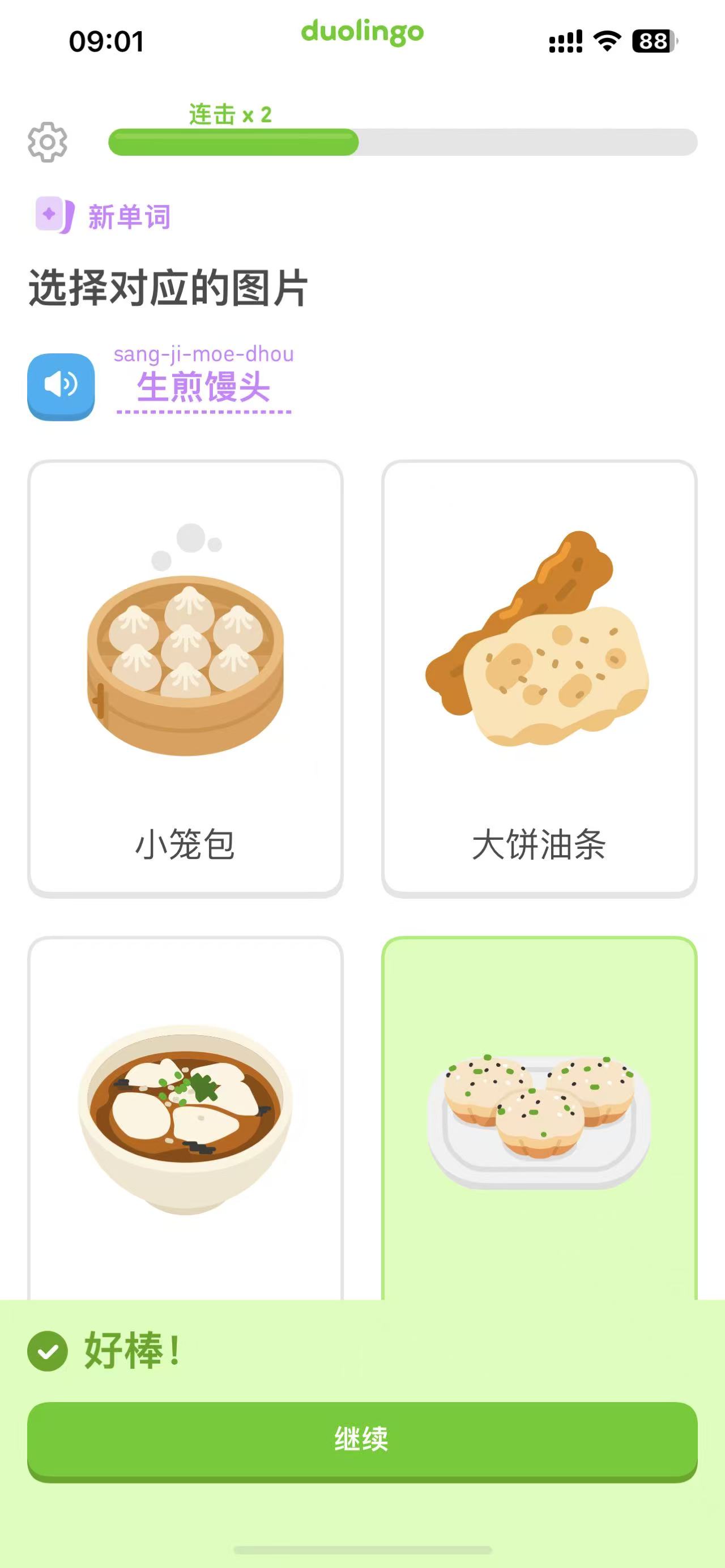
In a brief trial, the opening lesson introduced shengjian mantou (生煎馒头), Shanghai-style pan-fried buns, followed by a sentence meaning: "I want to eat pan-fried buns today." Listening and answer-selection exercises brought learners back to the same words several times.
Early users have welcomed the familiar expressions while questioning some pronunciations.
"The expressions fit everyday usage and are quite practical," one user wrote on social media app Xiaohongshu, also known as RedNote.
Other reviewers reported differences between phonetic spellings and the accompanying audio, questioned tones in longer expressions and said they had reported the problems through the platform.
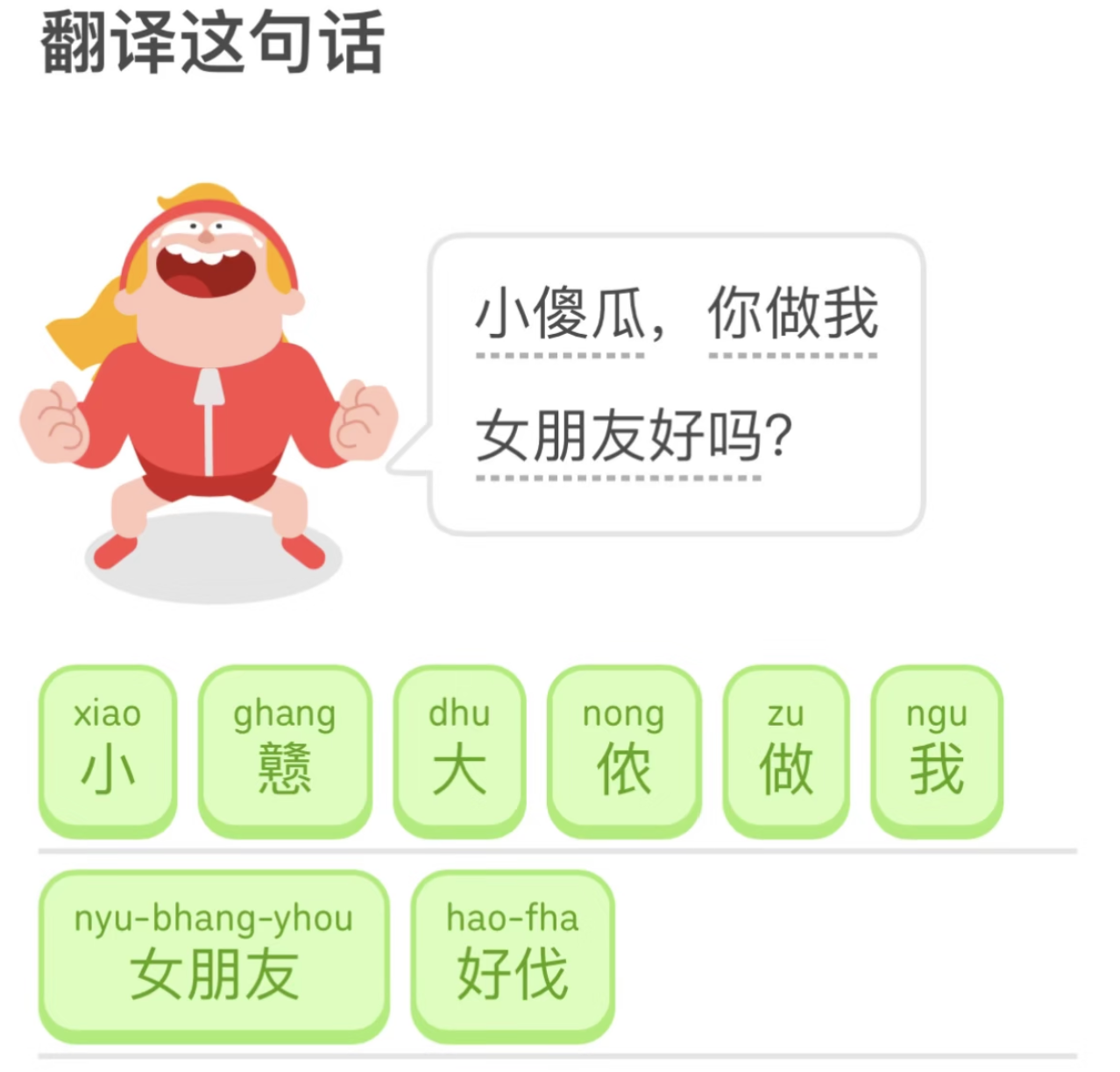
One exercise asked learners to translate "Silly, will you be my girlfriend?" into Shanghainese. A local commenter said she had lived in Shanghai for decades without anyone ever speaking to her that way.
As a native speaker, I can see why. Try that line on a Shanghai woman, and you may pass the lesson, but fail to get a date.
Another user, posting as Salmon Rice Ball, recognized expressions heard from grandparents but rarely used by their parents' generation.
On short video app Douyin, or TikTok, a user from Ningbo in neighboring Zhejiang Province said much of the material was understandable, but forming sentences was harder.
Those reactions suggest the course could appeal both to beginners and to people who grew up hearing Shanghainese but have little practice speaking it.
Getting started
1. Open Duolingo's course list and look under courses for Chinese speakers. Select "中文 (沪语)," meaning Chinese (Shanghainese). On a computer, you can also open the course page directly.
2. Start the course or sign in to an existing account.
3. Complete the setup questions, which in the trial covered prior knowledge and daily study goals.
4. Listen with the sound on and repeat each phrase aloud. If the Chinese instructions are difficult, work through the first lesson with a Chinese-speaking friend.

A language shaped by trade
Shanghainese belongs to the Wu branch of Chinese, which includes varieties spoken across much of southern Jiangsu and northern Zhejiang.
Its sounds, vocabulary and expressions differ enough from Mandarin that knowing one does not mean understanding the other.
The dialect's roots lie in the local speech of the historic Songjiang region. Shanghai's opening as a treaty port in 1843 brought migration, trade and sustained contact with other languages and dialects.
Linguist Qian Nairong has described how newcomers enriched Shanghai's existing speech with expressions from places including Suzhou and Ningbo.
The familiar ala (阿拉), meaning "we" or "us," came from Ningbo speech.
English also left its mark on everyday vocabulary, from food to building materials.
Baituo, an older word for butter, borrows the sound of "butter." Shuimenting, used for cement or a cement floor, comes from "cement."
Other borrowings combined an English sound with a Chinese description. Sibilingsuo takes "spring" and adds suo, the Chinese word for lock.
Some words acquired a more specific local meaning. Namowen, borrowed from "number one," became a term for a factory foreman in old Shanghai. It refers to a workplace hierarchy rather than a competition winner.
Ask a Shanghainese speaker to say these words aloud. The English echoes are easier to hear in their local pronunciation than when the characters are read in Mandarin.
Today's Shanghainese also differs from the speech of earlier generations. Research by linguists Yao Yao and Charles Chang has documented vowel changes associated with age and contact with Mandarin.
Meanings change, too. Qian has noted that qiangdiao, now often used to praise someone's style or presence, could carry a disparaging sense among older speakers.
A phrase heard in an old comedy recording may therefore have a different flavor from one used by a younger colleague.
Keeping the language in use
For families, a more immediate concern is whether children continue speaking the dialect at all.
I have watched that change in my six-year-old son. Before kindergarten, Shanghainese was his first language, and he spoke it better than Mandarin.
In his first year, his teacher told me he sometimes could not follow instructions in Mandarin. She would say them once in Mandarin, then again in Shanghainese.
By his final kindergarten year, he rarely spoke Shanghainese. He still understood it, but Mandarin came more easily. When he did use Shanghainese, his speech sounded increasingly influenced by Mandarin.
Qian argued that speaking Shanghainese with parents and grandparents was insufficient if children did not use it with their peers. He advocated using Mandarin in class and Shanghainese during breaks.
Some schools are creating opportunities through music and performance. At Jing'an No. 4 Central Primary School, a Shanghainese nursery-rhyme club established in 2021 later developed into a Huju opera club with community support.
Other efforts include a Shanghai dialect audio database, a dialect culture exhibition and experience space, and traditional performance activities in schools.
Travelers can hear the language, too. Shanghai Airlines has extended Shanghainese broadcasts to all Shanghai-bound flights. Some city buses and Metro Lines 16 and 17 also carry Shanghainese announcements.

Learning beyond the app
A willing local conversation partner can help turn listening into speech. Ask a friend or colleague to practice a short exchange about ordering food, the weather or weekend plans. Learn a question and its likely answer together, then swap roles.
For more listening practice, Shanghai's television and performance archives offer conversations, jokes and expressions from different generations.
Classic sitcoms are a useful starting point because their stories revolve around family, neighbors and work. Search for《老娘舅》 (Lao Niang Jiu),《红茶坊》 (Hong Cha Fang) and 《开心公寓》 (Kaixin Gongyu). Another option is《噱占上海滩》, a Shanghainese comedy set in an earlier Shanghai. Use the Chinese titles to find episodes and clips online.
For talk and humor, try《嘎讪胡》 (Ga Shan Hu), associated with host Shu Yue. 《沪语人气王》(Huyu Renqi Wang) showcases performances in the dialect.
Older comic recordings by Yao Mushuang (姚慕双) and Zhou Bochun (周柏春) offer wordplay, expressive delivery and the speech of an earlier generation.
Some routines deliberately imitate other regional accents, so beginners should ask a fluent speaker which passages to use as pronunciation models.
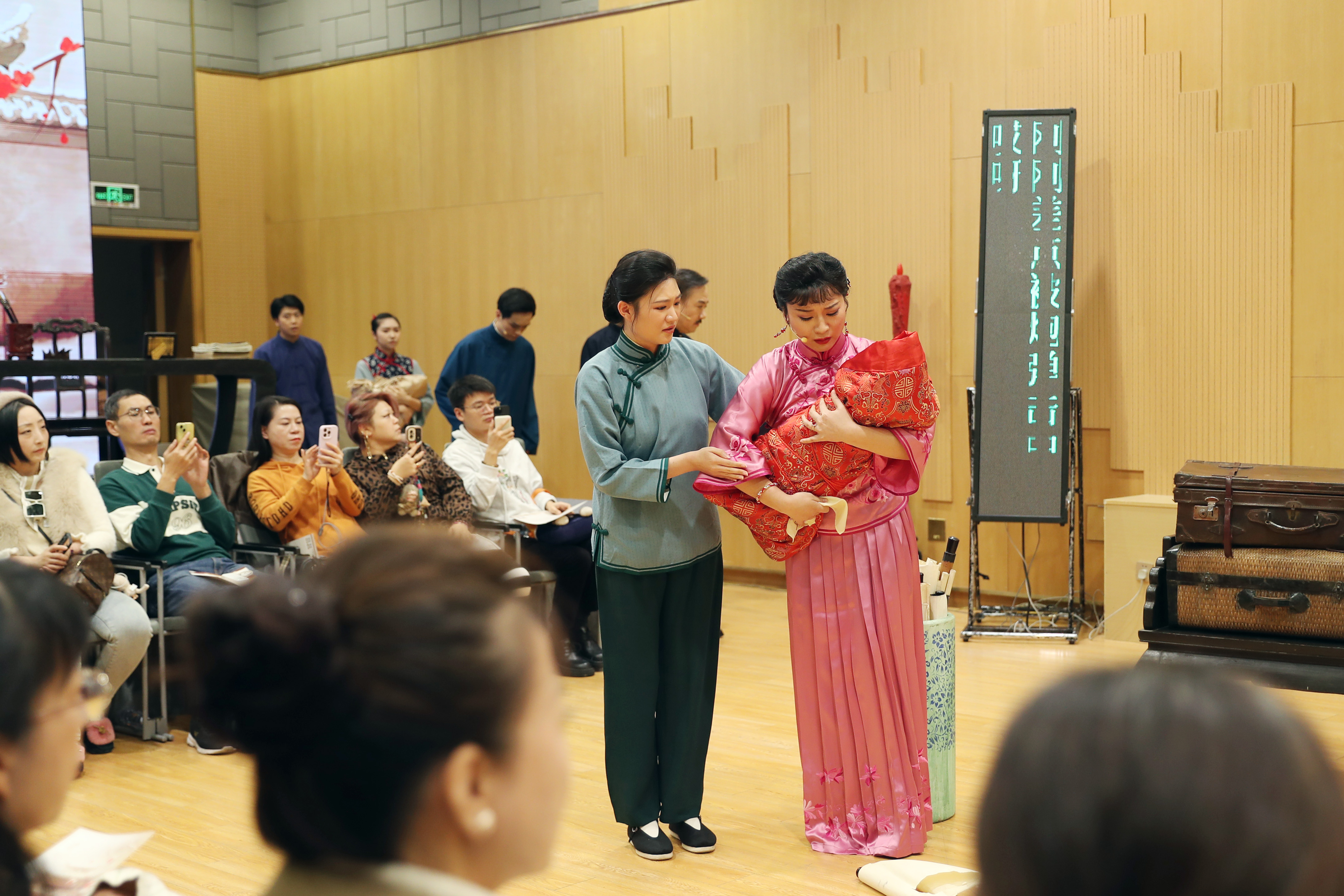
Huju, Shanghai's local opera, provides another way to hear the language. It developed from rural songs and folk performance around the Huangpu River.
Learners interested in everyday speech can begin with the spoken exchanges between songs, since singing follows musical timing and delivery.
More recent viewing includes the Shanghainese version of "Blossoms Shanghai" (繁花) and the film "B for Busy" (爱情神话). Check the audio selection where more than one version is available.
For another structured course, Mango Languages offers Shanghainese lessons with native-speaker audio, pronunciation tools and cultural notes. Its website lists the course as free, with no paid subscription.
Whichever resource you choose, copy the rhythm of whole phrases as well as individual words. Shanghainese tones change when syllables are spoken together, a feature known as tone sandhi. A word heard on its own can sound different within a longer expression.
After a lesson, take one phrase off the screen. Try it with someone who speaks Shanghainese, ask whether it sounds natural and listen to the reply.
Knowing how to order shengjian is a useful first step; answering the next question takes practice.
Source: City News Service