



党的领导继续推动新时代国家现代化进程 - 2026-07-01
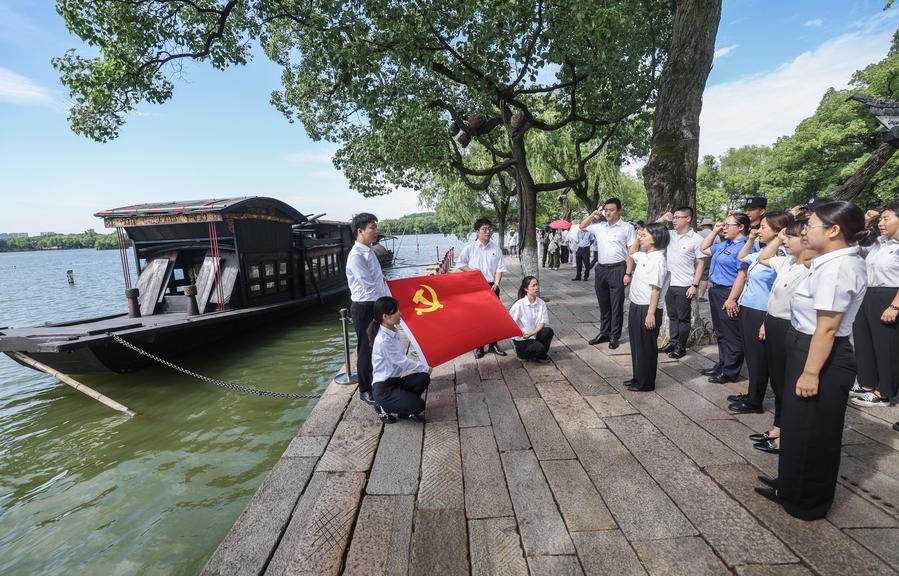
A gathering is being held in Beijing on Wednesday morning to mark the 105th anniversary of the founding of the Communist Party of China.
At the event, Xi Jinping, general secretary of the CPC Central Committee, will confer the July 1 Medal, the Party's highest honor, on model CPC members. He will also give an important speech that not only reviews the Party's history but also serves as a guideline for building the Party in the future.
At 105, the Party's institutional strength is inseparable from China's long-term development and modernization agenda.
The CPC had nearly 101.29 million members and over 5.43 million primary-level organizations as of the end of 2025. Party building represents a broad institutional strategy designed to improve leadership capacity, policy coordination, organizational discipline and implementation.
Understanding the role of Party building in the development of the CPC is essential to understanding the country's development, which has demonstrated that modernization depends not only on economic resources or technological innovation but also on the effectiveness of the institutions responsible for translating national priorities into practical outcomes.
Since the 18th CPC National Congress in 2012, the CPC Central Committee with Xi Jinping at its core has set forth a series of new ideas, thoughts and strategies on the Party's self-governance and on efforts to strengthen the Party, forming Xi Jinping Thought on Party Building. The Thought reflects an institutional logic by emphasizing political leadership, organizational cohesion, self-governance and continuous improvement of the Party's governing capacity.
Sustaining high-quality development increasingly requires effective coordination across industrial upgrading, scientific innovation, financial stability, environmental protection and social welfare. Such challenges place greater demands on governance than growth alone.
Xi Jinping Thought on Party Building integrates Party leadership with national rejuvenation, institutional modernization and governance reform through an effective institutional design.
The Thought stresses that upholding the Party's leadership is the defining feature of socialism with Chinese characteristics.
It emphasizes the need to uphold the centralized, unified leadership of the CPC Central Committee, exercise full and rigorous Party self-governance, stay true to the Party's original aspiration and founding mission, take the Party's political building as the overarching principle, and build cohesion and forge a solid ideological foundation with the Party's innovative theories.
It also stresses the need to enhance Party consciousness, improve an organizational system featuring cohesion across different levels and effective implementation, cultivate high-caliber officials capable of shouldering the mission of national rejuvenation, improve Party conduct on a regular and long-term basis, supervise and govern the Party in all respects with strict discipline, take coordinated steps to ensure that officials do not have the audacity, opportunity or desire to commit corruption, run the Party with systems and regulations, and fulfill the political responsibility of full and rigorous Party self-governance.
A country's modernization should not be judged solely by income levels or technological sophistication but also by governance effectiveness, long-term policy consistency and the ability to balance development with stability. Within this framework, Party building becomes part of a broader governance architecture intended to support Chinese modernization.
The growing external uncertainty underscores the importance of maintaining domestic policy coherence, institutional resilience and implementation capacity at home. Strong organizational leadership, in this view, is regarded as a source of strategic stability during periods of global volatility.
The effectiveness of Party building will ultimately be judged by measurable outcomes: whether it continues to enhance governance quality, sustain high-quality development, strengthen institutional resilience and improve public well-being.
It is of great significance for the entire Party to apply Xi Jinping Thought on Party Building to plan and advance the Party's development and exercise full and rigorous Party self-governance with higher standards and more concrete actions.
By doing so, the Party can leverage its 105-year legacy to better navigate a complex economy, a rapidly evolving society, and an era of increasing global uncertainty.
Source: China Daily
