



经济新闻
上海将把外资企业的“愿望清单”变为“服务清单” 2026-02-07
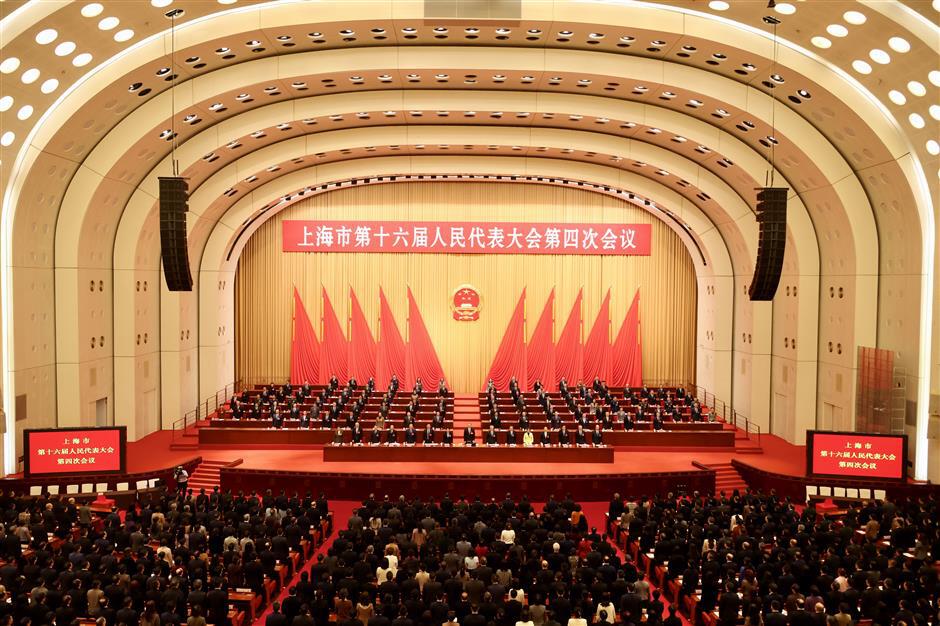 The annual session of the Shanghai People's Congress concluded last Saturday with a focus on high-quality development and the 15th Five-Year Plan goals.
Shanghai promises to turn foreign investors' "wish lists" into government "service lists" to further optimize its business environment.
The city also aims to open its telecommunications, medical care and education sectors wider to global capital.
Officials announced the new measures last Saturday when the annual session of the Shanghai People's Congress concluded.
"We will translate enterprises' 'demand lists' into 'service lists,' and deliver more high-quality services to boost their sense of fulfillment," said Shen Weihua, director of the Shanghai Commission of Commerce.
Shen said the city will align with high-standard international economic and trade rules.
"We will continue to promote the implementation of projects in key open pilot areas such as telecommunications, medical care, education and finance," he added.
Despite global economic headwinds, international investors showed strong confidence in Shanghai last year.
The city saw 6,300 new foreign-invested enterprises in 2025, a 6.8 percent increase from the previous year. Contractual foreign capital reached US$18 billion, a jump of nearly 20 percent.
While total actual use of foreign capital dipped slightly to US$16.06 billion, the quality of investment improved significantly, he said.
High-tech industries now account for 33 percent of the total, up 10 percentage points from the previous five-year period.
"Shanghai remains a preferred destination for foreign investment," Shen said. "It is a top choice for multinational companies to lay out their global industrial and supply chains."
Beyond investment, the city's role as a global trade hub continues to strengthen.
Total imports and exports exceeded 4.5 trillion yuan (US$620 billion) in 2025, reaching a record high. Service trade also surged, hitting US$257.8 billion – ranking first among Chinese cities.
Shanghai is accelerating major infrastructure projects, including the northern expansion of Yangshan Port and the fourth phase of Pudong International Airport.
The city's overall economy remains resilient. Shanghai's GDP reached 5.67 trillion yuan last year, growing by 5.4 percent. The growth target for 2026 is set at around 5 percent.
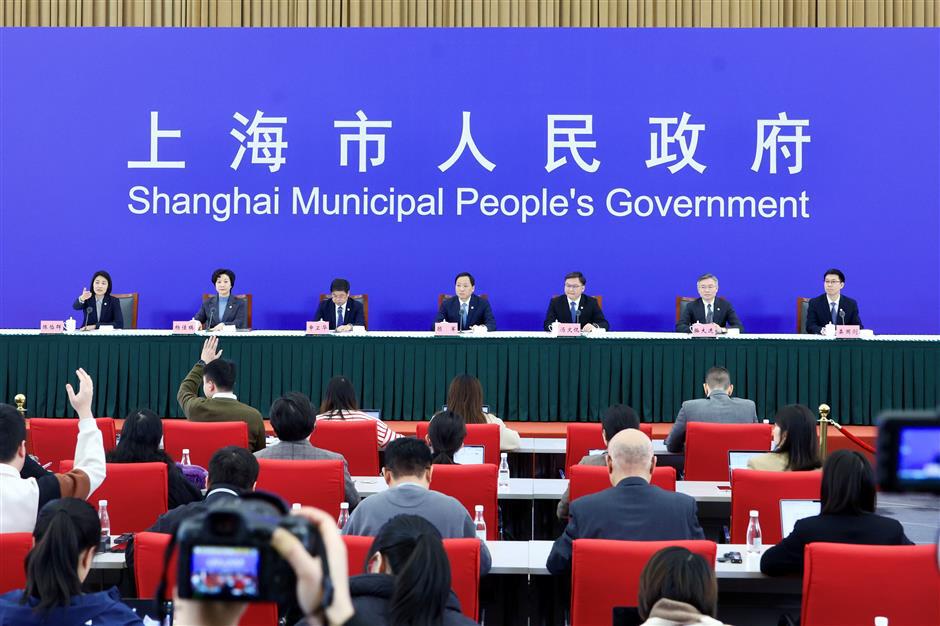 Officials answer questions during a press conference last Saturday.
Humanoid robots
The city is also betting on cutting-edge technology to drive future industrial growth.
Shanghai leads the country in the development of humanoid robots. Last year, the shipment of humanoid robots from Shanghai-based Agibot ranked first globally. Nearly 40 types of humanoid robots have been put into daily use and industrial production in the city.
The city plans to further bolster the "embodied AI" sector and expand the application of robots in healthcare, finance and manufacturing. It will also advance "future industries" such as brain-computer interfaces, quantum computing and 6G technology.
Technological innovation is being used to improve the quality of life for the elderly.
Shanghai is one of the most rapidly aging cities in China, with people aged 60 and above accounting for over 37.6 percent of its registered population.
The city has built 122 "smart nursing homes" equipped with digital platforms and monitoring systems. These facilities use smart mattresses and fall-detection sensors to track health data and ensure safety.
"We want to provide institutional service in a home setting," said Lou Guojian, deputy director of the Shanghai Civil Affairs Bureau.
About 500,000 elderly residents now use the city's "One-Click Service" platform. It helps them with medical appointments, utility payments and emergency calls.
To improve the living environment, Shanghai will continue its urban renewal efforts this year. The city plans to launch 19 "urban village" renovation projects and renovate 6 million square meters of old residential communities.
Employment remains a top priority for the government. Shanghai aims to create more than 600,000 new jobs in 2026. The city will focus on helping college graduates and young people find work in emerging industries.
It will also increase subsidies for vocational training, especially in high-tech and modern service sectors, to bridge the gap between labor supply and market demand.
Source: City News Service
