



经济新闻
低空经济成为春节科技亮点 2026-02-24
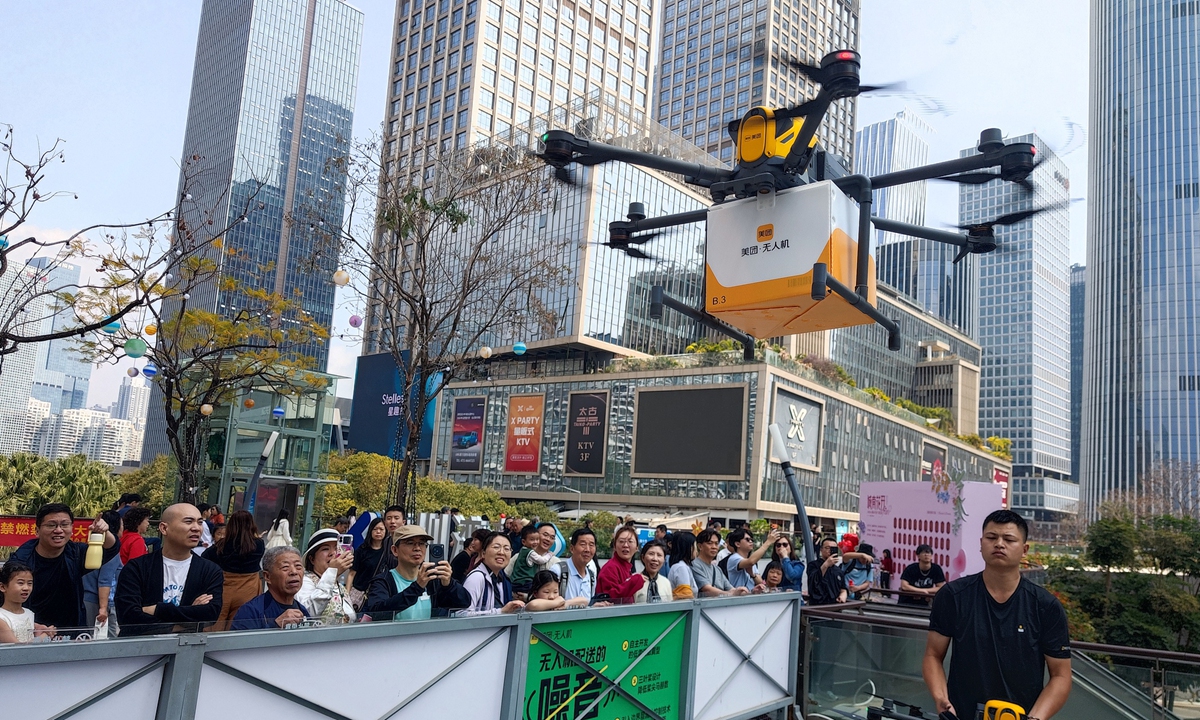
China's low-altitude economy is ushering in new opportunities in the spring of 2026, as a series of eye-catching unmanned aerial vehicle (UAV) shows during the nine-day Spring Festival holidays have allowed hundreds of millions of people to witness how the low-altitude economy has evolved from policy documents into everyday life.
With policy measures, market forces, and talent resonating together, this industrial spring breeze is driving accelerated development.
During the nine-day holidays, low-altitude services such as low-altitude aircraft, intelligent logistics and delivery, and aerial sightseeing were launched in multiple cities across the country. This enables scenes once only existing in science fictions to enter real life, becoming one of the most tech-savvy highlights of this year's Spring Festival.
Fabulous shows
At the Hefei sub-venue of the 2026 Spring Festival Gala on the evening of February 16, Chinese drone producer EHang Holdings' 22,580 GD4.0 drones ascended simultaneously in Hefei, capital of East China's Anhui Province, outlining the dynamic contours of Anhui-style architecture. Alongside the record-breaking drone light show was the synchronized flight of 16 EH216-S pilotless, passenger-carrying electric vertical takeoff and landing (eVTOL) aircraft.
EHang told the Global Times on Monday that the company conducted many UAV shows across the country during the nine-day holidays, which ran from February 15 to Monday, but didn't provide specific numbers, as some show services remain ongoing.
Equally notable was the debut of the world's first eVTOL water vertiport named SUNSHIP, independently developed by AutoFlight Aviation Technology, in the Yibin sub-venue of the gala in Southwest China's Sichuan Province.
Performances on the 2026 Spring Festival Gala, along with drone light shows and eVTOL demonstrations held across various regions during the past year, serve as symbolic showcases, drawing public attention to low-altitude economy technologies and demonstrating their feasibility and development potential, Luo Jun, executive director of the China Low Altitude Economic Alliance, told the Global Times on Monday.
AutoFlight told the Global Times on Monday that its water vertiport breaks through the limitations of traditional infrastructure, features flexible deployment capabilities, and does not occupy precious land resources. It can be quickly put into use in various water bodies such as rivers, lakes, and seas, with a single platform requiring only a few hours from arrival to commissioning. The company highlighted that it aims to expand the zero-carbon water vertiport beyond the Spring Festival Gala to better adapt to the diversified development needs of the low-altitude economy.
The low-altitude economy is a comprehensive economic form driven by low-altitude flight activities of civilian manned and unmanned aircraft, radiating into and promoting the integrated development of related sectors. Low-altitude airspace generally refers to the vertical airspace within 1,000 meters above ground level.
The low-altitude economy has a wide range of applications such as logistics, tourism, transportation, and emergency rescue and response operations. In China alone, the market size of the low-altitude economy was projected to grow to 1.5 trillion yuan ($210.6 billion) in 2025 and to 3.5 trillion yuan by 2035, according to calculations by the Civil Aviation Administration of China (CAAC).
Enormous potential
Just about one week before the Spring Festival Gala, the Ministry of Industry and Information Technology and four other government departments on February 10 jointly issued guidelines to boost low-altitude information and communication capacity. The document reads that the ground mobile communication network coverage for low-altitude public air routes across the country should be no lower than 90 percent by 2027.
Subsequently, on February 12, three Chinese government agencies including the National Development and Reform Commission, the country's top economic planner, issued Implementation Opinions on low-altitude insurance.
The document outlines measures to provide risk coverage for low-altitude aircraft operations, manufacturing, and infrastructure, including compulsory liability insurance for UAVs and scenario-specific insurance products.
A series of policy measures and the visual impact of the Spring Festival Gala together outline the trajectory of the 2026 low-altitude economy.
Luo said that the low-altitude economy is currently transitioning from a conceptual stage to one focused on infrastructure development and the establishment of industry standards and regulations - two key conditions for normalizing routine low-altitude flights - both of which are now being advanced.
The low-altitude economy had been included in the Government Work Report for two consecutive years, 2024 and 2025, and is expected to receive further emphasis at the two sessions in 2026, Luo said, adding that 2026 is set to mark the full-scale launch of both aerial and ground infrastructure construction.
He projected that cities such as Shenzhen in South China's Guangdong Province and Shanghai are expected to take the lead in rolling out projects including urban air passenger transport and drone delivery services.
The Recommendations of the Central Committee of the Communist Party of China on Formulating the 15th Five-Year Plan (2026-30) for National Economic and Social Development listed the low-altitude economy as one of the strategic emerging fields that the country will accelerate development.
The deep integration of the low-altitude economy with artificial intelligence (AI) - particularly the combination of geospatial intelligence in 3D geographic environments - serves as a key variable for transitioning from small-scale low-altitude flights to a large-scale low-altitude economy, Gao Yin, dean of the Real-scene 3D Economic Research Institute of the Moganshan Geospatial Information Laboratory, told the Global Times on Monday.
"China's unmanned aerial vehicle (UAV) industry is well developed with a high market share and holds an advantage in manufacturing infrastructure. Driven by demand for manned and unmanned aircraft with higher performance or lower costs, along with market growth from scaled applications, relevant infrastructure will continue to improve, enhancing core competitiveness and maintaining a favorable position," Gao said.
"The trillion-yuan market is moving from being 'perceivable' to 'tangible' in China," Gao noted.
Source:Global Times
