



经济新闻
逾350家中国企业亮相2026年世界移动通信大会展示新品 2026-03-04
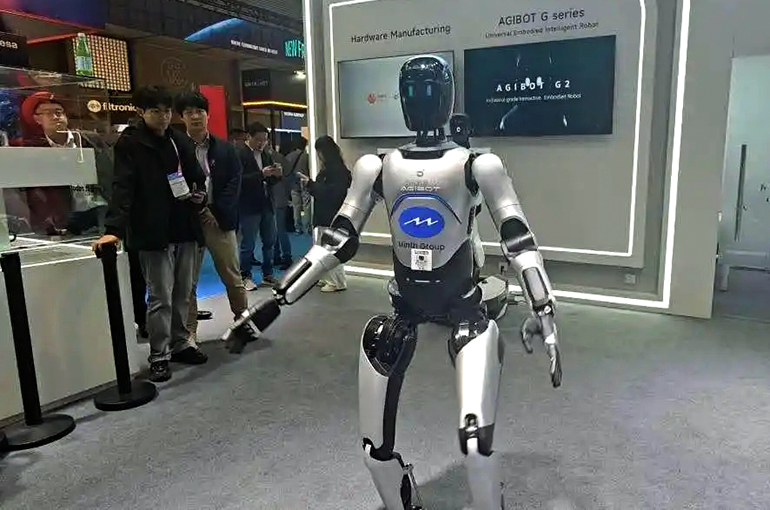 More than 350 Chinese exhibitors are taking part in this year's Mobile World Congress, with participants including smartphone and personal computer manufacturers, as well as debuts from robotics firms and developers of artificial intelligence models.
The four-day MWC, the world's biggest and most influential annual exhibition for the communications industry, kicked off in Barcelona on March 2 with about 2,900 exhibitors, according to data released by organizer Global System for Mobile Communications Association. The application of AI has been a highlight of the showcased products.
Chinese exhibitors, which accounted for 12 percent of the total, were the third most at the MWC after their ranks jumping 21 percent from a year earlier, with most participants coming from the United States and Spain.
The booth of the humanoid robot startup AgiBot at the entrance of Hall 6 was always bustling with visitors checking the Shanghai-based company's A2 series androids, X2 series compact robots, G2 wheeled robots, D1 quadruped robots, highly flexible OmniHand, and other cutting-edge products. The robots have welcoming and guiding functions, while also offering integrated solutions for applications in retail, manufacturing, and logistics.
"Our products primarily target the business-to-business market, and we are also looking for more partners in Europe," a worker at AgiBot's booth told Yicai. The robots were deployed in overseas markets such as Germany last year, with the company aiming to further expand its global market share, the person added.
In addition, Unitree Robotics showed its G1 humanoid robot, demonstrating its high dynamic motion control capabilities through a "fighting" performance, while MagicLab presented its full-size android Gen1, agile bipedal MagicBot Z1, and quadruped MagicDog.
Other Chinese firms also introduced their humanoid and quadruped robots designed for applications in industrial collaboration, guiding services, and high-dynamic control. Some representatives explicitly said they seek agents and partners in the European market.
Chinese developers of large language models focused on wearable AI devices. For example, Qwen showed its AI glasses for the first time overseas, with the AI assistant of Alibaba Group Holding reportedly planning to launch other new products, including rings and headphones, worldwide throughout this year.
Chinese smartphone makers also brought new AI-powered devices. Honor unveiled its Robot Phone, integrating a movable camera that enables it to actively track, nod, and respond to voice commands.
Unlike European and US manufacturers, which focus more on software-level AI capabilities, their Chinese peers are innovating hardware to integrate intelligent features, an overseas exhibitor told Yicai. They enable "emotional expression" and "automatic execution" into the physical layer of devices, which is an application path for AI tech based on manufacturing capabilities, the person noted.
However, hardware innovation entails higher costs and a more complex supply chain, the exhibitor stressed. During the process of developing products for the European market, establishing brand recognition and completing sales channels will take time, the person added.
Source: Yicai Global
