



经济新闻
“龙虾浪潮”席卷上海,人工智能峰会启航 2026-03-29

Booths feature lobster logos as the 2026 Global Developer Pioneers Summit (GDPS) opened in Shanghai on March 27.
The 2026 Global Developer Pioneers Summit (GDPS) kicked off on March 27 in Shanghai, transforming the city-level artificial intelligence conference into a sea of bright red lobster logos.
The crustacean has become the unofficial mascot of OpenClaw, the world's buzziest open-source AI agent framework currently taking China by storm.
The "lobster wave" was palpable across the exhibition floor. Companies offered one-stop installation services for various Claw-based tools, complete with free trial tokens. The buzz attracted a diverse crowd, from programmers and corporate professionals to social media influencers, all eager to witness a moment reminiscent of Chinese AI chatbot DeepSeek's market-shaking debut last year.
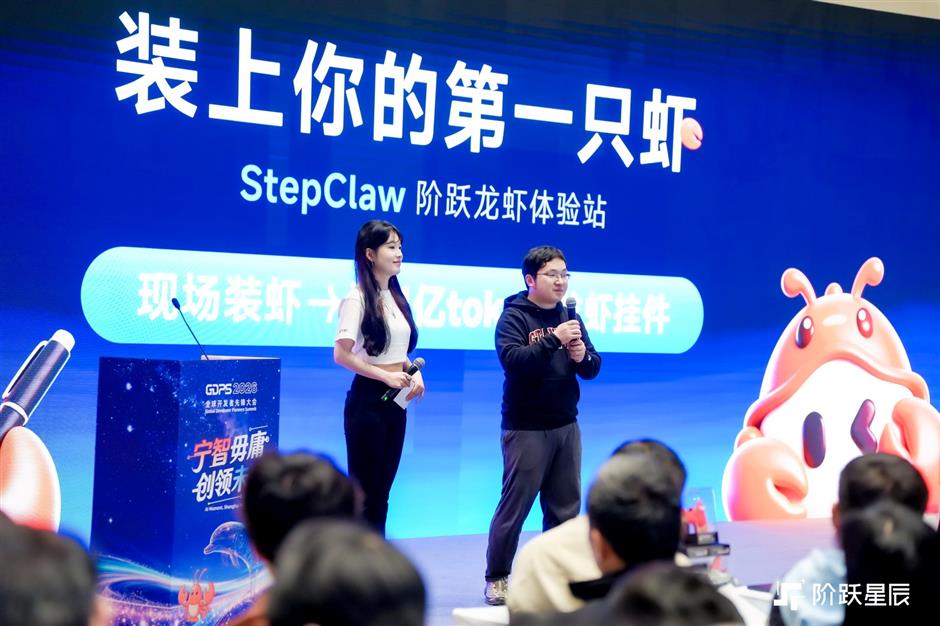
Shanghai-based StepFun offers onsite StepClaw installation services.
Shanghai-based StepFun took center stage, showcasing StepClaw, a versatile tool designed for both desktop and mobile platforms. To fuel the frenzy, the company offered a massive pool of 100 million "Lobster Tokens" to participants who installed the app on-site.
StepClaw's ascent isn't just marketing hype; it currently sits atop OpenClaw's monthly global rankings for application calls. Driven by robust reasoning, rapid-fire response times, and industry-leading affordability, the tool is a testament to the surging competitiveness of Chinese open-source models.
During the week ending March 8, usage of Chinese-developed models spiked by 35 percent, reaching a staggering 4.2 trillion tokens – officially overtaking their US counterparts in total volume. On the OpenClaw leaderboard, Chinese firms, including StepFun, Kimi and MiniMax, recently achieved a clean sweep of the top three spots.
According to Zhong Junhao, secretary-general of the Shanghai AI Industry Association, high quality and cost-efficiency are the primary engines driving the city's AI services.
"In Shanghai, a developer using OpenClaw might spend 6,000 yuan (US$857) for a specific volume of AI tokens. To get that same volume from overseas models, they would need to spend 60,000 yuan," Zhong noted, highlighting a price advantage that is turning AI into "real production capacity."
While OpenClaw dominated the exhibition site, the GDPS – which is runnng through Sunday – is also spotlighting breakthroughs in humanoid robotics and brain-computer interfaces (BCI), cementing Shanghai's status as a global AI hub.

A visitor tests a brain-computer interfaces demo onsite, as "concentration level" can determine whether you can catch dolls.
Source: City News Service
