



经济新闻
中国AED订单激增,专家称培训才是真正的挑战 2026-04-13
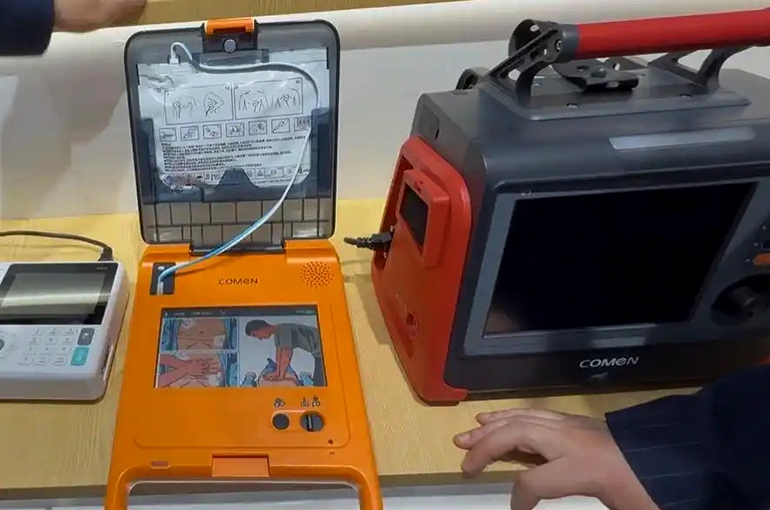
China is seeing a surge in orders for automated external defibrillators as public concern over sudden cardiac deaths rises, but experts warn that a lack of training remains the biggest obstacle to saving lives.
While growing awareness has driven exponential increases in AED demand over the past month, industry specialists said wider deployment alone is not enough. Ensuring that bystanders are willing and able to use the devices in emergencies is now the more pressing challenge.
Orders have climbed sharply following increased attention to cardiac arrest cases involving well-known figures, according to multiple AED manufacturers. At the same time, domestic prices have fallen significantly in recent years, making broader adoption more feasible.
AEDs were among the most discussed medical devices at the 93rd China International Medical Equipment Fair, held in Shanghai recently. Manufacturers, distributors, and agents actively promoted their products while also introducing visitors to cardiac emergency response knowledge.
About 550,000 people die from cardiac arrest in China each year, with many cases occurring outside hospitals. In general, the three to four minutes after cardiac arrest are considered the “golden rescue time,” and timely cardiopulmonary resuscitation (CPR) and AED use during that window can significantly improve survival rates.
Domestic Prices Fall, Deployment Expands
Mindray Bio-Medical Electronics and Comen Medical Instruments are currently the top two companies in China’s AED market by sales. A search by Yicai on an e-commerce platform found that domestically made AEDs are generally priced between CNY4,000 and CNY6,000 (USD586 to USD879).
“The price of AEDs has dropped from CNY10,000 to CNY20,000 at the beginning to around CNY4,000 to CNY5,000 for domestic products now. This has basically made it a reality that most imported AEDs have been replaced by domestic ones,” a salesperson at a company that distributes Mindray AEDs told Yicai.
Public data show that Shenzhen set a target in 2020 of reaching 300 AEDs per 100,000 people. By the start of this year, the city had deployed more than 43,000 units. With a permanent population of about 17 million, that works out to roughly 253 AEDs per 100,000 people, the highest level in China, although still short of the target.
Shanghai had 14,420 AEDs last year, equal to more than 58 units per 100,000 people. The city plans to add 6,000 more this year.
Even so, China still has room to improve overall AED coverage. In Europe and the US, AED density typically ranges from 200 to 400 units per 100,000 people, while Japan has about 500 units per 100,000 people. According to industry statistics cited in the article, China’s AED market exceeded CNY4 billion (USD585.4 million) last year, and the growth rate is expected to remain above 30 percent in the coming years.
However, expanding deployment is only one part of improving pre-hospital treatment for cardiac arrest. More important is ensuring that AEDs are both available and actually used, which depends heavily on training first-aid personnel.
Ge Junbo, director of the cardiology department at Zhongshan Hospital of Fudan University, told Yicai that even when AEDs are installed in many public places, they may still go unused if bystanders are afraid of being sued for using them incorrectly.
“I once rescued a patient on a public transportation facility. He insisted on seeing my doctor’s license and asked me to prove that I am a doctor. I said I only had a name card, and he took pictures of my name card.”
“Therefore, we should encourage the establishment of a system to protect the rescuers. Only in this way can more people be free from worries and be able to use the devices,” Ge said.
Ge added that AED use should be promoted more broadly and that delivery workers should be encouraged to take AED first-aid training, with subsidies also worth considering.
Source: Yicai Global
