



经济新闻
业内人士称,中国工厂中的脏、险、累工作正被机器人和具身人工智能接管 2026-04-16
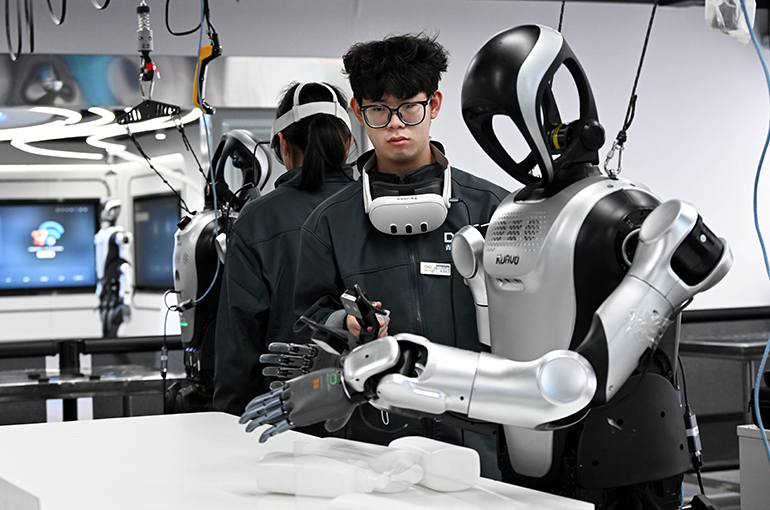
Robots and embodied intelligence are transforming Chinese factories by freeing workers from dirty, dangerous, and dull jobs, also known as the 3Ds, according to industry insiders.
The roles robots do are labor-intensive and physically demanding for humans, said Zhong Junhao, secretary general of the Shanghai AI Industry Association, who observed Agibot's Genie G2 robots performing precise tasks on the assembly line at the tablet plant of the Chinese humanoid robotics startup's client Longqi Technology in Nanchang on April 14. The robots liberated human workers, Zhong stressed.
The work done by the robots, which Agibot broadcast in full in an eight-hour livestream, marked the world's first large‑scale production at an embodied intelligence-powered 3C (computers, communications, and consumer) products precision manufacturing plant.
Humans are smarter than machines but prone to error, noted Yao Maoqing, partner, senior vice president, and president of Agibot's Embodied Intelligence Business Unit. Deploying robots for strenuous, repetitive tasks improves stability and consistency in production, Yao said.
"Robots do not have emotional fluctuations, so they do not cause variations in product yield," Yao said. "Multiple Genie G2 robots are already operating stably at customers' production lines.
"We plan to expand the deployed fleet to 100 units by the third quarter, while applications will rapidly extend to other industrial sectors, including auto, semiconductors, and energy," Yao pointed out.
The use of intelligent equipment is not limited to 3C manufacturing, with the Hunan factory of Want Group buying robot dogs to conduct daily inspections, He Chengbing, deputy general manager of the equipment center and production operations department of the company's Production & R&D Cluster, said to Yicai.
"Robot dogs can perform autonomous inspections around the clock, replacing humans in high‑risk and tedious patrol tasks," He noted. "This not only frees up labor but also improves the accuracy and efficiency of plant safety management."
The Chinese arm of French waste management firm Veolia Environnement has built an intelligent inspection system, where drones equipped with thermal imaging conduct real‑time inspections of industrial boilers and high chimneys, cutting inspection cycles from days to hours, a representative from the company told Yicai. The use of inspection robot dogs fitted with multi‑dimensional sensors has also boosted efficiency and ensured on-site safety, the person stressed.
The evolution of robots is essentially a history of evolving human‑machine relations, Chang Li, VP of Jaka Robotics, a developer of industrial collaborative robots, said to Yicai. The industry has moved from "machine replacement of humans" and "human‑machine collaboration" to "human‑machine co-creation," according to Chang.
Robots are upgrading from mere execution tools to partners that understand work scenarios and co-create value with human workers, Chang said. Frontline industrial workers will not be replaced when robot capabilities improve, but will undergo a career upgrade to become skilled technicians who operate and manage robots, Chang added.
Source: Yicai Global
