



经济新闻
披萨品牌调整中国市场发展计划 2026-04-22
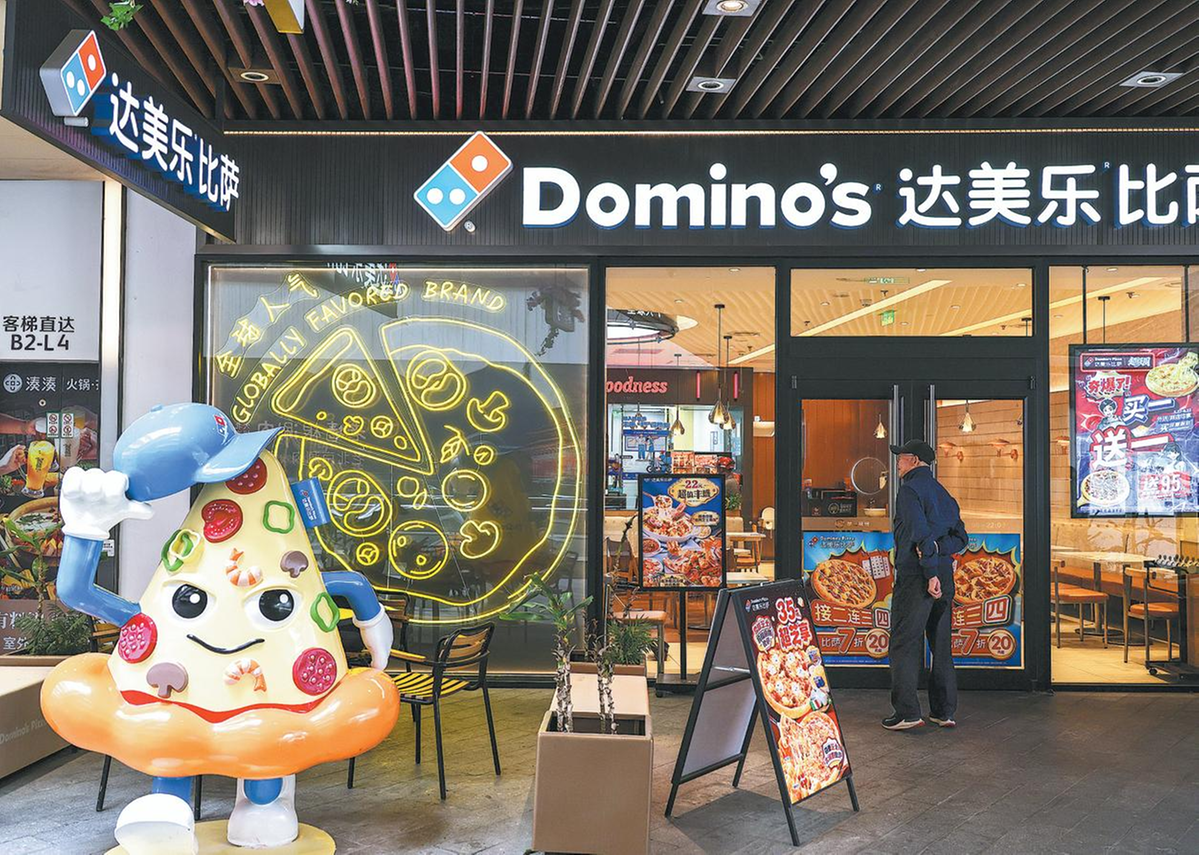 A Domino's Pizza store operates at a shopping mall in Shanghai on April 8.
 The pizza market in China is being reshaped by rapid expansion into lower-tier cities and shifting consumer preferences, forcing brands to rethink how they compete and grow.
Against this backdrop, DPC Dash Ltd, or Domino's Pizza China, reported another year of outsized growth in 2025, as aggressive store rollout and localization helped it pull ahead.
The operator said on March 25 that revenue in China rose 24.8 percent year-on-year to 5.38 billion yuan ($789 million), while adjusted net profit climbed 43.3 percent to 188 million yuan.
The results marked the fifth consecutive year of double-digit growth in both revenue and profit, positioning the company as one of the fastest-growing international quick-service restaurant brands in China.
"We have consistently delivered revenue growth above 20 percent since 2020, reflecting both the effective execution of our growth strategy and the compelling potential of Chinese QSR market," Aileen Wang, CEO of DPC Dash, said during an earnings call. Wang attributed the performance to disciplined execution and the long-term potential of the pizza segment in the country.
At the heart of Domino's China strategy is a robust store development plan, particularly in non-tier-1 cities, where competition remains less intense and consumer demand is rising.
Tier-1 cities continued to provide stable growth, supported by same-store sales gains and strong brand recognition. Revenue in these core markets rose 5.2 percent year-on-year to 2.2 billion yuan.
China has now become Domino's third-largest international market by store count. The company added a net 307 stores in 2025, entering 21 new cities and bringing its total store count to 1,315 across 60 cities nationwide. More than 60 percent of those outlets are now located outside the top-tier cities of Beijing, Shanghai, Guangzhou and Shenzhen, in Guangdong province.
These lower-tier markets are no longer peripheral. They contributed nearly 60 percent of the company's revenue in 2025, up from just over half a year earlier.
On New Year's Day 2026, Domino's China opened 62 stores across 46 cities in a single day, setting a global record for the brand. A flagship outlet in Dalian, Liaoning province, generated nearly 700,000 yuan in first-day sales.
The rapid expansion has been accompanied by improving operational metrics. Store-level EBITDA rose 20.4 percent to 1 billion yuan in 2025, while store-level operating profit increased 18.5 percent to 740 million yuan.
Growth was particularly pronounced in lower-tier cities, where revenue surged 43.4 percent to 3.17 billion yuan, accounting for 58.8 percent of total revenue. The increase was driven largely by the addition of 299 new stores in these markets.
The pizza chain has leaned heavily on localization and value positioning to attract younger consumers and increase order frequency.
The company refreshes its menu every six to eight weeks and launched more than 70 new products in 2025. It offers products such as the "Volcano" crust series, durian pizzas and limited-edition snacks.
Pricing has also played a central role. As Chinese consumers grow more price-sensitive, the company has emphasized affordability alongside its 30-minute delivery promise. Delivery sales in tier-1 cities rose to 76.2 percent of total revenue in 2025, up from 70.7 percent a year earlier, with delivery services now covering 76 percent of the cities where the brand operates.
Marketing efforts have focused on younger demographics, particularly Generation Z consumers. Collaborations with popular intellectual properties such as Snoopy and Kuromi, along with themed campaigns tied to holidays and viral visuals, have helped boost engagement on social media platforms.
 A livestreamer promotes pizza at a food ingredients expo in Wuhan, Hubei province, on March 28.
 Other pizza chain operators have shown mixed results.
Japan-based Saizeriya, which operates extensively in China through subsidiaries, has slowed its expansion pace. As of December, its operations in the Chinese market totaled 627 restaurants, with a net addition of 69 stores during the year, down from 81 in 2024.
The deceleration comes amid weakening operational metrics. While sales posted single-digit growth in 2025, operating profit declined by double digits across key markets.
Some indicators improved — such as a 4 percent same-store sales increase in Guangzhou and a rebound in Beijing operating profit.
Meanwhile, the sector's dominant player Pizza Hut is pursuing a different path, focusing on premiumization and experiential dining. The chain recently introduced its higher-end "Pizzeria" concept in Beijing, opening outlets in the Xisi and Yansha areas.
The format emphasizes Neapolitan-style wood-fired pizzas, featuring open kitchens and imported ovens. The concept is positioned as a hybrid of dining and cultural experience, targeting urban consumers and tourism traffic.
"The launch of Pizza Hut Pizzeria at Xisi is a model of localization innovation for an international dining brand," said Jia Feiyue, head of the Beijing Food and Beverage Industry Association.
The competitive dynamics are unfolding against a backdrop of rapid market expansion.
According to a report by 36Kr, China's pizza market reached 48 billion yuan in 2024 and is projected to exceed 77 billion yuan by 2027, implying a compound annual growth rate of about 15.5 percent. The market remains relatively concentrated, with chain operators gaining share as consumers increasingly favor standardized quality and convenience.
Younger consumers — particularly those born after 1990 and 2000 — are driving demand, especially in first to third-tier cities.
At the same time, consumption patterns are evolving. Pizza is shifting from a novelty product to a more regular dining choice, with greater emphasis on quality, health and customization, according to the report.
Surveys show that 43.9 percent of consumers want more flexibility in choosing ingredients, while 36 percent prioritize uniqueness and 31.5 percent seek innovative flavors that depart from traditional recipes — trends that are pushing brands to invest more in product development and differentiation.
Source: China Daily
