



经济新闻
仓单正在重塑中国的商品贸易格局 2026-05-07
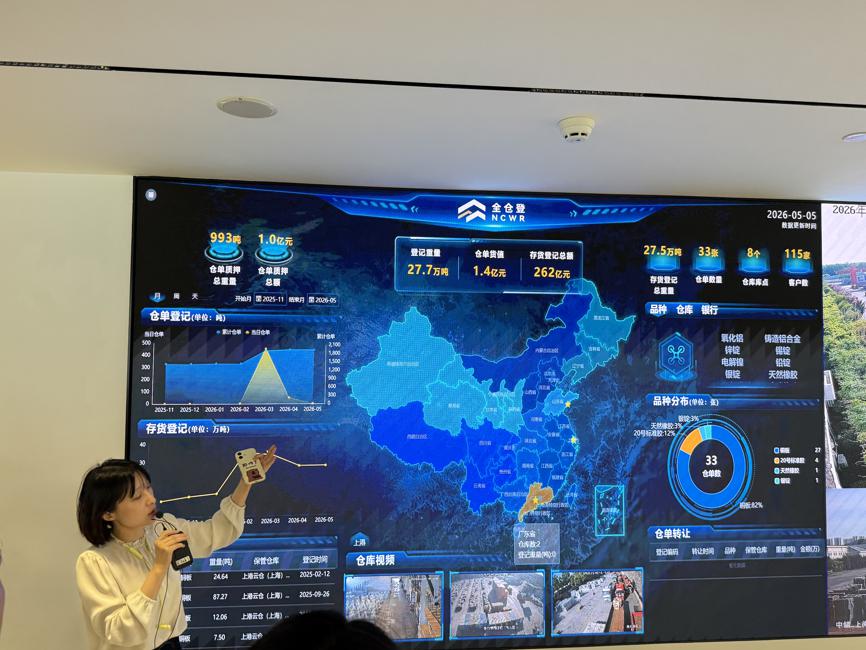
Shanghai Commodity Warehouse Receipt Registration Co Ltd, or NCWR, has leveraged warehouse receipt registration to drive the comprehensive digitalization of the commodity ecosystem, facilitating the integrated development of the Yangtze River Delta region and Shanghai's goal of growing into a global resource allocation center, according to experts.
Strategic layout in the YRD is a key priority for NCWR this year, as Jiangsu, Anhui, Zhejiang, and Shanghai serve as hubs for the production, logistics, and consumption of bulk commodities, NCWR's top management team said during a press briefing on Wednesday.
As major pillars of the national economy, bulk commodities directly affect the security and stability of industrial chains, as well as the implementation efficiency of major national strategies when their circulation, risk control, and resource allocation go through any ups and downs, the NCWR executives said.
Therefore, NCWR has built a new model integrating the flows of goods, transportation, capital, and commercial notes throughout the commodities trading in the YRD. It has rolled out an independent third-party warehouse receipt registration system which further integrates industries and finance, they said.
Established in 2022, the company has signed agreements with four leading warehousing and logistics enterprises, including CMST Development Co Ltd and SIPG Logistics. To date, the total registered weight of commodities has topped 277,000 tons. The value of warehouse receipts came in at 140 million yuan ($21 million) while the value of inventories reached 26.2 billion yuan.
The core registered varieties are primarily non-ferrous metals and precious metals such as copper, aluminum, lead, zinc, tin, nickel, and silver, with ongoing expansion into other highly liquid bulk commodities, including natural rubber and paper pulp.
Teaming up with China Zheshang Bank, NCWR launched a pilot warehouse receipt pledge financing registration business in February. The total registered pledged weight has reached 993 tons so far, with a total pledge value of over 100 million yuan.
Meanwhile, the company plans work with Shanghai Clearing House to launch a warehouse receipt transfer registration service later this year, which attempt will further enhance the circulation efficiency of bulk commodity trade.
Ningbo Jintian Copper (Group) Co Ltd has expanded its business across China and serves as a major producer of deliverable goods for the Shanghai Futures Exchange. The warehouse receipt registration at the NCWR solves the long-standing industry problem of confirming ownership of goods, giving banks the confidence to extend credit to companies, Jintian's general manager, Liu Liangxin, said.
Financial institutions said that the NCWR's registration system has enabled a paradigm shift from relying on corporate credit to embracing collateralized trust in physical goods. Banks can thus serve more small and medium-sized manufacturing enterprises.
Zhang Chunsheng, deputy head of Bank of Jiangsu's Shanghai branch, said that Shanghai boasts a concentration of companies' headquarters, with its industrial chains extending to the rest of the YRD and radiating throughout the whole country and even globally. The NCWR's warehouse receipt registration mechanism can better support Shanghai in establishing an innovation hub in the YRD.
He added that no single existing transaction system can fully evaluate an enterprise's creditworthiness. Big data should be better explored to serve more and better SMEs.
Xu Chao, deputy head of Bank of Communications Shanghai branch, agreed that data currently sits in isolation. Effectively utilizing data for operations and credit assessment is a huge challenge.
However, shipping and trade chains make it possible to break down the isolation. It can address data inconsistency and make data both usable and trustworthy, he said.
Xu also noted that the repeated scandals in the commodity sector, often involving huge sums, stem from questions about the genuineness of goods and duplicate pledges. A large amount of banks' credit assessment work has been spent in verifying these two issues. But such extensive verification often causes banks to miss fleeting trading opportunities. NCWR's warehouse receipt registration system helps to remove such burden, allowing banks to focus on financing and transaction services, he said.
Zhao Xusheng, general manager of China Zheshang Bank's supply chain finance department, noted that Shanghai is the center for bulk commodity shipping, finance, and information, while the neighboring Zhejiang, Jiangsu, and Anhui are the hubs of manufacturing and end-product processing.
With the infrastructure provided by NCWR's warehouse receipt registration system, bank capital can flow seamlessly into these networks, facilitating stronger coordination, he said.
Source: China Daily
