


经济新闻
外国汽车制造商将中国工厂改作出口基地使用 2026-05-18
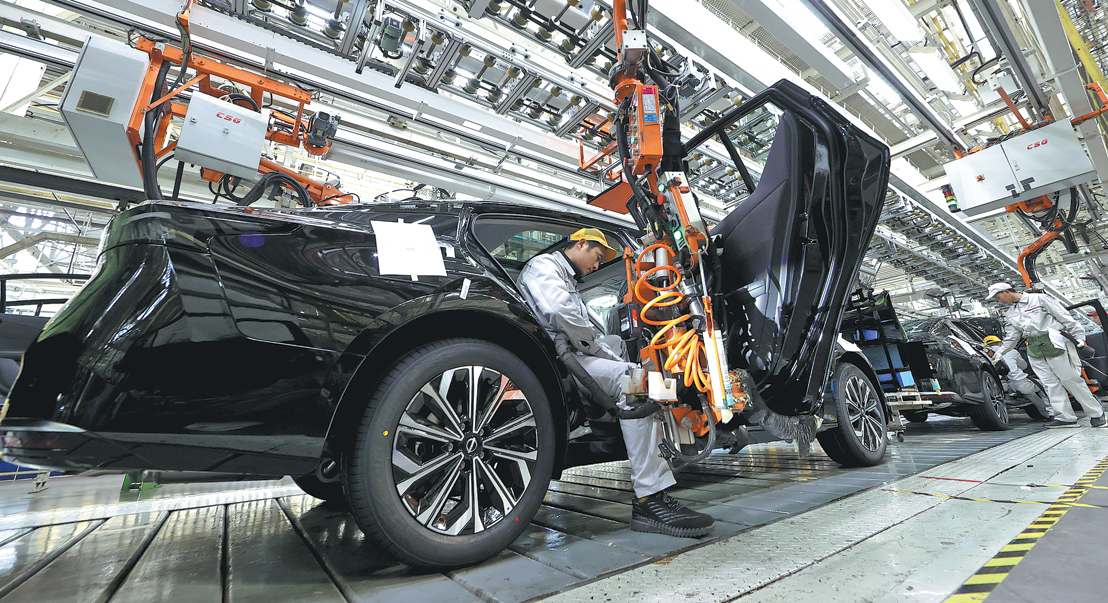
Workers assemble cars at the workshop of Dongfeng Nissan's Xiangyang factory in Hubei province in December 2025.
Foreign automakers, once content to manufacture and sell within China, are turning their joint-venture factories into global export hubs, tapping the world's largest auto market for cost advantages and advanced local technology as they seek to boost competitiveness.
Nissan is among those using China as a production and innovation springboard to enhance competitiveness in overseas markets. The Japanese automaker will soon ship the N7 sedan, made by Dongfeng Nissan, to Latin America and Southeast Asia. The Frontier Pro pickup will also go to those regions plus the Middle East, with NX8 SUV exports planned.
"These products are good not only for China. The technologies, the speed of development and the cost that we have achieved in the China ecosystem can play a very important role for us overseas," Nissan Chief Executive Ivan Espinosa said at Auto China 2026 in Beijing in late April.
The automaker has set up an import-export joint venture in China with a short-term export target of more than 100,000 units and a long-term goal of around 300,000.
For South Korea's largest auto group, Hyundai Motor, China is not only a production base and R&D center, but will become a hub for launching new products to other markets, President and CEO Jose Munoz said.
The automaker will deploy cutting-edge technologies in China and expects to leverage the Chinese market to popularize these technologies and export them to other regions, he added.
German auto giant Volkswagen is also evaluating China as an export base. By partnering with local companies including XPeng, Horizon Robotics, Gotion and CATL, Volkswagen is accelerating its move to smart electric vehicles, reducing development time by 30 percent and development costs by 40 percent.
Volkswagen Group CEO Oliver Blume said in late April that considering cost positioning and the technological advantages, Volkswagen aims to provide products and services to the Southern Hemisphere from China.
SAIC Volkswagen's ID. ERA 9X, the German automaker's first extended-range electric model that features Momenta's driving assistance system and CATL's battery, will also be exported to Germany in the future, the automaker announced at the SUV's launch event in late April.
Yale Zhang, managing director of Shanghai-based consulting firm Automotive Foresight, said that China has emerged as a global leader in electrification and intelligent driving technologies, becoming indispensable for foreign automakers striving to catch up in the new energy vehicle race.
"By relying on China to develop new models, foreign automakers gain both superior product capabilities and the cost benefits of China's powerful industrial chain," he added. "It's a smart move with good prospects."
In fact, foreign automakers have long turned to exporting China-made vehicles to boost sales recovery — and that push has only intensified as domestic headwinds mount.
In 2025, the market share of joint-venture brands in China plummeted to around 30 percent, a sharp drop from the 60-70 percent they held at their peak around 2014. This decline has directly squeezed sales volumes and left significant factory capacity idle. Some plants have even been forced to shut down, yet exports have effectively revitalized this unused capacity.
Among Hyundai's Chinese ventures, Yueda Kia is an early-mover with exports starting from 2018. The joint venture has shipped more than 582,000 vehicles from its Yancheng plant in Jiangsu province. According to Gasgoo Automotive Research Institute, its exports exceeded 170,000 units in both 2024 and 2025, ranking among the top three joint-venture exporters.
The export business has helped it stabilize its position in China's crowded market and post steady sales growth, making it a rare success story among joint ventures.
Beijing Hyundai exported 82,000 vehicles in 2025, up 48.7 percent year-on-year, accounting for about 39 percent of its total production.
SAIC Volkswagen has shipped Tiguan L Pro, Passat Pro and Teramont Pro models to Uzbekistan via the China-Europe freight train, targeting a region where the local auto industry remains underdeveloped and the mid-to-high-end vehicle market relies heavily on imports.
But most of these earlier exports were overseas-designed, China-manufactured gasoline-powered cars, primarily aimed at absorbing idle capacity at joint-venture factories, Zhang noted.
This stands in stark contrast to the future exports of new energy vehicles, which will be fully designed in China and equipped with core Chinese technologies.
He sees the strategy as a long-term shift. A key reason is that product lines do not conflict. China fills product gaps for foreign brands, and by using Chinese factories, automakers get the suitable vehicle size and cost advantages — a winning formula in global competition, he said.
Zhang added that Chinese NEVs are far more competitive overseas than combustion cars. He forecasts that NEVs' share of China's total auto exports will jump from about 35 percent in 2025 to above 60 percent this year.
Source: China Daily
