



经济新闻
人工智能和芯片企业提振中国大城市写字楼市场 2026-06-10
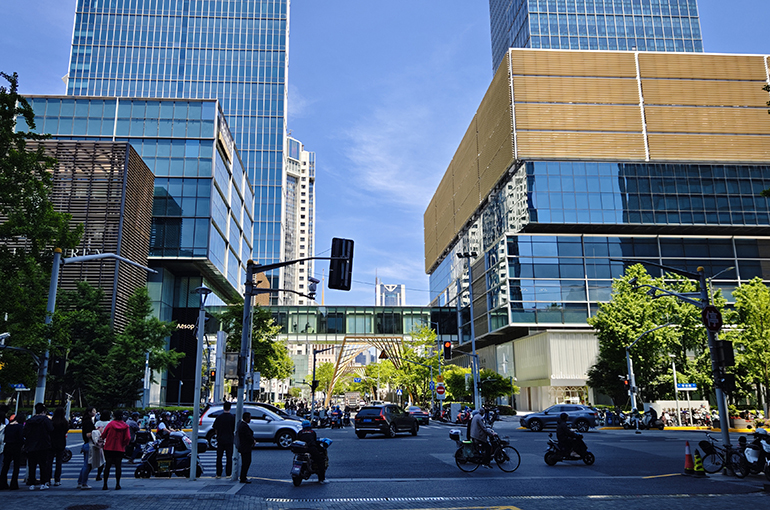
Businesses in artificial intelligence, computing power, and semiconductors have been renting large office spaces or even buying whole buildings in major Chinese cities over the past year, helping fuel an office market revival in central business districts.
Demand from AI companies has helped push net office absorption higher in core cities, while vacancy rates in technology clusters across Shenzhen, Hangzhou, and other major hubs fell to around 20 percent in March from roughly 30 percent at the end of last year, according to a recent report by UBS.
Before this rebound, the Chinese office market was under sustained pressure from a steady pipeline of new supply, as financial institutions pressed ahead with cost-cutting and efficiency drives and internet companies shrank their office footprints.
Demand from AI and integrated circuit companies is growing rapidly, a veteran of Shanghai’s Grade A office leasing and asset-management market told Yicai, adding that the market’s long-standing tenant mix, once dominated by financial and internet businesses, is being reshaped.
“Terms that used to appear often in project marketing materials, such as ‘financial center’ and ‘internet headquarters,’ are now being replaced by phrases like ‘AI industry ecosystem’ and ‘large-model cluster,’” the person noted.
Increasing demand from emerging industries has created a clear split in the office market. Traditional financial business districts remain subdued, while some areas positioned around AI, computing power, and chips are running hot. They include the Xuhui Riverside West Bund Digital Industry Belt, the Zhangjiang Moli Community, and the Yangpu Yunji Shangpu project -- all in Shanghai.
The arrival of big corporate tenants has driven demand in such districts. The Yangpu Shangpu project in Shanghai’s downtown district of Yangpu, for instance, gave the city one of its biggest office deals last year. The project, which has a total floor area of more than 100,000 square meters, signed a lease for about 40,000 sqm with ByteDance’s AI app Doubao at the end of 2025.
“Such large tenants move quickly, lease large spaces, and demand high building quality,” the source said. “Once you land one of them, the rest of the building usually leases up fast.” The Yunji Shangpu project is now nearly fully occupied, the person said.
The pattern is can be seen elsewhere too, as more AI and chip companies move out of incubators and co-working spaces into higher-grade office towers in tech-heavy hubs such as Shenzhen’s Nanshan Science Park and Hangzhou’s Cloud Valley.
Some financially stronger AI companies are going a step further and buying buildings outright. One example is Zhipu AI, which bought Beijing’s Diamond Tower in Zhongguancun Software Park in April to serve as headquarters and operating space for its large model business.
Still, some industry insiders are cautious about the idea that AI is single-handedly reviving the commercial office market. One consultant told Yicai that while AI businesses are clearly adding incremental demand, it is still too early to say the era of the “super tenant” has returned.
The key difference from the internet era, the consultant noted, is that although AI companies may command high valuations, they generally employ far fewer people. Most are still in the financing and hiring stage, so the full impact of the AI industry’s rapid growth on the office market may take some time to show up, according to other insiders.
Source: Yicai Global
