



经济新闻
朗驰公司高管表示,人形机器人可解决工厂劳动力短缺问题 2026-06-30
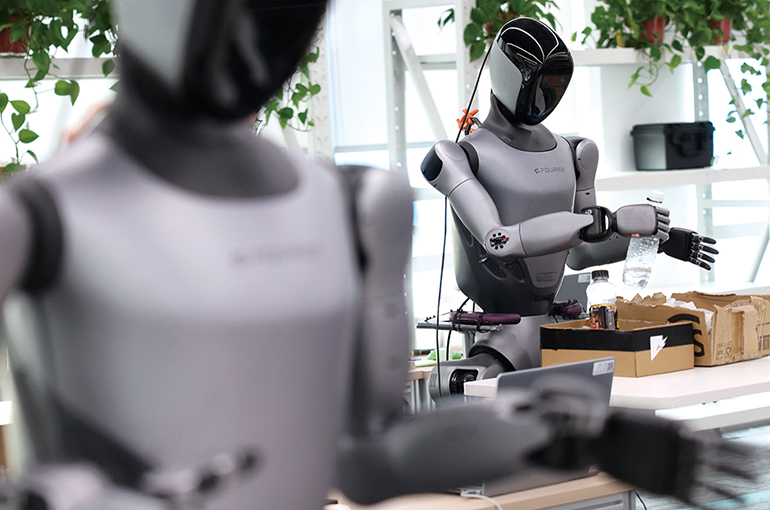
The difficulty in retaining young workers in repetitive, monotonous, and high-intensity assembly line jobs is one reason why factories are increasingly partnering with robot makers to bring in androids, according to a senior executive at Longcheer Technology, which live-streamed a public stress test of robots working on one of its production lines last week.
"Young people generally remain at plants for around three months -- six months at most," Zhang Long, who oversees Longcheer's pilot project with humanoid robotics startup AgiBot at its Nanchang plant, told Yicai. "By the end of the year, most positions may have seen a complete turnover of employees."
Longcheer, a Shanghai-based contract manufacturer of smart electronic products, teamed up with AgiBot to deploy eight Genie G2 androids to inspect tablet computers on a commercial production line, with their work live-streamed over six days last week. They checked more than 17,000 tablets with a success rate of 99.99 percent.
The use of humanoid robots could also help factories lower operating costs, raise productivity, and fundamentally alter their cost structures, said Ai Wen, project director of AgiBot's Genie business unit, adding that a Genie G2 costs about the same as an assembly line worker's two-year wage. As robot manufacturing costs continue to decline, he expects their economic advantages to become even more pronounced.
The eight Genie G2 units worked together seamlessly at the Nanchang plant, Yicai saw during an on-site visit. While performing their designated tasks, they also communicated with the testing equipment to continuously monitor the status of product testing and, based on the test results, made corresponding adjustments to the operations of the entire production line.
The work efficiency and first-pass success rate of these robots have already reached the standards required by the factory, Zhang pointed out.
Future Potential
The robotic arms already used for quality inspections on the factory’s phone assembly line remain the better choice than the Genie G2 robots in terms of individual work capability, Zhang noted. And adding artificial intelligence functionality to robotic arms in a smart manufacturing environment presents major challenges in data collection, model training, and system integration, while also resulting in relatively high upgrade costs, Zhang said.
But since smart manufacturing requires equipment capable of end-to-end data connectivity, flexible deployment, autonomous decision-making, and self-optimization, the Genie G2 offers far greater potential for future development, Zhang added.
Once data interconnectivity is achieved, robots at their workstations can integrate with operational machinery, inspection equipment, and human-staffed processes to form a unified operational unit, an employee involved in robot deployment at the Nanchang plant told Yicai.
This enables real-time analysis of factory data, product status tracking, and the issuance of timely alerts, guiding engineers through troubleshooting when issues arise, the person pointed out.
Obstacles Remain
Still, numerous technical challenges still need to be overcome, with an industry insider telling Yicai that before robots can take on factory roles, they must undergo various forms of intelligent training. Once they meet predetermined capability benchmarks, they must also pass a series of product-specific tests, the person added.
"For example, developers must submit fundamental data -- such as the robot's gripping force control, operational stability, and various product-related metrics -- to the client,” the insider said. "Only after the client approves these can the robot officially take on its role," making the verification period required for any successful deployment relatively lengthy, the person stressed.
In addition, the challenge of scaling up robot deployment in plants lies in improving their overall operational success rate, AgiBot's Ai pointed out. In the case of 3C (computers, communications, and consumer) product manufacturing, the overall success rate on the assembly line must exceed 99.5 percent, he said.
Even if a robot achieves a 100 percent success rate in performing a single task, it still does not meet the requirements for deployment if its success rate in handling complex tasks remains low, he noted.
Embodied intelligence models are still not "smart" enough and lack generalization capabilities, directly affecting the pace at which robots can enter factories, according to a source at an investment firm.
Source: Yicai Global
