



经济新闻
华为加速昇腾AI芯片路线图,超级节点部署规模扩大 2026-09-17
Huawei Technologies is accelerating the commercialization of its Ascend AI processors as part of a broader drive to build China's self-developed AI chips and architecture, with its latest product roadmap running quarters ahead of schedule, the tech giant announced on Thursday at the Huawei Connect 2026 conference in Shanghai.
Over 1,000 Ascend 910C super-nodes have already been deployed, and the Ascend 950 super-node has entered large-scale commercial use. This ecosystem has emerged as a key AI infrastructure consensus across industrial,academic and research sectors, said Wang Tao, rotating chairman of Huawei.
Super-nodes are defined as systems physically composed of multiple computing nodes and chips tightly interconnected via high-efficiency protocols. This design allows these systems, powered by domestic AI chips, to match the computing capacity of systems utilizing advanced Nvidia chips. Those Nvidia chips are forbidden to be sold in the Chinese mainland.
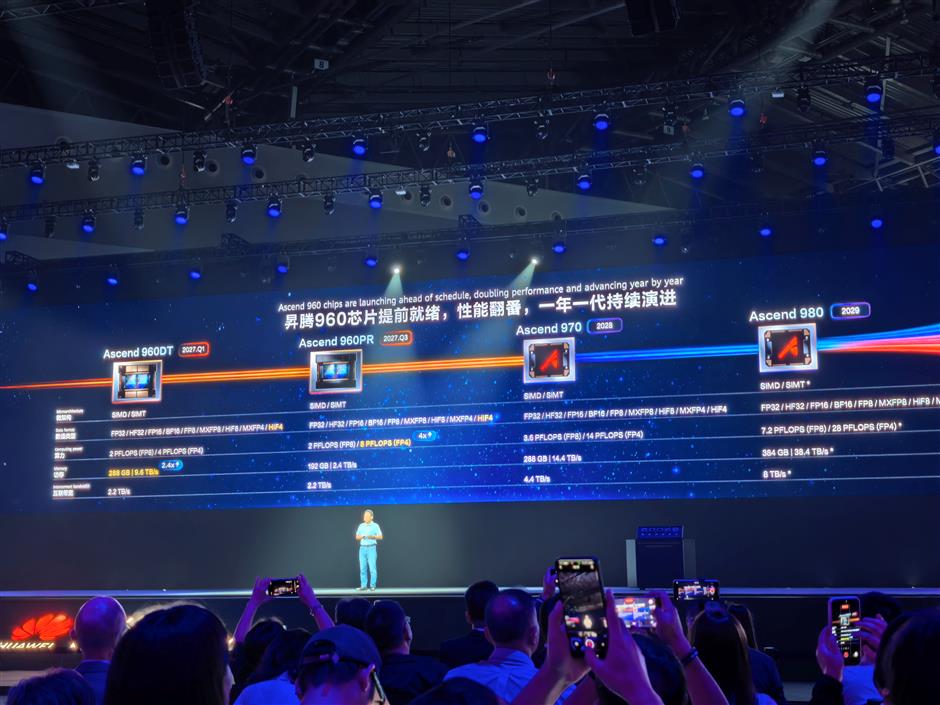
Wang also reaffirmed Huawei's commitment to an annual update cycle for its Ascend chip lineup. The development of the Ascend 960 series is running three quarters ahead of schedule, while achieving doubled performance, with the chip slated to be ready in the first quarter of 2027. Looking further ahead, the Ascend 970 is expected in 2028 and the Ascend 980 in 2029, both featuring the new Tao architecture.
Today, the parameter counts of AI models are rapidly approaching 10 trillion and are projected to exceed 100 trillion by 2030. Meanwhile, AI agents, which are currently capable of continuous operation on an hourly scale, will be able to execute tasks over month-long duration by 2030. China's daily inference token volume has already risen to around 500 trillion, a figure expected to reach the quadrillion scale by the end of the decade. According to Huawei, these sweeping changes place unprecedented demands on the scale, performance, and reliability of future AI infrastructure.
Source: City News Service
