



经济新闻
新增长动力增强上海经济韧性 2026-10-22
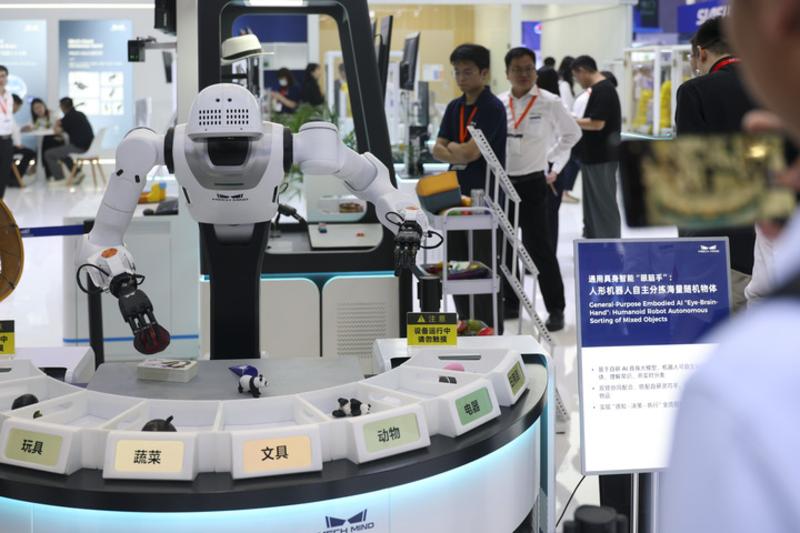
Ongoing industrial restructuring has helped Shanghai's GDP grow by 5.5 percent year-on-year in the first three quarters to 4.33 trillion yuan ($648.6 billion), outperforming expectations and the national average, according to the data released by the Municipal Bureau of Statistics on Thursday.
The added value of the city's secondary industry rose 4.6 percent, with industrial value-added growing 5.5 percent.
While traditional advanced manufacturing — such as rail, ship, aerospace, and other transport equipment — continued to report strong year-on-year growth of 13.3 percent, output of the three pioneering industries — integrated circuits, artificial intelligence and biomedicine — surged 17.1 percent. Furthermore, the output of AI spiked 24.8 percent, IC jumped 23.4 percent, and biomedicine rose 7.9 percent.
Strategic emerging industries saw their output rise 9.3 percent from a year earlier, with new-energy vehicles soaring 26.7 percent and new energy up 15.8 percent. Output of service robots and industrial robots rose 27.3 percent and 23.1 percent, respectively.
Services are moving up the value chain. The added value of the tertiary sector increased by 5.7 percent. Finance, which is one of Shanghai's major strengths, grew 9.5 percent from a year earlier. By the end of September, turnover of the city's securities brokerage outlets spiked 70.3 percent year-on-year, continuing to outpace the national average.
The added value of information transmission, software, and IT services rose 8.9 percent. Transport, warehousing, and postal services registered year-on-year growth of 6.5 percent.
In the first eight months of the year, revenue generated by Shanghai-based IC design companies surged 32.4 percent. The revenue of information processing and storage support services rose 10.7 percent, and that of digital technology application services grew 11.8 percent.
Professional services also expanded, with advertising, human resources, and legal services revenue up 14.7 percent, 7.7 percent, and 5.7 percent, respectively.
Signs of improvement can be seen on the demand side. While fixed-asset investment climbed 4.3 percent year-on-year, the city's industrial investment jumped 21.9 percent and high-tech investment surged 30.6 percent.
Purchases of equipment and tools — which are indicators of companies' expanded production capabilities — shot up by 54.6 percent, contributing 8.6 percentage points to overall investment growth. Manufacturing investment, infrastructure investment, and high-tech manufacturing investment reported year-on-year increases of 24.4 percent, 23.3 percent, and 34.8 percent, respectively, signaling that resources are flowing toward industrial upgrading and technological innovation.
Despite the external uncertainties and headwinds, Shanghai's foreign trade reached a record high in the first three quarters. Total goods trade rose 17.9 percent to 3.94 trillion yuan, with exports up 22.3 percent to 1.81 trillion yuan and imports up 14.4 percent to 2.13 trillion yuan. High-tech exports grew 33 percent and accounted for nearly 30 percent of total exports. IC exports were up by 29.8 percent and that of medical instruments up 18.3 percent.
Although the city's retail sales fell 1.1 percent in the first nine months, the gauge would still register a 1-percent increase if the sales of automobiles are excluded. On the other hand, culture, sports, and entertainment revenue increased 13.1 percent from a year earlier, pointing to growing service consumption. The number of inbound tourists rose 26.9 percent in the past three quarters. Cultural services revenue grew 24.8 percent and other cultural and arts brokerage revenue jumped 51.1 percent in the first eight months.
Source: China Daily
