



今日上海
当地儿科医院的研究病房吸引了海外患者 - 2025年12月22日
Local pediatric hospital's research ward attracts overseas patients

Since launching a research ward dedicated to pediatric rare diseases in July of last year, the Children's Hospital of Fudan University has treated over 200 patients with challenging-to-diagnose rare diseases, including several international patients who traveled to Shanghai for treatment.
Pediatric rare and difficult-to-diagnose diseases are a tough medical problem in the world. About 72 percent of rare diseases are genetic, often affecting multiple organ systems and accounting for 35 percent of infant mortality. Diagnosing rare diseases in children is a worldwide challenge, characterized by delayed diagnosis, significant variability, and diagnostic pitfalls. On average, it takes between four to eight years from the first appearance of symptoms to reach a final diagnosis.
Recently, a 2-month-old South African girl suspected of having Krabbe disease, accompanied by family members, traveled to the hospital for medical consultation and ultimately received a personalized treatment plan, including hematopoietic stem cell transplantation. It is a typical example of international pediatric patients seeking help here, hospital officials said.
Aromatic L-amino acid decarboxylase (AADC) deficiency is a rare, fatal, autosomal recessive genetic disorder. Currently, only a few countries have developed gene therapy treatments for it. To tackle this challenge, the hospital is conducting innovative clinical research involving direct bilateral putaminal intracerebral injection of gene therapy for AADC deficiency patients.
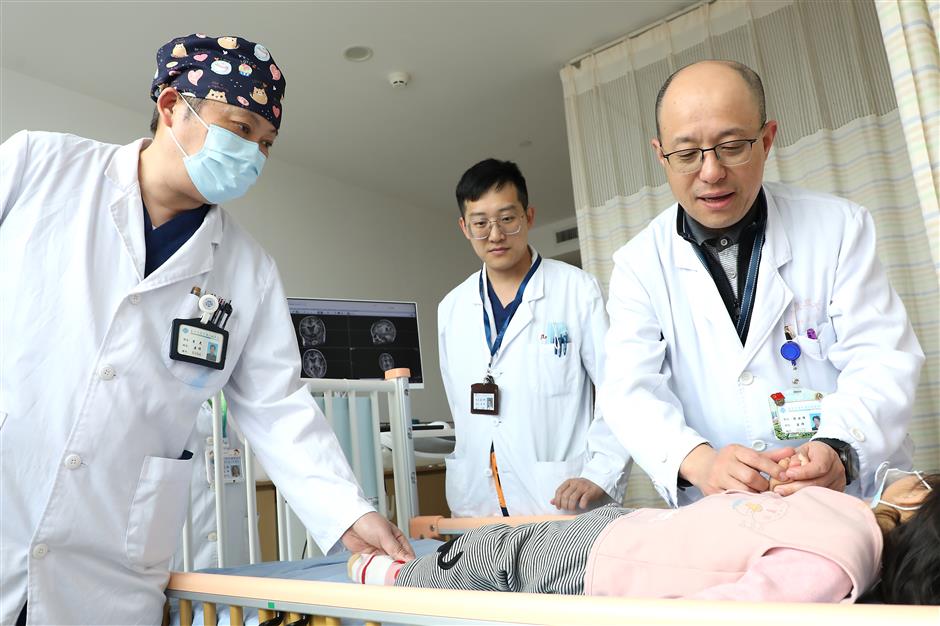
Doctors at the Children's Hospital of Fudan University check a child with rare disease.
Within the research ward, several-edge clinical studies are steadily progressing: China's original base editing technology for treating severe β-thalassemia successfully performed autologous hematopoietic stem cell transplantation on a Pakistani child; the world's first Fabry disease gene therapy study has completed cutting dosing for all five participants, who are now in long-term follow-up.
In August 2025, the hepatology team also initiated the world's first antisense oligonucleotide (ASO) drug treatment for children with Alagille syndrome, with three participants completing dosing. In October, the nephrology/dermatology department started a gene therapy project for dystrophic epidermolysis bullosa (DEB), having already enrolled three participants successfully.
From July to November, a total of 32 projects, including registered clinical trials (GCP) and investigator-initiated trials (IIT), have been conducted in the research ward. These projects encompass 12 clinical specialties, including neurology, hematology, nephrology, surgical oncology, hepatology, dermatology, and intensive care units. Nine of these are high-risk gene therapy projects, developed in technical collaboration with the Shanghai Key Laboratory of Rare Disease Gene Editing and Cell Therapy, with a focus on precision treatment for genetic and rare diseases.
The research ward offers hope for many families who came to Shanghai after learning about the new research body.
Earlier this year, a 4-year-old Russian girl sought treatment at the hospital. After hospitalization in the research ward and multidisciplinary consultation, the child was diagnosed with the rare disease Spinal Muscular Atrophy with Progressive Myoclonic Epilepsy (SMA-PME) and received hematopoietic stem cell transplantation. A 1-year-old Vietnamese girl with Spinal Muscular Atrophy (SMA) Type 1 received gene therapy at the hospital and was discharged successfully.
Rare disease diagnosis and treatment have long been practiced at the hospital, which has established China's first early screening cohort for childhood autism, increasing the early screening rate by nearly 30 percent. Related achievements were applied by the National Health Commission in formulating the "Service Specification for Screening and Intervention of Autism Spectrum Disorder in Children Aged 0-6 Years," providing crucial technical support for autism prevention and treatment in China.
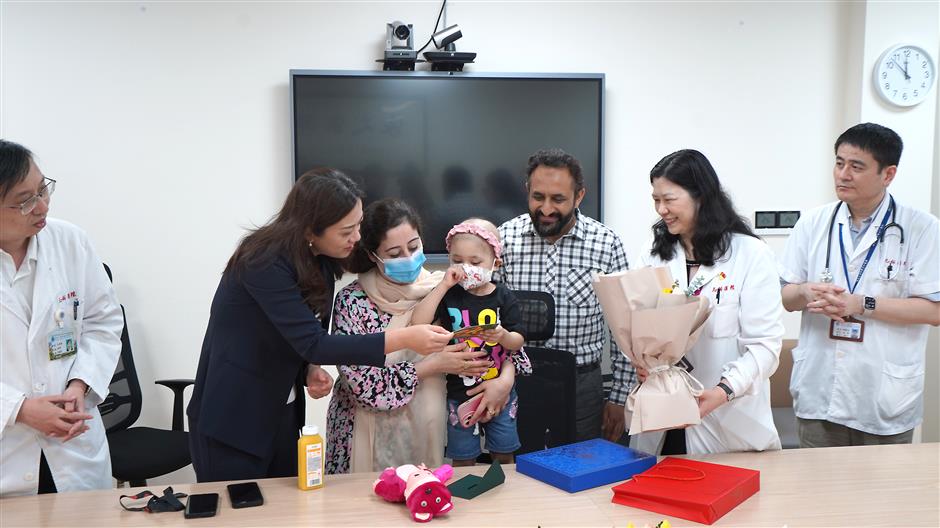
A 4-year-old Pakistani girl with a serious blood disorder – thalassemia – was treated at the Children's Hospital of Fudan University in May.
The hospital has also developed an internationally leading dual-indicator screening protocol based on large-sample, prospective research. This protocol has been included in China's authoritative textbook "Practical Neonatology " and translated into national public health policy, providing important evidence-based guidance for global congenital heart disease screening.
To date, the hospital has established nearly 100 specialized disease cohorts covering rare conditions such as Spinal Muscular Atrophy (SMA), Duchenne Muscular Dystrophy (DMD), neuroblastoma, biliary atresia, thalassemia, primary immunodeficiency, and Fabry disease.
Among them, the DMD specialized clinic receives and follows up with over 500 patient visits annually, and more than 2,000 cases with standardized clinical testing and follow-up information have been accumulated, making it the largest DMD specialized sample bank internationally.
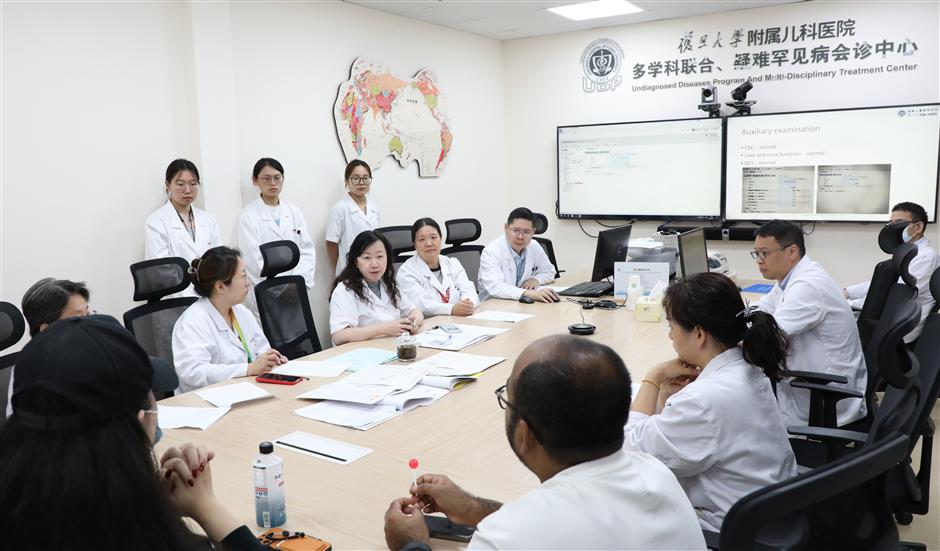
Medical experts discuss rare disease cases with the participation of family members.
The "Fudan Pediatrics" standard for rare disease diagnosis and treatment is gaining international recognition. For rare diseases such as Congenital Central Hypoventilation Syndrome, Overgrowth Syndrome, Cri-du-chat syndrome, and Spinal Muscular Atrophy with Progressive Myoclonic Epilepsy, the precise diagnosis rate through consultations exceeds 90 percent. This provides references for diagnosing and treating similar diseases, igniting hope for more affected families. The hospital has also made innovative progress in areas like epigenetic modification and novel medical device development, contributing to the high-quality development of pediatric medicine in China.
So far, the hospital has handled approximately 220,000 rare disease cases, covering about 30 percent of known rare disease types.
Hospital president Wang Yi said that efforts will continue to actively promote innovation in rare disease clinical research, basic translation, new technology application, talent cultivation systems, and the effective utilization of global collaborations and social resources. Furthermore, the hospital will leverage the comprehensive advantages of Fudan University, fulfill its role as a National Children's Medical Center, and promote rapid advancement in technology translation and innovative medical services to benefit more families with children suffering from difficult and rare diseases.
Source: City News Service
