



今日上海
“最天马行空的幻想”也能成真:想来场太空之旅吗? - 2026年02月07日
'Even the most outlandish fantasies' become possible: fancy a trip into space?
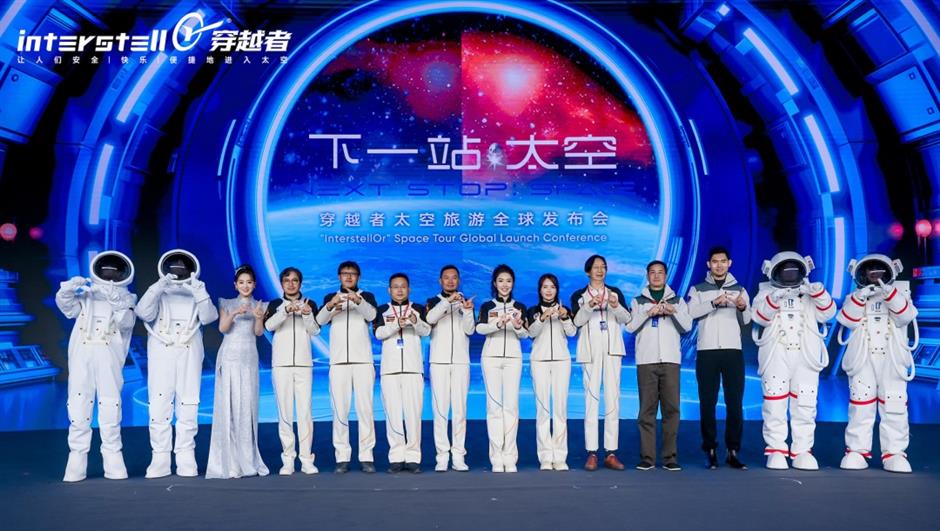 People have signed up for a suborbital space trip around 2028 offered by Beijing-based space start-up InterstellOr.
Space is no longer just a new frontier for exploring planets, moons, asteroids and distant galaxies. It's also become the newest horizon for AI data centers, advanced satellite communications and space tourism.
And China is aiming to be at the forefront of it all.
China is aggressively expanding its aerospace program to rival that of the United States. It is developing satellite clusters and orbital data centers to rival SpaceX and also exploring opportunities in commercial space tourism – an industry already tapped by Richard Branson's Virgin Galactic, Jeff Bezos' Blue Origin, which has flown 98 people into space, and Elon Musk's SpaceX, which is operating space flights on a regular basis and has already completed a commercial space walk.
Once the exclusive domain of astronauts and elite scientists, space is becoming a viable destination for a diverse new class of travelers. Wealthy tycoons, film stars and academics are now among those booking tickets. Notably, even a humanoid robot is on the passenger list, signaling China's intent to blend its world-leading robotics industry with its aerospace ambitions.
Space development is one of the centerpieces of China's 15th Five-Year Plan (2026-30), with reusable rocket technology a prime target, supported by the involvement of privately owned companies. But the element that has caught public imagination is the idea of sub-orbital space trips for paying passengers.
"Humans have dreams, and this era makes even the most outlandish fantasies possible," says Qiu Heng, chief marketing officer of Shanghai-based robotics firm AgiBot.
Last month, Beijing-based space start-up InterstellOr created a buzz on social media when it firmed up plans to send tourists into suborbital space, beginning in 2028. Qiu and actor Huang Jingyu were among the 20 or more people signed up for seats. Qiu said he managed to secure a ticket for 3 million yuan (US$430,000). Other passengers include Li Licheng, 85, of the Chinese Academy of Engineering, and PM01, a humanoid robot created by Shenzhen-based Zhongqing Robot.
InterstellOr is the second Chinese company to announce a timeline for such missions, following Jiangsu Province-based Deep Blue Aerospace, which announced in 2024 that it had already sold two tickets at 1.5 million yuan each for a suborbital rocket ride scheduled in 2027.
The InterstellOr flight in 2028 will soar up to 100 kilometers above Earth to the so-called Karman line where space begins. The trip will last 2.5 hours, including up to 6 minutes of weightlessness, and the ride doesn't require extensive astronaut training.
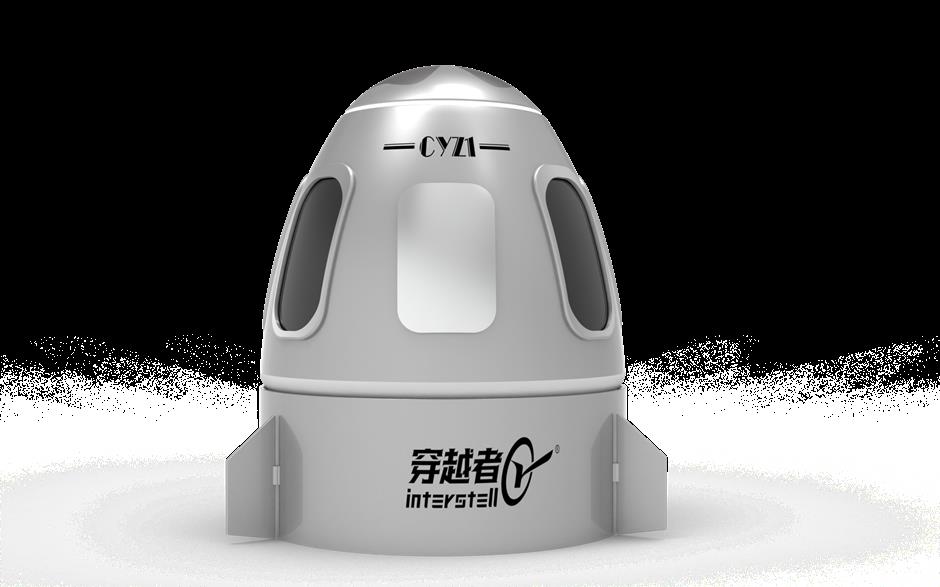 InterstellOr's Spacecraft for the voyage
Gazing back on beautiful Earth
Qiu, a former marketing manager at tech giant Huawei, said he has visited dozens of countries, but his lifelong dream has been "to fly into space and gaze back at our beautiful Earth." After attending numerous rocket launches and even collecting stones scorched by flames near launch sites, he put his name on the list for a flight, paying an upfront deposit of 300,000 yuan. The cost doesn't bother him. He calls it a "a fair deal" for a history-making trip.
But for space travel to become more mainstream, costs must fall.
Lei Shiqing, founder of InterstellOr and a former China Central Television space broadcaster, said she believes the industry will see "explosive growth" by around 2030. She said the company's goal is to reduce the costs and put space travel within the reach of more people.
There's no doubt about the public zeal for a ride into space.
Actor Huang enthused on social media, "It's an honor to become a space traveler, especially boarding a spacecraft built by the Chinese people, to reach the sea of stars."
China is racing to catch up with the US. Craig Curran, president of the US-based DePrez Group of Travel Companies and an agent for Virgin Galactic space flights, told Singapore's The Straits Times that China is now where the US industry was 10 to 15 years ago, but it is fast closing the gap.
Curran, who noted that key principals in InterstellOr don't have aerospace credentials but come instead from backgrounds in broadcasting, business administration and applied psychology, said space travel requires vast technical hurdles to overcome to achieve safe and reliable launches for people. Delays experienced by companies such as Blue Origin and Virgin Galactic may well affect Chinese space tourism timetables, he added.
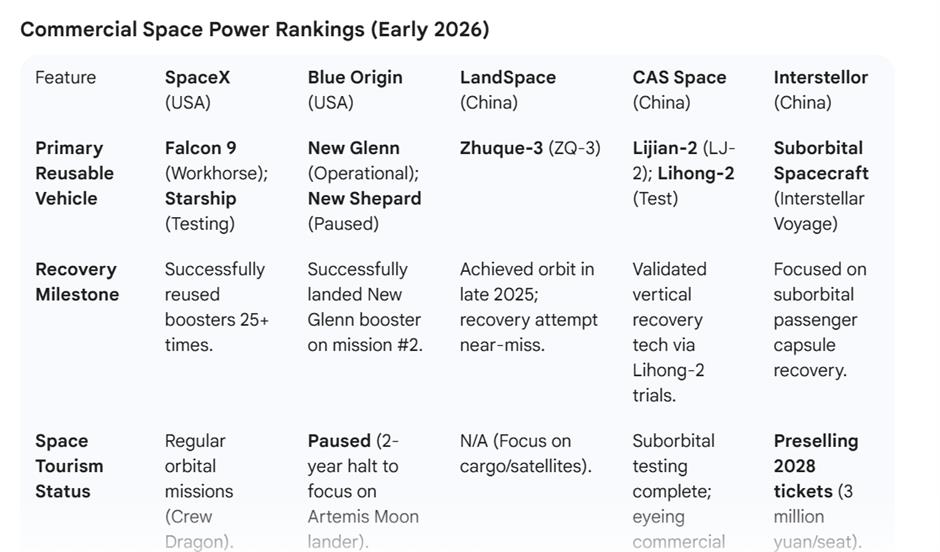 Chinese and American firms' space tourism roadmaps, according to CBB and Gemini
Reusable rockets a vital key
Space tourism will remain a niche market in the short term. Its development hinges heavily on the development of reusable rockets, which are also a key factor in China's ambitious plans to create a vast low-orbital constellation of communications satellites.
China has applied to the International Telecommunications Union with plans to launch nearly 200,000 satellites that would create the world's largest internet constellation. Industry experts predict China will conduct about 500 satellite launches under the current five-year plan, and by 2030, its satellite internet market value will hit over 1 trillion yuan.
China's commercial space companies, including LandSpace Technology, Galactic Energy and CAS Space, are accelerating plans for reusable rockets. Shi Xiaoning, vice president of CAS, said 2026 will be a pivotal year for suborbital reusable vehicles that cut costs and relaunch times. His company has conducted multiple suborbital flights of its Lihong-2 rocket and is pursuing a dual development track combining small expendable rockets for ride-sharing launches with larger reusable vehicles for satellite internet constellations.
LandSpace said its Zhuque-3 rocket aims to achieve first-stage recovery and re-flight this year, before moving into mass production with an annual capacity of up to 30 launches. The company plans further upgrades to boost payload capacity.
Galactic Energy is targeting the maiden flight of its Pallas-2 reusable rocket by the end of 2026, leveraging 100-ton-class engines and 3D-printed components to reduce weight and costs.
China's space companies are turning to capital markets for funding. LandSpace has applied for an initial public offering on the tech startup STAR Market in Shanghai, seeking to raise 7.5 billion yuan. More companies are expected to follow
Shanghai and the Yangtze River Delta region are key hubs for China's commercial space industry.
Guo Kangxi, a deputy in Shanghai People's Congress and chairman of the Shanghai-Hong Kong International Consulting Group, has proposed measures to accelerate space industry development, with an emphasis on rocket technologies needed for enhanced commercial launches.
Digital computing in space
China's space ambitions don't end there. The nation's main space contractor, China Aerospace Science & Technology Corp, said it is planning to construct orbital AI infrastructure to meet terrestrial computing demands and compete with SpaceX.
Orbiting AI data centers can tap the stronger solar power outside the Earth's atmosphere to reduce costs and allow transmissions back to earth in split seconds. Alibaba Cloud's Qwen-3 was one of the first general-purpose AI models to be operated in orbit, marking a milestone for China.
This new "space race" isn't just about humans. Robotics also plays into the industrial mix.
Robotic arms are already used in space station operations and in payload handling. China, the world's leading robot maker, is keen to test how robots can perform maintenance and other functions in low-gravity environments before humans establish permanent lunar bases.
As science presses ever further into space, robots are expected to provide critical support for human exploration of unknown territories of hostile environments. Quadrupedal and humanoid robots can undertake tasks such as material transport, facility patrols and equipment inspections at extraterrestrial bases, according to AgiBot, which ranked first in the world in robot sales last year.
Source: City News Service
