



今日上海
上海最后一家报刊亭焕发新生机 - 2026年03月05日
Shanghai's last newsstand finds new lease of life
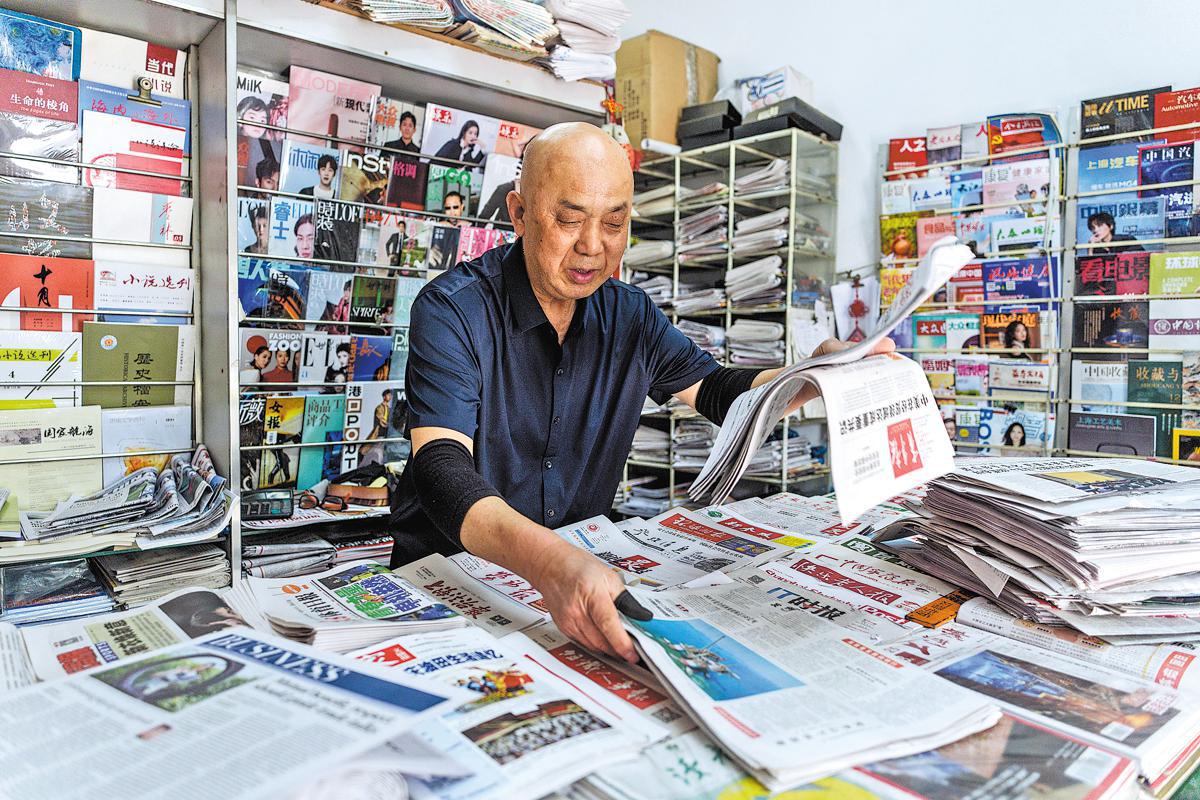 Jiang Jun organizes different newspapers at the newsstand's old location at Wusong Road in Shanghai's Hongkou district last year.
 Shanghai's last remaining newsstand is experiencing what the operator called "its best business" in history following its relocation on New Year's Day, which attracted significant media attention and drew in both new and returning customers.
The newsstand operator, 67-year-old Jiang Jun, who has dedicated his life to selling newspapers, said that since the move, daily foot traffic has nearly doubled, with a noticeable increase in younger customers. The shop's location on Hongkou district's Zhapu Road, which is not far from the Bund, has allowed it to become a popular weekend destination for young residents and tourists.
This newsstand, which has been in existence for more than two decades, is dubbed a "living fossil" of Shanghai's print retail industry by local media.
"I have been selling newspapers for 38 years, not out of personal perseverance, but constantly driven by the demand from readers," said Jiang, a Shanghai native.
"The presence of these readers reassures me that even in today's media landscape dominated by new media, traditional print still holds irreplaceable market and social values," he said.
Jiang started managing print retail in the postal system in 1988. Two years later, he was recognized as a national model worker in the postal system for selling 600,000 newspapers annually and generating nearly 120,000 yuan ($17,200) in revenue. For decades, his daily routine was to set out at 4:30 am every morning to pick up newspapers from the printing factory, open his shop before 6 am, and work until after 6 pm, without taking a single day off all year round.
In 2019, when he was supposed to retire at age 60, the closure of thousands of newsstands in Shanghai, due to the impact of new media and disordered business models, left this newsstand, located 200 meters from his current shop, as the last remaining in the city.
To ensure readers could still purchase newspapers offline, Jiang chose to postpone his retirement and continue managing the stand.
"By that time, I had worked at the shop for 32 years. I devoted a lot of effort to this job. I didn't take a single day off, working 14 hours a day on average, and sometimes even up to 18 hours," he said.
Last year, due to age and labor regulations, Jiang and the leaders at the postal system reached an agreement to close the shop by year's end. However, the closure notice on the door sparked public interest, leading to offers of rent-free locations from various district governments, office parks and cultural institutions. Eventually, the shop relocated to a site near Shengli (meaning victory) Cinema in a cultural zone. This site is provided by the cinema for free.
Jiang explained that he chose this location because it is close to the original store, making it convenient for long-time readers to find. Additionally, the current shop is over 30 square meters, which is more spacious than the previous one, allowing for more display racks for newspapers and magazines, and making it easier for readers to come in and browse. In the shop, readers can find over 1,000 different newspapers and magazines.
The relocation has been widely covered by the media, drawing visitors of all ages. A primary school student, after watching a live broadcast by local media from the store, specifically came to visit with his father. The boy purchased 424 yuan worth of newspapers and magazines, including those on science and humanities.
"We encourage the child to read more books and spend less time on electronic devices, but such advice comes in vain all the time. This time, however, the child took the initiative to buy newspapers and magazines, which we parents believe is very positive for his development," said Qi Feng, the father, 42.
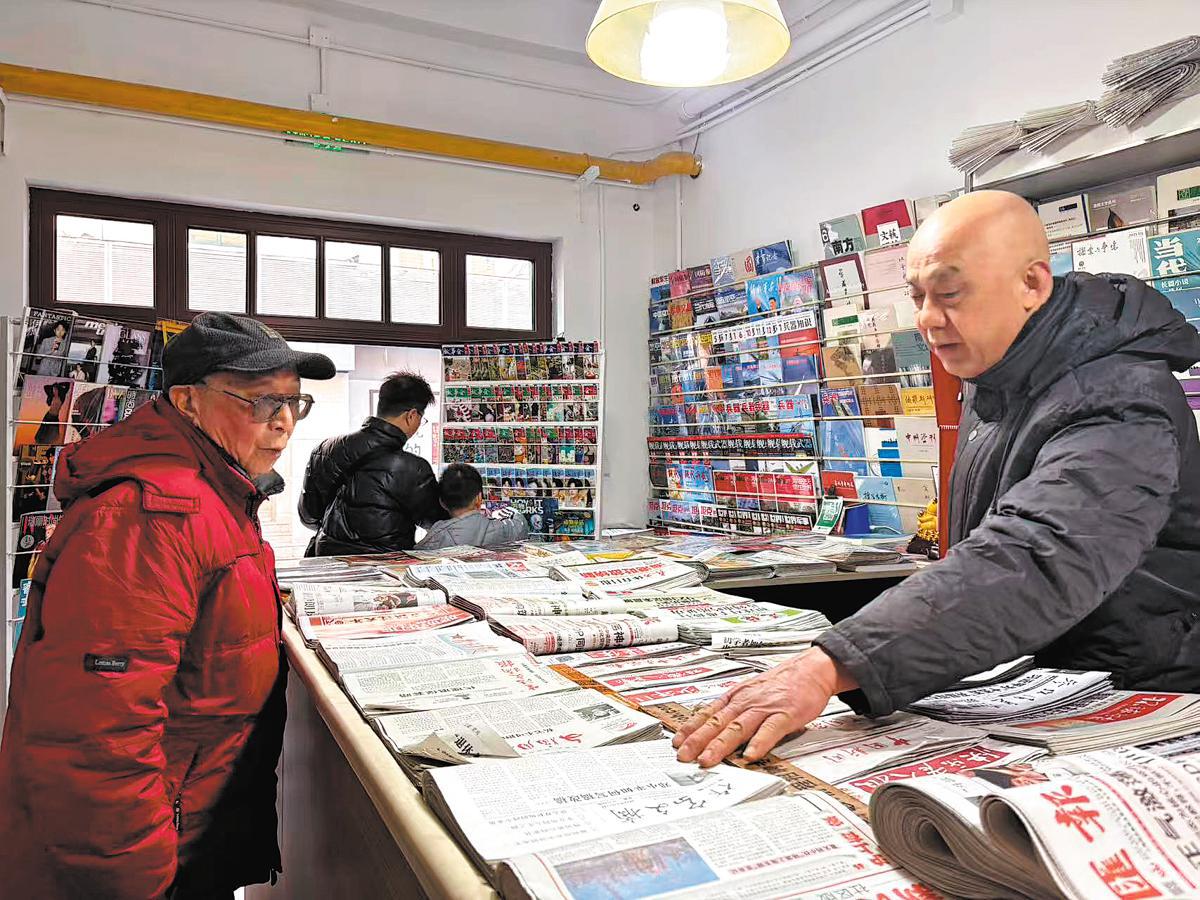 Jiang serves customers at the newsstand's new site at Zhapu Road in January.
 Another customer who impressed Jiang was a university student who sought a specific issue of the People's Daily several months ago that featured an article about his professor's research. He was excited to find what he wanted at the shop, and spent over 2,000 yuan on additional publications to share with dormmates.
Jiang observed that, contrary to popular belief, most of his customers are young to middle-aged groups.
"Also, such individuals are stronger in consumption power. They often buy multiple publications at once after browsing this and that. In contrast, older customers typically purchase a single newspaper daily out of habit," he said.
Chen Zaixuan, a 16-year-old high school student living in Pudong New Area, takes a round-trip bus ride of more than an hour every week to visit the store and buy magazines. For him, this is like a weekly trip to a bookstore, a habit he has maintained for nearly two years. He typically purchases magazines on current affairs, natural sciences, and literature.
The shop's history reflects the broader evolution of Shanghai's print retail industry. In the late 1990s and early 2000s, thousands of newsstands were cultural landmarks in the city. The rise of mobile internet led to their gradual decline after 2010.
However, there is still a dedicated group of readers for print publications. Jiang mentioned that 70 percent of his hundreds of WeChat contacts are readers. Every day, he receives messages asking him to reserve a specific newspaper for a specific date so readers can pick it up later at the store. There are also readers from outside of Shanghai who ask him to mail the publications to them.
Long-time customer Wang Kai, born in 1981, continues to prefer printed newspapers for his reading habits. He visited the store to buy the Economic Observer, which he started reading from the first issue in the early 2000s, back in his university days.
"I followed it up to around issue 1,000. But for some years, I couldn't find a place to buy it, so I stopped," he said, holding the latest issue, the 1,255th, published on Jan 19.
"Although community service centers and libraries also have newspapers and magazines, I can't annotate or cut out borrowed materials, which doesn't suit my reading habits. So, when I come across something I like to read, I still prefer to buy it and take it home," he said.
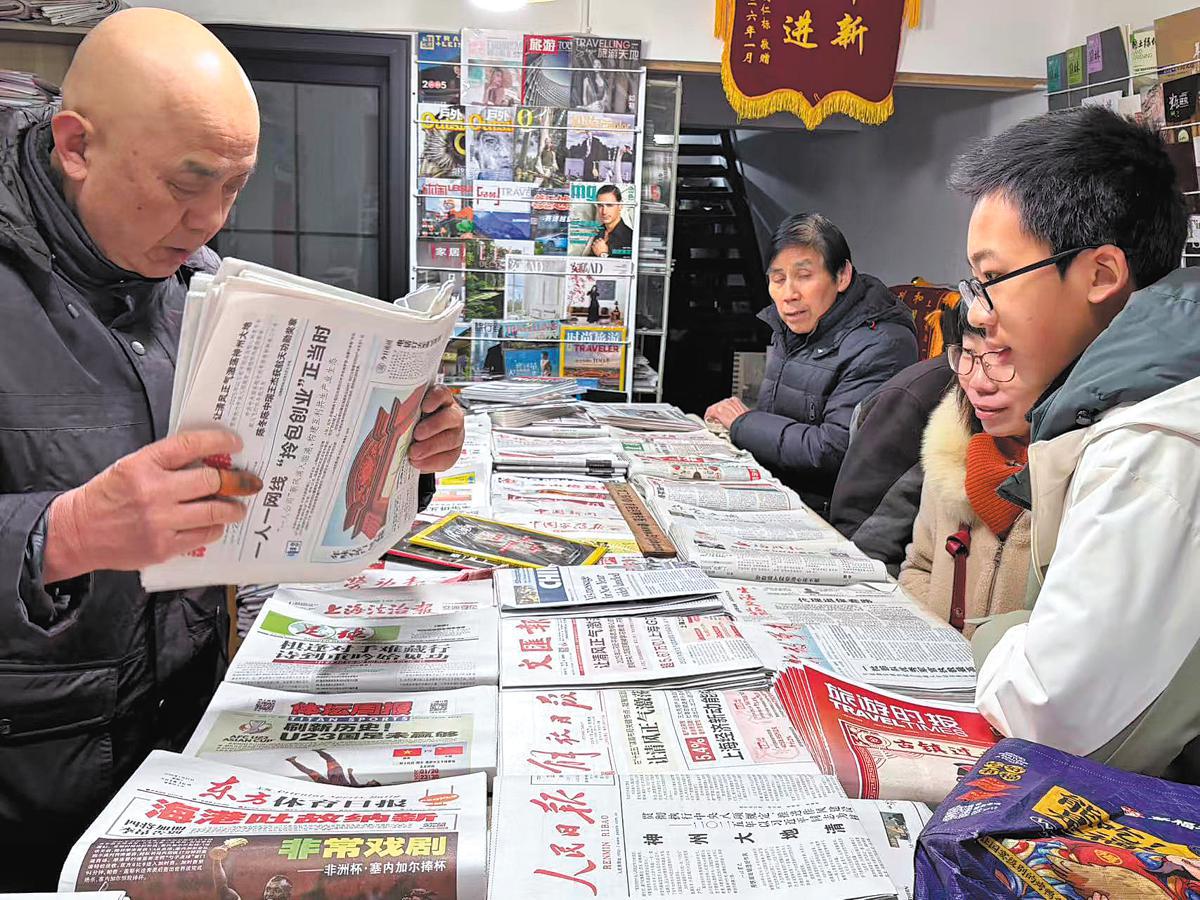 Chen Zaixuan (right), a 16-year-old high school student, buys magazines at the newsstand operated by Jiang Jun (left) on Jan 22. Chen has kept the habit of coming to the newsstand to buy publications once a week for nearly two years.
Another customer, who only gave his surname, Wang, lives 10 km away in Xuhui district, and made a special trip to the store to buy several newspapers on current affairs and sports. He said he reads newspapers because he wants to break away from the era of algorithm-driven content and engage in active reading.
Reading on a smartphone may seem convenient, but the content is controlled by algorithms that tailor push notifications to personal preferences, said Wang. Everybody ends up seeing content limited to their own understanding, which narrows their perspective, he said.
"In contrast, print publications present content from the perspective of media and journalists, allowing people to break out of the filter bubble and understand things from different viewpoints," said the 39-year-old aviation engineering designer.
Moreover, he added that print publications have a collectible value, helping to preserve memories.
"For instance, with the U23 Asian Cup of soccer, where the Chinese team reached the finals, I really want to keep the news reports from now on. In a few years, say when the team reaches the finals again, I can look back at these reports," said Wang.
"The last time the Chinese men's football team reached the finals of an Asian national team event was in 2004, and I still have that newspaper. I think it's very meaningful," he said.
Some sociologists believed that the pressure on the last newsstand should not be borne solely by individuals, and that the cultural value of newsstands may far exceed their commercial value.
"For now, the relocation of the last newsstand has reached a comedic conclusion. As cities need cultural vitality and physical cultural entities, I hope that this should not remain a unique case in the future," said Li Yizhong, a professor at the School of Media and Communication, Shanghai Jiao Tong University.
Source: China Daily
