


今日上海
确保未来五年的进步与稳定 - 2026年03月08日
Ensuring progress and stability over the next five years
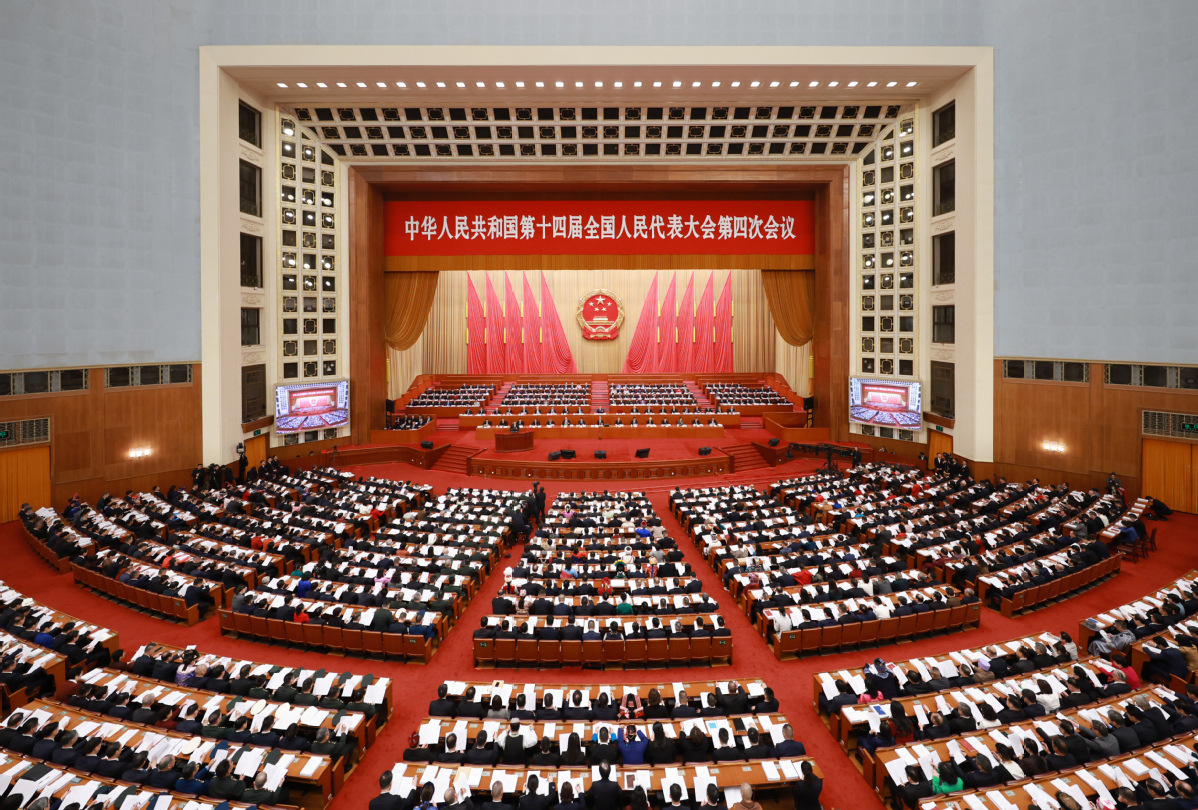
The 14th National People's Congress, China's top legislature, opens its fourth session at the Great Hall of the People in Beijing last Thursday.
Pursuing progress while ensuring stability, driving the future through innovation
China's 2026 government work report, framed within the broader goal of high-quality development, sets out clear priorities for the country's economic and social progress. It conveys a strong policy orientation of pursuing progress while maintaining stability, promoting stability through progress, and establishing before breaking, offering both a roadmap and practical guidance for sustaining economic momentum and strengthening technological self-reliance.
The report outlines pragmatic and steady economic targets, reflecting confidence and strategic composure. The projected annual growth rate of 4.5 to 5 percent aligns with China's long-term development strategy while balancing key priorities such as employment, price stability and environmental protection. This approach underscores the integration of growth and quality, development and security. Among the policy priorities, building a strong domestic market is placed at the forefront, with greater emphasis on demand-driven growth. This strategy responds to an increasingly uncertain global environment while addressing the current structural imbalance between strong supply capacity and relatively weak domestic demand, creating space for economic restructuring and new growth drivers.
Innovation is placed at the center of the development agenda, with emerging industries expected to accelerate growth momentum. The report identifies scientific and technological innovation as the core engine of high-quality development and emphasizes strengthening the real economy. Key sectors — including integrated circuits, aerospace, biomedicine and the low-altitude economy — are highlighted as emerging pillars, while future industries such as advanced energy, quantum technology, embodied intelligence, brain-computer interfaces and 6G communications are also mapped out. The expansion of "AI Plus" applications, stronger support for enterprises as the main drivers of innovation, and efforts to scale up technological breakthroughs all aim to deepen the integration of innovation, industry, finance and talent, injecting sustained dynamism into economic transformation.
Ensuring stability while seeking progress will consolidate the foundations of development, while innovation will open new horizons. As 2026 marks the opening year of the 15th Five-Year Plan period, the report stabilizes expectations through realistic targets and unlocks new momentum through forward-looking innovation strategies. Together, these measures will help China enhance quality and efficiency during economic transformation, maintain steady progress through greater openness and cooperation, and lay a solid foundation for building a modern socialist country in the years ahead.
The author is Fan Xin, deputy head at the School of Economics, Renmin University of China.
Steady progress, innovation at the core
China's 2026 government work report, marking the opening year of the 15th Five-Year Plan period, underscores a policy approach of pursuing progress while ensuring stability. With a balanced focus on economic targets and technological innovation, the report combines near-term feasibility with long-term vision while highlighting the role of new quality productive forces in driving high-quality development.
First, stability with forward momentum: pragmatic economic targets. The report sets the GDP growth target for 2026 at 4.5 to 5 percent, including the creation of over 12 million new urban jobs. These targets reflect current domestic and international conditions while leaving room for economic restructuring and the transition to new growth drivers. Fiscal and monetary policies are expected to work in tandem to expand domestic demand, stabilize investment, support trade-in programs for consumer goods, and accelerate major infrastructure projects. Rather than pursuing rapid expansion, the focus is on stability, efficiency and sustainable quality growth, laying a solid foundation for livelihoods and risk management.
Second, innovation as the key driver: technology and new productive forces at the forefront. Scientific and technological innovation are positioned as the central engine of development. The report calls for deepening the "AI Plus" initiative, building large-scale intelligent computing clusters and satellite internet infrastructure, and accelerating the commercialization and widespread application of AI. It also identifies integrated circuits, the low-altitude economy and biomedicine as emerging pillar industries, while planning ahead for future sectors such as quantum technology, brain-computer interfaces and 6G communications. With the support of "patient capital", these initiatives aim to nurture innovative enterprises and strengthen the entire chain from technological breakthroughs to industrial transformation and ecosystem development.
Overall, the 2026 government work report strikes a balance between stabilizing the present and shaping the future. By integrating technological innovation with industrial upgrading, it both anchors economic fundamentals and positions China to seize new opportunities in the global innovation landscape, providing a clear direction for the country's economic and social development in the years to come.
The author is Yang Guoliang, a professor at the Institutes of Science and Development, University of Chinese Academy of Sciences.
China committed to driving development through science and technology innovation
The 2026 government work report mentions many achievements made in the science and technology sector. Last year, China's R&D spending reached 2.8 percent of GDP, and the value of technology contract transactions increased by 10.8 percent. The integration of technological and industrial innovation has picked up pace; the transformation and upgrading of traditional industries has continued; emerging industries and industries of the future achieved impressive growth; and rapid development was sustained in modern services. The industrial application of artificial intelligence gathered pace, and new intelligent terminals emerged continuously.
During the 14th Five-Year Plan (2021-25) period, China's momentum for scientific and technological innovation remained robust, with new drivers generated by innovation emerging as fresh engines of economic growth. High-tech industries and strategic emerging industries have significantly strengthened their support for economic expansion, acting as accelerators in the transition from old growth drivers to new ones. Future-oriented industries, including artificial intelligence, brain-computer interfaces, biomanufacturing, quantum information, humanoid robotics and new types of energy storage are rapidly taking shape as sources of new quality productive forces.
China vows to focus on high-quality development in the 15th Five-Year Plan (2026-30) period, requiring the promotion of new quality productive forces driven by science and technology innovation. In order to do so, the government will enhance the foundational capabilities and competitiveness of industries, foster new industries and emerging growth sectors, advance breakthroughs in frontier technologies, and strengthen fundamental innovation capacity.
This year carries important historical significance as it marks the opening of the 15th Five-Year Plan period, linking the past with the future to ensure a strong start to the new plan. In light of the current domestic and international economic landscape, as well as the challenges facing innovation-driven development, the government work report has identified the need to foster new growth drivers at a faster pace, and develop new quality productive forces in light of local conditions.
At the same time, China will continue to build a modernized industry system, moving faster to achieve greater self-reliance and strength in science and technology, and seizing the historic opportunities emerging from the latest round of technological revolution and industrial transformation to raise innovation capacity across the board and provide the scientific and technological underpinning needed for high-quality development.
The author is Sui Jigang, director of the Institute of Innovation and Development Policy, Chinese Academy of Sciences' Institutes of Science and Development.
Source: China Daily
