



今日上海
大西洋两岸的分歧凸显了美国让权力感凌驾于判断之上所带来的影响 - 2026年03月19日
Transatlantic divide highlights impacts of US letting sense of power override judgment
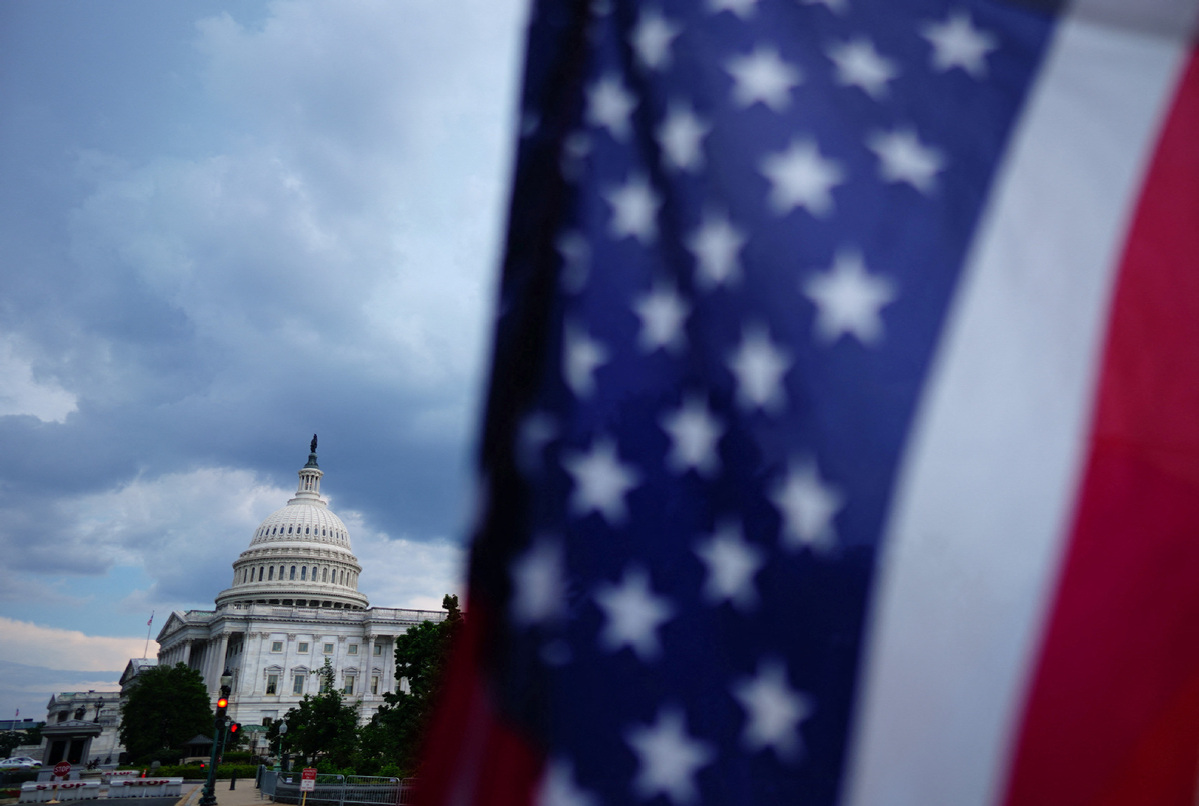 The US Capitol stands behind a US flag on Capitol Hill in Washington, DC, US, June 29, 2025.
 The Iran conflict is becoming a Rorschach test for the transatlantic alliance. What Washington frames as a test of resolve, many of its NATO partners see as a failure of judgment. The latest bone of contention — whether to accede to a United States demand that they participate in escort missions in the Strait of Hormuz — has laid bare a familiar but deepening divide: not over burden-sharing, but over the wisdom and legitimacy of the mission itself.
For the US, the argument is straightforward. The consumers of the oil and gas flowing through the strait are obliged to protect its security. Yet for many allies, the issue is not whether the waterway matters — it plainly does — but the fact that it was Washington's precipitous actions that caused the crisis. That distinction separates traditional alliance solidarity from what some now fear would amount to complicity in a conflict they neither sought nor support.
The hesitation in European capitals is therefore less about capability than about consent. Behind closed doors, officials speak of strategic deja vu: a sense that Washington is once again asking its allies to manage the consequences of a policy they had little role in shaping. Participation also risks legitimizing a chain of escalation that many believe could and should be avoided.
The split reflects a deeper worry that alliance mechanisms are being bypassed at precisely the moment they are most needed.
This unease is not confined to the far side of the Atlantic. Within the US itself, the Iran conflict has exposed fractures. The resignation of National Counterterrorism Center Director Joe Kent — in protest against the US administration's Iran policy — is telling. In a letter posted on X, the US administration's top counterterrorism official said that Iran posed "no imminent threat" to the US and claimed Washington "started this war due to pressure from Israel and its powerful American lobby".
Such resignations are rare, and when they do occur, they point to a breakdown in internal consensus over both the ends and the means. The official's departure underscores a broader anxiety within the US security establishment that the current trajectory risks strategic overreach. Escalation of the situation in the Middle East, once set in motion, is unlikely to remain neatly contained. The fear in Washington's more rational quarters is not simply of war, but of mission creep — of sliding into a wider conflict without any clearly defined objective.
Kent's concern is justified as apparently Israel has its own calculus, one that does not always align neatly with that of its principal ally. With the US preoccupied with Iran, Israel's expanding military operations in Lebanon — alongside its broader regional posture — suggest a determination to reshape the strategic environment while the spotlight remains fixed on Iran.
In doing so, Israel is advancing objectives long constrained by practical limits, making it the main beneficiary of the Iran conflict. Reports of escalating ground operations in Lebanon and widening theaters of engagement reinforce the sense that Israel is moving decisively to lock in territorial gains that had previously remained out of reach. Yet these parallel agendas risk compounding the very instability they purportedly seek to address. What appears tactically advantageous in one theater is strategically destabilizing across the region. The danger is not merely of escalation between states, but of cascading effects — proxy conflicts, disrupted supply chains and an expanding arc of insecurity.
Nowhere is this more evident than in global energy markets. Even before the latest flare-up, supply conditions were tightening. The disruption — and even the credible threat of disruption — to shipping through the Strait of Hormuz has amplified those pressures. Since liquefied natural gas is hard to store, a more urgent but ignored world energy crisis is unfolding in the LNG sector. Many economies' oil reserves can last months, but their LNG reserves only weeks.
The broader global economy, still recovering from successive shocks, is ill-equipped to absorb another prolonged crisis. Uncertainty is fast becoming the dominant currency — in markets, in diplomacy, and in security calculations. The longer the conflict endures, the greater the risk that temporary disruption hardens into structural strain.
Leadership in such moments is not measured solely by the willingness to act, but by having the wisdom to recalibrate. The US retains unparalleled capacity to shape the trajectory of this conflict — not only through military means, but through diplomacy. What makes reopening the diplomatic channel difficult is not only that the US and Israel attacked Iran while diplomatic endeavors — by all accounts, seemingly fruitful — were underway, but also the fact that so many senior officials of Iran have already been eliminated, including those pushing for diplomatic solutions.
History offers clear lessons: conflicts rarely yield to force alone. They require negotiation, however unpalatable, and a recognition that de-escalation is not a concession, but a necessity.
If Washington is to rebuild confidence among its allies — and restore coherence within its own ranks — it should accept this reality. Taking the lead in pursuing a ceasefire would not signal weakness; it would demonstrate strategic clarity. It would also provide a pathway to align efforts behind a common objective rather than a contested premise.
The alternative? The Iran conflict will become a quagmire for both the US and Israel.
Source: China Daily
