



今日上海
更精简,更高效——一人公司正在改变我们的工作方式 - 2026年05月20日
Leaner, keener — OPCs altering way we work
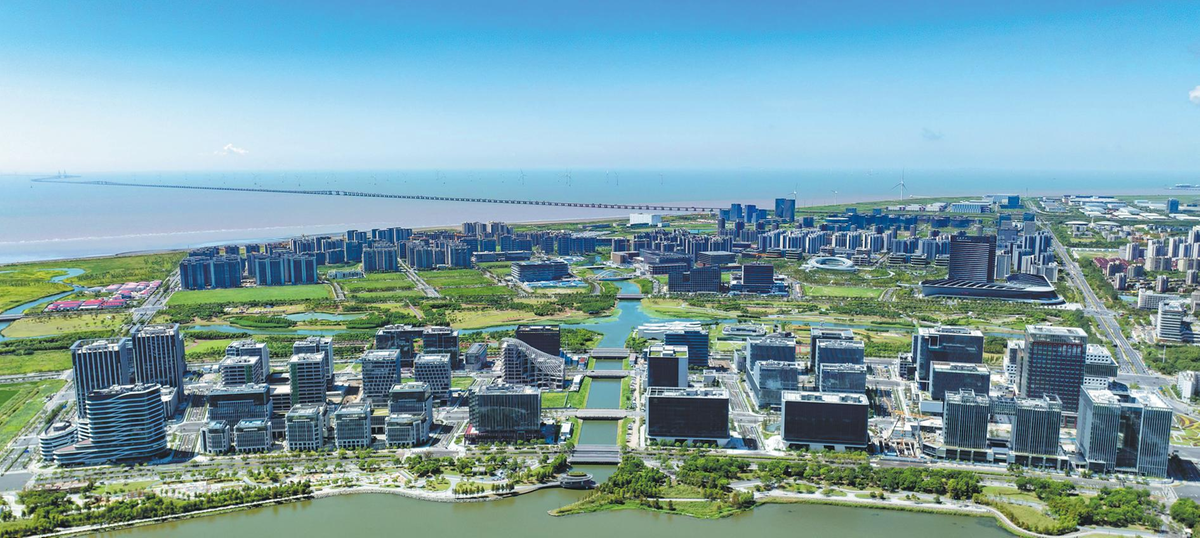
The one-person company (OPC) community in Lin-gang Special Area, which is part of the China (Shanghai) Pilot Free Trade Zone, has attracted over 500 such entities. The Lin-gang administration introduced a set of special measures in early April to facilitate the development of these companies.
Shanghai is positioning itself as the center of the coming one-person company (OPC) wave, which, with the help of artificial intelligence, is radically changing the way many people work, experts said.
Lujiazui Financial City in Pudong New Area is home to over 8,000 licensed financial companies. On April 28, it founded the Cyber Harbor OPC Community. In less than one week, over 30 OPCs started operating in the newly opened space.
Nan Chuan, founder of the OPC lovstudio.ai, is one of the original tenants of the community. Starting his own business in 2023, Nan has developed over 10 AI-powered developer tools, which can significantly improve efficiency in content creation and company operations.
"Favorable policies such as capital, compute power or housing subsidies are not the primary reasons bringing me here. This place has the right 'vibe'. I can discuss artificial general intelligence with all the other OPC founders here all the time. More importantly, the community operator is a true believer in the transformative power of AI as well as the heavy use of AI tools," he said.
'Cheaper, better'
OPCs are rapidly emerging as a defining feature of China's digital economy, prompting local governments to rethink how they can support and scale entrepreneurship.
The leapfrogging progress in AI, which makes technology cheaper and more accessible, has catalyzed the mushrooming of these entities. By mid-2025, China had more than 16 million one-person limited liability companies, according to a report by the Zhongguancun Talent Association.
AI tools — from code generators to content engines — are dramatically lowering the cost of starting and running a company. In 2010, for instance, building a software-as-a-service product required a small engineering team and an infrastructure budget of over $50,000.
But in 2026, a single founder using coding tools like Claude Code or Cursor, can come up with a product in under 30 days, costing less than $200 per month in tooling.
Every 1 yuan ($0.15) of AI investment at an OPC equates to 72 yuan of expenditure on human capital, according to Honghub, a Hangzhou-based OPC community founded in September in Zhejiang province.
"In places with higher human capital costs, the efficiency of AI tools in replacing equivalent human labor costs is more noticeable. As AI programming capabilities continue to improve, the corresponding efficiency gains will be further amplified," said Honghub's co-founder Zhou Zhuoran.
Zeng Gang, director of the Institute of Urban Development at East China Normal University, explained that OPCs outsource their non-prime functions to AIs. They have a strong demand for networked social collaboration and intelligent agent tools such as OpenClaw.
"Ever since the surge of hard technology companies such as DeepSeek and Unitree Robotics, governments have come to realize that disruptive forces that burst from individuals or small groups may serve as the key engines of industrial revolution," he said.
Given their smaller size, OPCs have advantages in quick decision-making, high innovation flexibility, and low costs of trial and error. They naturally fit into the role of new forces seeking active breakthroughs in hard technologies, said Zeng.
The majority of the current OPC founders, about 75 percent, have no background in technology. Product managers, content creators, designers and industry experts constitute the diverse backgrounds, according to Honghub.
 A global OPC digital innovation and entrepreneurship competition is held in Lin-gang on Dec 18.
 Powerful tools
Zhang Chenchen is a screenwriter based in Shanghai. It took her six years to have one of her works debut on a local TV station, and eight years for another to be picked up by an online video platform.
It often takes years for a script to go from a concept to the screen, with dozens of revisions unavoidable. But now, with AI video generation tools, it is possible to produce in a single day audiovisual material lasting up to 10 minutes, said Zhang.
"It was impossible for ordinary people to come up with TV series, which need the collaboration of directors, actors, and cinematographers, among others. That means stratospheric costs. But everyone can produce a film or TV series by using AI," she said.
At the end of last year, Shanghai-based AI giant SenseTime launched its AI video generation platform, Seko.
Zhang tried entering prompts and debugging the storyboard with the tool. One week later, she decided to set up her own OPC. Shortly after Spring Festival, she moved into an OPC community in central Shanghai's Xuhui district.
She is now preparing her first AI-powered short drama series. "The script failed to be sold years ago. But luckily, it will become my own IP with the help of AI," she said.
Zhang Yunyun set up her own OPC in Lingang Special Area in eastern Shanghai late last year. With the help of OpenClaw, she built a stand-alone internet literature website within two days on her own, targeting readers overseas.
"There are options, like hiring freelancers. But the interface churned out by OpenClaw is more refined and its performance is more complete," she said.
But there is one drawback of using AI — Zhang quickly used up all the free compute power. "Compute power is expensive. It is way too easy to burn through," she said.
In early April, Lin-gang administration introduced special measures that entitle every OPC to a free computing quota of 100 GPU-card-hours over half a month. The amount is enough to train a mid-sized AI model prototype and test whether a product is feasible for investment, a process that typically takes about two weeks.
However, the amount of compute power will soon be insufficient as OPCs become increasingly reliant on agent tools in their daily activities, said Shen Zhen, general manager of China Telecom's Lin-gang branch.
Costs are going to take off, and are expected to top 8,000 yuan per person every month, he said.
"This will be a huge burden for OPCs that are just getting started. Therefore, compute subsidies are essential for supporting the development of these entities," he said.
Honghub's Zhou said an OPC can be defined as a "complex" comprised of one person and AI infrastructure. In this context, compute power can be considered part of the AI infrastructure.
Aware of this, local governments have stepped in to build OPC communities and industrial parks where subsidies and free compute power are provided.
Compute power coupons, model vouchers, and corpus subsidies provided to OPCs in Zhangjiang Science City — a national-level innovation hub in eastern Shanghai — were the major reasons for Kong Xiangyu setting up his education-focused OPC in the location.
"These are basically the biggest concerns for OPCs at the very early stage as they incur the most costs. With these barriers removed, OPCs can make more aggressive moves," Kong said.
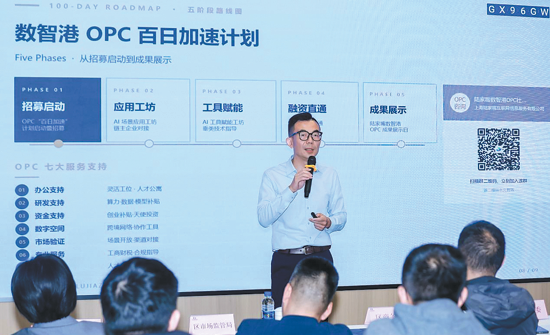 Huang Liang, head of industrial service provider Cyber Harbor based in Shanghai's Pudong New Area, gives a keynote speech for the official opening of its OPC community in April.
Widespread competition
So far, Shanghai has built nearly 20 OPC communities. In Lin-gang Special Area alone, 10 such communities will be built in the coming three years, with the special area looking to attract 1,000 teams and 10,000 entrepreneurs over the same period.
The Shanghai municipal government proposed building an OPC innovation and entrepreneurship ecosystem in its 15th Five-Year Plan (2026–30) guidelines.
In July, the municipal government announced several measures to further broaden the application of AI and boost the development of the city as an AI powerhouse. They include offering 600 million yuan worth of computing vouchers, 300 million yuan of model vouchers, and 100 million yuan of dataset vouchers. In addition, subsidies will be offered to cover up to 30 percent of computing rental costs and up to 50 percent of model application programming interface costs. The city is also building a national computing interconnectivity network with unified standards.
Looking beyond Shanghai, the entire Yangtze River Delta region has been riding the OPC wave.
Suzhou, in neighboring Jiangsu province, announced in November plans to build more than 30 OPC communities, cultivate 1,000 new OPC enterprises, and attract over 10,000 OPC talents by 2028.
In March, an international AI community in Changzhou, Jiangsu, launched a 100 million yuan OPC fund, offering up to 5 million yuan in equity investment for projects that qualify for it.
Jiangsu's capital city, Nanjing, has established a 10 million yuan proof-of-concept pool in one of its OPC communities, offering up to 500,000 yuan to individual early-stage projects and another 200 million yuan via a talent fund.
Shen Hao, chief engineer of the Shanghai Artificial Intelligence Research Institute, said local governments have acted quickly, mainly because they want to seize the next "intersection" of the industrial revolution, where rapidly evolving AI agents meet the entrepreneurial rise of the "mental labor" of individual businesses.
Different cities have different advantages.
Shanghai has a multiplicity of scenarios for commercialization, while Hangzhou boasts a solid data reserve thanks to its long history of e-commerce.
Lower level governments, such as districts, should play a bigger role in the development of OPCs as they are even closer to the market. Government bodies can quickly adjust their policies in response to the latest technology upgrades, leading to an exponential influence over industries, Shen said.
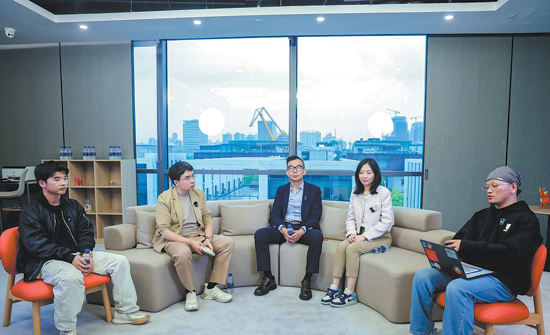 Nan Chuan (far right), founder of the OPC lovstudio.ai, shares his thoughts during a panel discussion during the community's opening ceremony in late April.
 Physical changes
The rise of OPC communities has echoes of the global co-working boom that emerged around 2015, which saw individuals sharing work spaces, ideas and equipment.
Both tend to serve smaller enterprises. Flexibility is the major feature of co-working, while OPC communities emphasize the coordination and integration of resources and industrial ecosystems, said Zhang Xiaoduan, deputy head of the Cushman & Wakefield Research Institute.
Zhang Fan, deputy head of the Shenzhen-based Mingyuan Real Estate Research Institute, said the demand for large traditional office spaces has fallen since last year, and that gap has been filled by OPC communities. Small workstations and "micro offices" have become a basic market need.
The business model of traditional commercial real estate will be changed fundamentally as OPCs proliferate. Office buildings and industrial parks will have to change their "business-attraction" model into a "business-cultivation" model, Zhang said.
"While they used to be 'fruit pickers', they need to plant and tend young trees in the future," he said.
Also facing fundamental change is the future of the workplace. A prelude was sounded by the rise of contracting businesses more than a decade ago, said Nicholas Kirk, CEO of the recruitment company PageGroup.
"This (the rise of OPCs) is not the first big tech shift that has affected businesses … but is this the future for every single organization? I do think that humans like being with other humans, and the best ideas are often generated in that (environment)," he added.
Ni Ying, CEO of the Adecco Group China, said: "Technology advancement has nurtured higher tolerance for employment forms and business models. This has been testified by history, as we have changed from working seven days nonstop to a five-day work routine."
China leads the world in the number of freelancers and self-employed people, with the ratio at least 15 percent of the entire working population, Ni said. The rise of the platform economy, for example, ride-hailing and food delivery services, has ushered in the new era.
China's legislative approach has been forward-looking. In October 2005, the Company Law was revised to allow the formation of a "one-person limited liability company" for the first time.
"But it does not mean that OPCs will be the mainstream, but rather, hiring relations will be more loose in the future. We can anticipate a mixture of large corporations and OPCs," said Ni.
Source: China Daily
