



今日上海
中国新能源汽车体型更大、重量更重,催生按重量征税呼声 - 2026年05月26日
China’s bigger, heavier NEVs spur calls for weight-based taxes
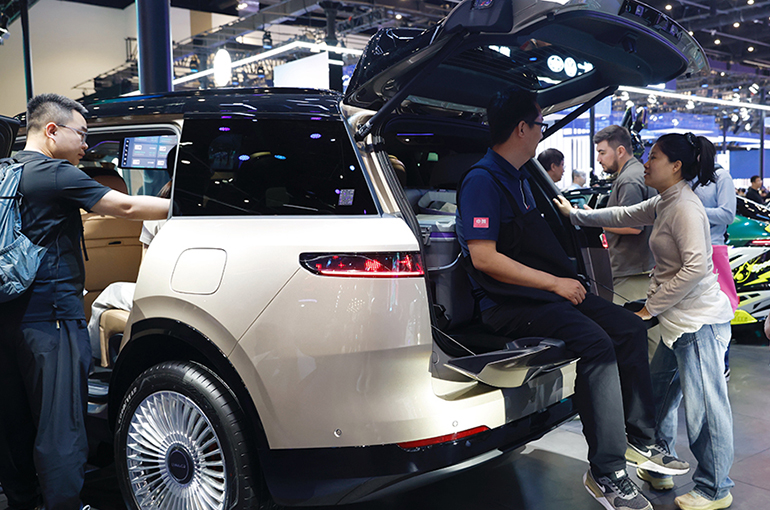
Driven by market demand, new electric vehicle models in China are becoming larger and heavier. Industry insiders have proposed introducing an automotive tax reform system based on vehicle weight to help reduce sizes.
The purchase tax, consumption tax, and other taxes levied on new energy vehicles should be linked to the product weight to ensure that heavy-duty vehicles pay a greater share of the costs for road maintenance and upkeep, Ji Xuehong, director of the Automotive Industry Innovation Research Center at North China University of Technology, told Yicai.
The average curb weight of NEVs in China increased nearly 30 percent between 2012 and 2024, mainly because of heavier battery packs and the rising popularity of sports utility vehicles. However, this comes with several negative aspects, such as higher energy consumption, greater damage to roads, shorter tire lifespans, and a decline in braking performance.
China should introduce a tiered vehicle tax or consumption tax based on the weight to restrict the number of overweight vehicles, as well as preferential policies to give priority to low-weight, high-energy-efficiency vehicles to help the industry get rid of the tendency to raise vehicle weight, said Cui Dongshu, secretary general of the China Passenger Car Association.
The existing vehicle consumption tax, which is levied based on engine displacement, should be adjusted to be calculated based on the vehicle's curb weight, Han Zhiyu, professor at the College of Automotive and Energy Engineering of Tongji University, told Yicai. Moreover, vehicles' daily charging volume should be included in the tax collection system -- the heavier the vehicle, the more electricity it consumes, the higher the tax.
"China's fuel vehicle tax system once effectively curbed the production and consumption of large-sized cars, but the existing NEV tax reduction and exemption and subsidy policies have instead encouraged automakers to produce vehicles larger and heavier," Han said, adding that it is time to implement an equal taxation policy for fossil fuel and electric autos now that the NEV penetration rate has exceeded 50 percent.
"If all the over 300 million passenger vehicles in China became heavy-duty vehicles, the roads would be crushed," Li Bin, founder of Chinese NEV startup Nio, told Yicai. Relying solely on automakers' self-discipline to stop this trend is not enough, he noted, adding that the government should impose restrictions on vehicle weight.
The policy currently in force already has requirements for the energy consumption of NEVs. For example, the vehicle purchase tax policy implemented this year sets the maximum consumption per 100 kilometers for battery EVs heavier than 2,710 kg at 19.1 kilowatt-hours if they want to enjoy a 50 percent reduction in the purchase tax.
This curbs the urge of carmakers to raise the weight of new models to some extent, but it is not enough.
Bigger Isn't Always Better
The average curb weight of NEVs in China was 1,704 kilograms in 2024, almost 400 kg heavier than in 2012, according to data from the Ministry of Industry and Information Technology. The average curb weight of NEV models by Li Auto and Seres Group exceeded 2.4 tons, while that of Nio and Xpeng Group was over 2.2 tons and 2 tons, respectively.
The MIIT has not yet unveiled the average weight data of passenger vehicles released after 2025, but there is not much optimism. For example, in the latest new vehicle catalog, the two new Maextro models weigh over three tons each. The Maextro V800 is 3.8 tons, more than a light-duty truck.
The reasons behind the increasing weight of NEVs include the fact that a single battery pack now is 500 to 600 kg due to the popularity of large SUVs and the pursuit of long range, Han said.
Features such as smart cabins and intelligent driving hardware have further increased the vehicle's weight, according to Cui. Moreover, the upgrading of safety regulations also calls for an increase in the use of high-strength steel or aluminum in the protective structures of vehicles and battery packs.
The introduction of more and more configurations has also continuously raised the weight of vehicles, Han explained. "One or two airbags were sufficient, but now cars have 11 to 12," he noted, adding that ordinary seats have been transformed into massage chairs, and there are also refrigerators, color televisions, and other devices aboard.
"Even though this way cars are more comfortable, they are getting heavier and heavier," Han pointed out.
"Consumers are more willing to buy larger autos because of consumption upgrading, increasing size of families, and a desire for status," Ji said. "Therefore, automakers are more inclined to produce high-priced, large-sized models because this can lead to higher profits."
The continuous increase in vehicle weight raises vehicle energy consumption, intensifies carbon emissions, consumes more scarce mineral resources, accelerates the wear and tear of roads and bridges, shortens the lifespan of tires, hikes the maintenance costs of public roads, and also leads to a decline in vehicle braking performance, a reduction in road traffic efficiency, and an increase in the risk of more hazardous traffic accidents, Cui pointed out.
Moreover, the heavier the vehicle is, the more complicated the dismantling process becomes after it is scrapped, and the more difficult it is to recycle it, Han noted.
Source: Yicai Global
