



今日上海
职场女性着装打破无形面纱,设计师品牌标签还重要吗? - 2026年09月20日
What women wear to work has broken a glass veiling. how much does a designer label matter?
A designer pedigree does not have to come with a luxury price tag.
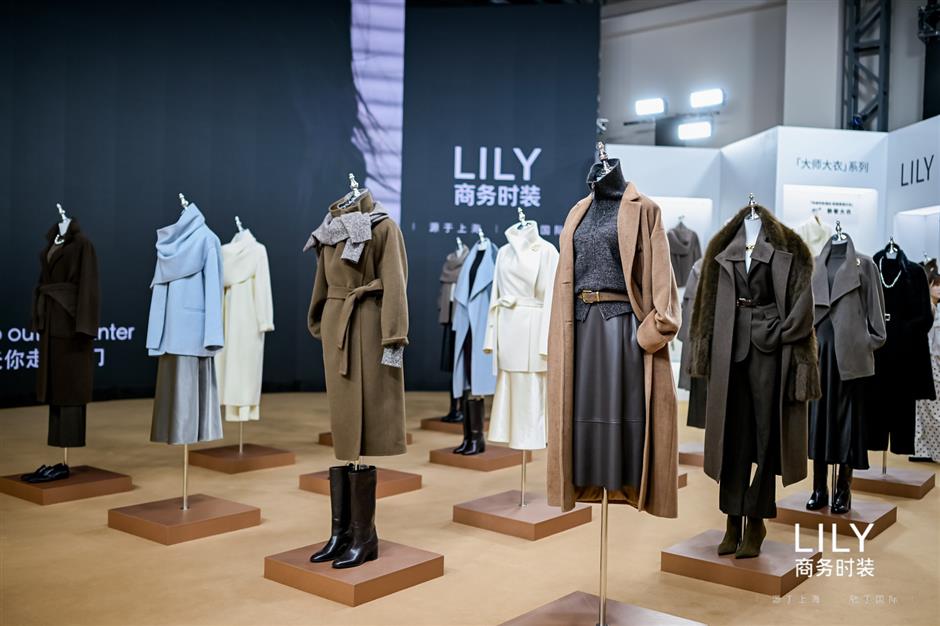
A new winter coat collection unveiled in Shanghai this week tops out at just under 4,000 yuan (US$596). Developed under designer Zoe Turner's direction for Lily, a Shanghai-based business-fashion brand, it brings international design credentials into the increasingly fluid wardrobe of China's working women.
The bigger shift is not what women wear to work, but how little the label "workwear" defines what they buy.
Office dressing has become less a uniform look and more a showcase of how clothes make a statement about the individual wearing them. A 2025 iiMedia Research survey found that 36 percent of Chinese respondents described their usual office attire as "formal business" wear, while 24 percent favored a more fashion-conscious look. Some 22 percent prioritized simplicity and comfort.
Looking appropriate is taking on a range of meanings.
When Shanghai office worker Xu Jia wore an elaborately embroidered dress to work, a colleague jokingly asked whether she had a date that evening.
"A decade earlier," she said, "this would have been normal office wear."
The distinction matters. Women still need clothes they can wear to work, but the office is becoming just one reason of multiple reasons for choosing garments. As the workplace loses much of its power to dictate what women buy, clothing has to do more to market itself.
The Lily collection puts the emphasis on fabric, construction and fit. Materials include superfine Australian merino wool, cashmere and alpaca blends. One style combines a coat with a down vest. Turner has also adjusted silhouettes around the height, shoulders and neck proportions of Chinese women.
Details related to comfort matter. The polished office look has survived, but some discomfort historically attached to it has not.
High heels are still around on the office scene, but flats are encroaching on their territory. A 2024 Shanghai Daily review of Taobao shoe sales found that most of the platform's 10 most popular footwear brands were selling sneakers, boots and loafers rather than heels. At Belle, the best-selling high heel ranked only 23rd in its flagship store. At Staccato, once strongly associated with fashion heels, sales of flats were almost five times those of heels.
The same tension becomes more expensive when the purchase is a winter coat.
A coat near the top of Lily's new range approaches 4,000 yuan. Some styles use fine merino wool and double-faced construction. At the other end of the price spectrum, Max Mara's iconic 101801 coat is currently listed in China at 30,900 yuan. The Italian label's version is made from 90 percent wool and 10 percent cashmere, with a design dating back to 1981.
That is not a like-for-like comparison. The Max Mara price buys more than cloth. It includes four decades of design history, craftsmanship, distribution, service and the intangible value of one of fashion's best-known coat franchises.
But a price gap of that size makes the consumer calculation unusually visible.
A shopper can spend around 4,000 yuan on a wool coat carrying the input of a designer with luxury experience, or several times that amount for one made by an established high-end icon. The question is not whether the two products are equivalent. They are not. It is which parts of the premium still matter enough for the consumer to pay for them.
That question has become more pressing in China.
The personal luxury market on the Chinese mainland contracted 3 percent to 5 percent in 2025, according to Bain & Co, while luxury fashion fell 5 percent to 8 percent. Consumers have become more selective, Bain said, favoring products that balance quality, exclusivity and practicality. The consultancy also pointed to repeated price increases and limited innovation as factors making some luxury purchases harder to justify.
That does not amount to a wholesale rejection of premium fashion. Nor does it mean shoppers suddenly judge a coat by fiber content alone. Brand heritage can be valuable. So can provenance, construction, design originality and the emotional satisfaction attached to ownership.
What has changed is the level of scrutiny.
For a generation of Chinese working women who have already discarded the idea that professionalism requires stilettos, the label "business fashion" is no longer enough on its own. Neither, increasingly, is a famous name.
A premium has to be legible in the product.
That may be why the most interesting contest in business womenswear is no longer simply over who can dress women for the office. It is over what, exactly, can still persuade them to pay more.
Source: City News Service
