



今日上海
中国入境旅游蓬勃发展,但海外消费却相对滞后 - 2026年09月20日
Inbound tourism booms in China, but overseas spending lags

Travel guide Chen Xiaodan organized a unique Beijing tour for foreign tourists this summer.
Instead of taking a group of about 30 visitors from Jakarta, Indonesia, to popular tourist attractions like the Forbidden City or Tian'anmen Square, she took them into a traditional courtyard home on an August afternoon to learn how to fold dumplings.
"It's part of a broader trend," Chen noted, a trip planner at Beijing's Jinhe Travel Agency.
More foreign visitors are eager to immerse themselves in everyday Chinese life, rather than simply ticking off a list of famous landmarks.
The shift is happening as record numbers of foreigners enter China. In the first half of 2026, 22.9 million foreign visitors entered the country, up 20.4 percent from a year earlier, according to China's National Immigration Administration. Nearly 78 percent came in visa-free, as China keeps adding countries to its visa-free list.
Last year, China welcomed 154.5 million inbound tourists, including visitors from Hong Kong, Macau and Taiwan, according to a report released on September 10 by a research institute under China's Ministry of Commerce.

That gave China the largest share of any country worldwide – 10.1 percent of all international arrivals.
However, the revenue has not kept up with the growth. China earned US$55.2 billion in international tourism receipts last year, just 2.9 percent of the global total and the ninth-highest amount in the world.
Each inbound tourist spent an average of US$357.30 per trip, only 29.1 percent of the world average, according to the Jiemian News.
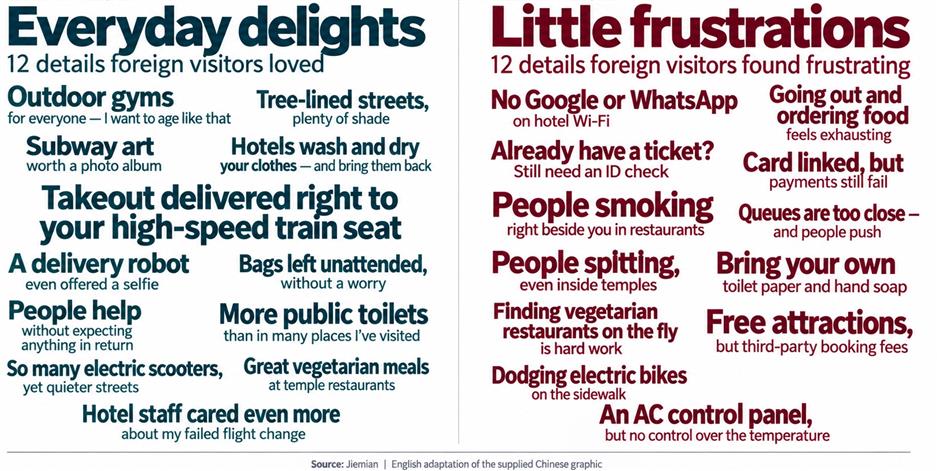
"I really wanted to see a special museum in Shenyang, but TripAdvisor doesn't work here, so I couldn't find it," a foreign tourist said on the social media platform X. "I also wanted to get a haircut the Chinese way, but talking to the barber was really difficult."
The Ministry of Commerce report built a five-part framework to explain what turns a visit into spending: tourism supply, destination appeal, transportation, service quality and the broader economic environment. Service quality, they found, has the strongest effect on whether tourists actually open their wallets.
Trip.com, China's largest online travel platform, is trying to close that gap on the ground.
At the Longji Rice Terraces in South China's Guangxi Zhuang Autonomous Region, for instance, foreign tourists once waited up to 20 minutes at manual ticket windows, with online booking available only in Chinese.
After Trip.com helped install multilingual self-service machines and QR-code booking, foreign visitor numbers at the site jumped 464 percent from a year earlier, the company said.
Trip.com has also pushed hotels to label rooms for halal dining, non-smoking floors or smart toilets so visitors can find what suits them.
In April, the company named actor Jackie Chan as an ambassador to promote authentic experiences, including a long-spout teapot pour at a Chengdu teahouse and a Tang Dynasty-style banquet show in Luoyang.
Beijing's Zhong'an Hotel sits on the site where American journalists Edgar Snow and Helen Snow once lived in the 1930s and where part of the book "Red Star Over China" was written.
Last year, the hotel spent more than six months training 15 bilingual guides to give a nightly talk about the Snows at 8pm and added daily calligraphy and paper-cutting sessions for guests.

Inbound bookings at the hotel rose 121 percent in the first eight months of 2026 through Trip.com's overseas platform, making up 82 percent of its total bookings.
Travel agencies are evolving as well. The Jinhe Travel Agency has started creating customized trips specifically for foreign travelers, expanding its staff from six to eight members to over 20.
But problems remain. Hotels offering halal food and prayer rooms are still scarce, tour operators said. Many foreign visitors struggle with squat toilets and unclear foreign-language signs at transit stations. Older and less mobile tourists often face long walks between attractions.
"What matters differs by market," Sun Tianxu, a Trip.com vice president, said. "Japanese tourists often ask about smart toilets. Muslim tourists care more about halal food and prayer facilities."
Trip.com Group co-founder and chairman James Liang has said China's inbound tourist numbers could roughly triple by 2030, bringing in about US$300 billion in tourism revenue worth 2 to 3 percent of the country's gross domestic product.
Trip.com has set its own five-year target: helping attract 200 million inbound visitors, according to the company.

Source: City News Service
