



今日上海
全球航运巨头齐聚北外滩论坛,寻求应对不断升级的不确定性的解决方案 - 2026年10月21日
Global shipping giants gather at North Bund Forum to seek solutions to escalating uncertainties
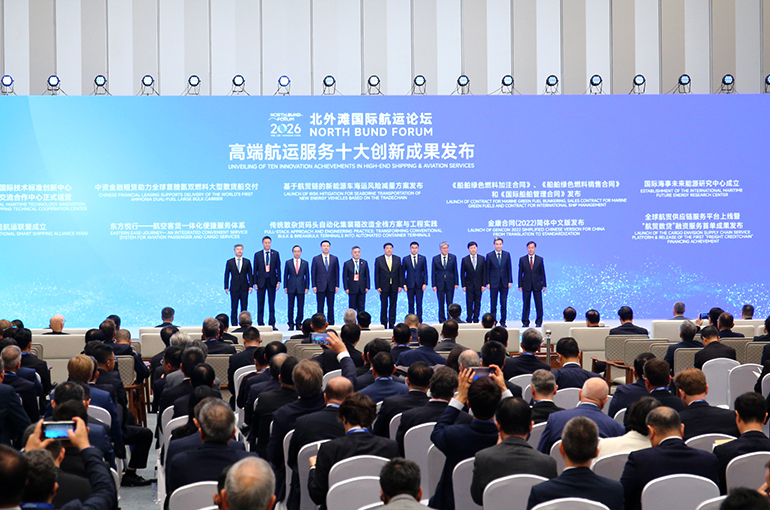
More than 800 guests from over 50 countries and regions are attending the 2026 North Bund International Shipping Forum, aiming to come up with solutions to escalating global uncertainties and risks and find paths for the resilient development of the global shipping industry.
More than 110 attacks on merchant ships have occurred in and around the Strait of Hormuz so far this year, killing at least 24 seafarers, Arsenio Dominguez, secretary-general of the International Maritime Organization, said in his keynote speech at the opening ceremony of the North Bund Forum on October 20. He then called for navigation safety to be respected and seafarers to be protected.
China’s Transport Minister Liu Wei proposed three initiatives to tackle risks and challenges facing the safety and resilience of international shipping in his address at the North Bund Forum opening ceremony. The first is to jointly build a diversified and resilient maritime transport corridor network, enhance the risk-resistance capacity of key corridors, and accelerate the upgrading and renovation of port infrastructure.
Liu’s second proposed initiative is to co-promote the digital, intelligent, and green development of shipping, while the third is to jointly promote the order of international shipping development, support the IMO in playing a greater role, and improve the global maritime governance system.
Shanghai will continue to improve its seaport, airport, cruise port, and intermodal transport systems and work with its neighbors to build the world-class port cluster and airport cluster in the Yangtze River Delta region, further enhancing the connectivity and stability of its shipping network, Mayor Zhu Zhongming said.
The city will also focus on promoting the digital, intelligent, and green transformation of shipping, deepen the digitalization of shipping and trade, increase its green fuel bunkering capacity, advance the construction of international green shipping corridors, provide more shipping risk management tools, strengthen risk early-warning and emergency rescue capabilities, and raise the resilience and safety of shipping, Zhu added.
As one of Europe’s most important gateways, the Port of Antwerp-Bruges is evolving rapidly under crisis, said Tom Hautekiet, the port’s chief commercial officer. Shipping companies and ports are restructuring supply chains with faster responses, attracting new customers, adjusting shipping routes, introducing new vessel types, and increasing safety stock in warehouses.
This year, European ports and shipping firms plan to increase investment in the Chinese market and expand their localized teams in China, Hautekiet pointed out. Over the coming decades, cargo volumes from Asia to Europe will continue to grow, and the Port of Antwerp-Bruges is expanding its container throughput capacity accordingly.
Nearly one-third of global maritime trade is related to China, providing broad space for global maritime insurance, Wang Xuwen, first-level inspector at the property insurance department of China’s National Financial Regulatory Administration, said at the North Bund Forum’s finance and insurance sub-forum yesterday.
China’s marine cargo insurance premiums accounted for 19 percent of the global total last year, ranking first, according to data from the Ministry of Transport. Meanwhile, the country’s hull insurance premiums accounted for 11 percent of the global total, ranking second.
Shanghai’s hull and cargo insurance businesses rank first in China by scale, Vice Mayor Lu Shan said. The city’s next step is to strive to provide a set of public goods that make risks measurable, prices discoverable, assets appraisable, and disputes adjudicable, he noted.
Shanghai’s Hongkou district began building a global shipping and trade supply chain management service platform in February to address the pain points of inconsistent data standards, independent systems, and prominent information silos in the shipping and trade industry. It officially launched the platform at the North Bund Forum.
As the core carrier area of the Shanghai International Shipping Center, Hongkou is home to more than 4,600 shipping service enterprises and over 4,000 freight forwarding firms. Eighteen of the world’s top 50 container liner companies have set up operations in the district, and its registered fleet capacity accounts for about 70 percent of Shanghai’s total.
Source: Yicai Global
