



今日上海
上海智慧气象服务全城守护各行业 - 2026年11月17日
Shanghai's smart meteorological services safeguard industries citywide
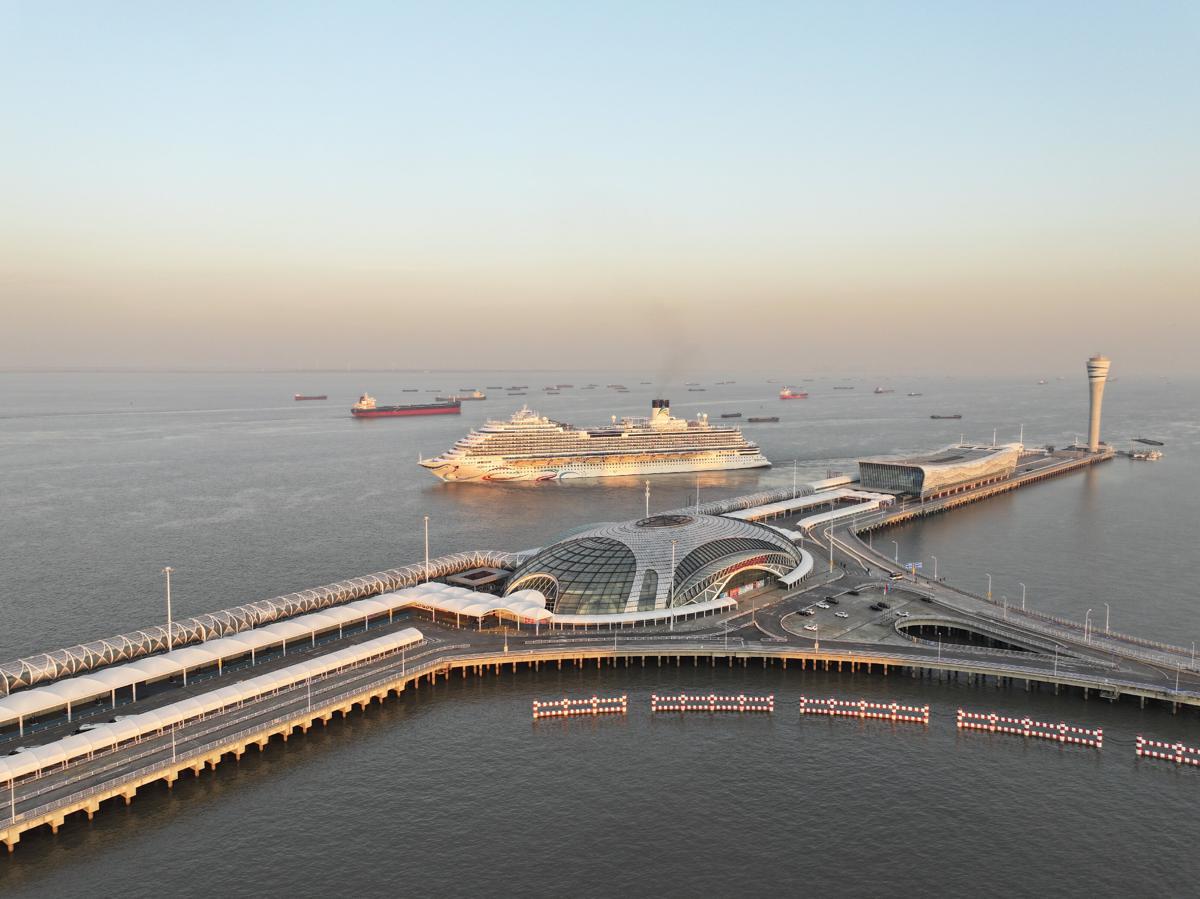
Shanghai's timely, accurate and smart meteorological services are firmly safeguarding diverse industries across the city, including cruise operation, shipbuilding and airlines operation.
Departing from the Shanghai Wusongkou International Cruise Terminal in the city's Baoshan district on Nov 9, China's large domestically built cruise ship Adora Flora City completed its first trial voyage on Nov 12. Behind the success stood the district's meteorological bureau, which had been providing solid support over two weeks prior.
Whether a cruise ship can dock and depart safely on schedule often depends on a window of opportunity measured in hours. Xu Lingxuan from the bureau pointed out that cruise lines particularly emphasize the fast-changing wind and visibility conditions, as well as severe weather in port areas and fairways.
Coordinating with the cruise line, culture and tourism department and other authorities, the bureau established a phased meteorological service plan to guide the docking and departure of Adora Flora City.
After providing weather forecasts for the cruise's maiden voyage 15 days in advance, the bureau began submitting daily reports for the voyage every five days. In addition, detailed forecasts broken down by time slots were issued by the bureau three days ahead of the departure, followed by weather advisories and forecast alerts that were updated on a rolling basis till the cruise successfully departed.
Such mechanism is not exclusive to Adora Flora City. Since the Wusongkou International Cruise Terminal opened in 2011, the district's meteorological bureau has provided specialized support for cruise operations, primarily assisting with the arrival, docking and departure of cruise ships. In 2025, the bureau supported a total of 230 cruise ship calls and served more than 1.75 million passengers, achieving a safety record of zero accidents.
Working with tourism, transportation and maritime departments and cruise lines, the bureau also launched a shared meteorological service community to better support the city's cruise industry.
"Our bureau is currently working on building a Shanghai International Cruise Meteorological Service Center, which aims to meet the demands of high-quality growth in the city's cruise industry. We are also looking at integrating more artificial intelligence products to further improve our service," said Xu.
In fact, the meteorological service had already begun providing support much earlier, at Shanghai Waigaoqiao Shipbuilding, a subsidiary of China State Shipbuilding Corp and where the Adora Flora City cruise ship was built.
Located in the city's Pudong New Area, the company started construction of the vessel in August 2022. Zhang Ping, senior manager of Shanghai Waigaoqiao Shipbuilding, told China Daily that many production procedures at the shipyard are directly affected by the weather.
"For instance, thunderstorms, strong winds, freeze and other tough weather conditions will bring big challenges for our outdoor crane operations, and the ships under construction and docked at the pier. Efficient meteorological information can help us better prepare response measures and ensure safe production," Zhang added.
To provide more targeted and accurate weather monitoring, Pudong's meteorological bureau established two automatic weather stations within the production area in 2024. One of them is installed at ground level to monitor the wind speed, wind direction, visibility, precipitation and temperature changes, while the other, installed on the roof of a building, especially monitors high-altitude winds to meet the shipyard's needs, according to Lu Jialin from the bureau.
Focusing on the construction of high-end vessels, the bureau has established a customized, intelligent and end-to-end service system to align with the pace of shipbuilding production. In addition to issuing accurate daily forecasts for the shipyard, it also issues early warnings for strong winds, lightning and heavy rain to help avoid risks.
For frequently occurring disasters such as typhoons, heavy rains and dense fog, trend forecasts are issued 48 hours in advance along with detailed warnings 24 hours in advance. In addition, real-time tracking and updates are provided to help aid emergency response, according to the bureau.
Thunderstorms, visibility and dense fog are also some of the key factors that airlines pay the most attention to. Joining hands with the Shanghai Meteorological Service Center, the Shanghai-based Juneyao Airlines officially adopted a customized AI agent at the beginning of this year to predict risks and help with operations.
When a user enters the flight schedules for a specific date, the agent can automatically analyze the weather risks along each flight route, and generate a summary with detailed risks indicated on three levels, enabling the airline to grasp the meteorological conditions for that day's flights at a glance.
These capabilities are made possible by the integration of data from ground-based automatic weather stations, weather radars and satellites, as well as the airline's real-world operational scenarios, flight schedule data and risk thresholds.
The system features a built-in database of en-route meteorological risk rules and configurable thresholds, covering wind, temperature, humidity, turbulence, icing and convective clouds. These criteria can also be dynamically adjusted based on different airports, seasons and aircraft types.
"Every diverted flight and delay due to the weather can result in a big increase in our operating costs. Thus, accurate aviation weather forecasts and early risk warnings are key to airline operations, both in safety and operating performance. It would allow us to make the best possible preparations in advance," said Wang Liuran, meteorological manager at Juneyao Airlines.
Source: China Daily
