



今日上海
线控转向进入更广阔市场 - 2026年11月23日
Steer-by-wire enters wider market
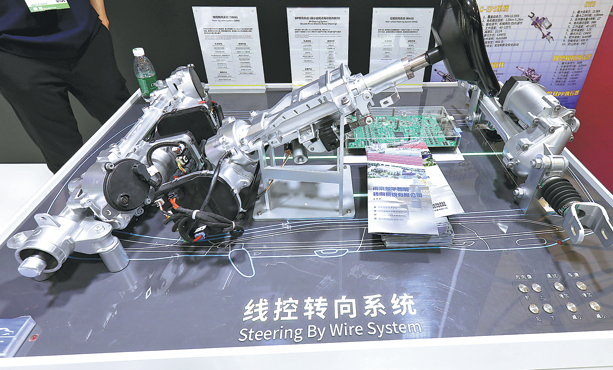
Chinese automakers have begun incorporating steer-by-wire and other intelligent chassis technologies into mass-produced vehicles. These features, once limited to high-end models, are now becoming available in more affordable family models.
Steer-by-wire replaces the mechanical link between the steering wheel and the front wheels with electronic controls. Some systems can make parking easier by reducing how far drivers need to turn the steering wheel.
In late September, SAIC Motor's IM Motors launched its new LS6 electric SUV with a starting price of 202,900 yuan ($30,435), featuring steer-by-wire as standard across all three trims.
Prior to this, steer-by-wire was largely confined to far pricier models. Li Auto's i9 debuted at 369,800 yuan and Nio's ES9 starts at 498,000 yuan including the battery pack.
IM Motors says the LS6's steer-by-wire system has a backup power supply and a separate backup communications channel.
Xiang Jiao, chief technology officer of IM Motors, said developing key chassis controls in-house and drawing on SAIC Motor's supplier network helped keep costs low enough to offer the technologies on the LS6 as standard.
SAIC Motor set up a team to develop steer-by-wire in 2018. Xiang said testing for the broader chassis development program totaled about 1 million kilometers and included trials in hot and cold conditions.
The Nio ET9 sedan was the first domestically mass-produced vehicle in China to feature the steer-by-wire system. Its deliveries began in the first quarter of 2025 priced at around 800,000 yuan.
Its steering requires only 240 degrees for a full turn, allowing U-turns.
Li Auto's i9 combines steer-by-wire with rear-wheel steering. To reduce the turning radius, the rear wheels turn in the opposite direction from the front wheels at low speeds, according to the owner's manual.
Zhang Junzhi, a professor at Tsinghua University, said advances in chassis technology give carmakers new ways to set their vehicles apart. He said combining steer-by-wire with active suspension on flagship models allows engineers to better coordinate steering and body movement.
However, widespread rollout across the industry faces hurdles around cost, technical maturity and supply chain constraints.
Industry figures show vehicles fitted with intelligent chassis make up less than 2 percent of China's total passenger car sales.
Li Xiang, CEO of Li Auto, noted that high costs keep steer-by-wire and rear-wheel steering a rare sight even among electric SUVs priced near 400,000 yuan.
At present, the bill of materials for foreign steer-by-wire modules stands at 7,000-9,000 yuan, versus 4,000-6,000 yuan for domestic alternatives. Rear-wheel steering adds further expense.
For electro-mechanical braking — the technology that sets the performance ceiling for brake-by-wire systems — the segment remains an optional, premium add-on.
Bosch said competition is shifting away from the race to be first to mass produce, and toward delivering lower costs and faster customer responsiveness.
Ji Xuehong, director of the Automotive Industry Innovation Research Center at North China University of Technology, said manufacturers still need to gather more data and refine by-wire chassis systems even after those systems have passed validation tests and entered production.
Higher production volumes could attract more suppliers and help lower costs, Ji said. That could allow more carmakers to offer the technology on lower-priced models, boosting sales and bringing production costs down.
Source: China Daily
