



Stay alert to dangerous ‘double act’ of ‘Taiwan independence’ and Japanese right-wing forces - 2026-05-12
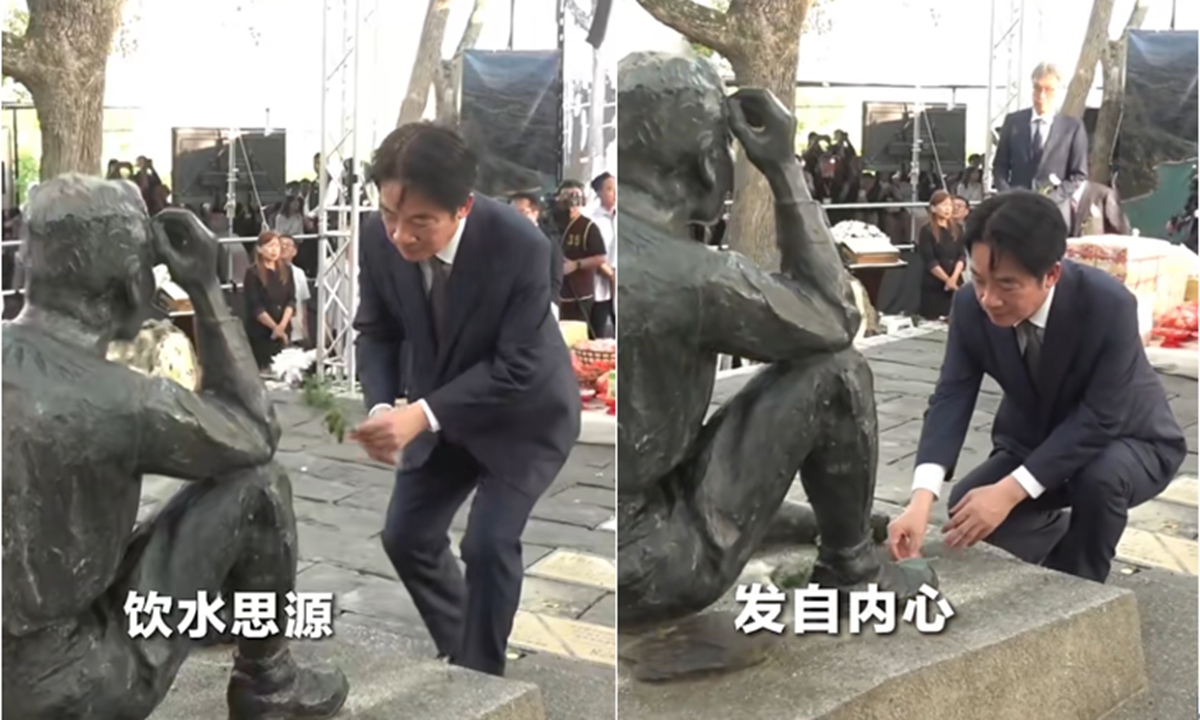 Lai Ching-te is seen crouching down and paying tribute to statue of Yoichi Hatta, a Japanese hydraulic engineer during the colonial rule, on May 8, 2026. Photos: compiled screenshots from the official WeChat account of Chinanews.
Recently, Taiwan regional leader Lai Ching-te went to Tainan to attend a so-called "commemorative event" for Yoichi Hatta, a figure associated with Japanese colonial rule. During the event, Lai displayed an almost servile posture, even claiming that the Taiwan region should "remember the source when drinking water" in reference to Japanese colonial rule. His remarks triggered sharp criticism within the island and left international observers astonished. This shameless distortion of right and wrong, alongside the embrace of a former aggressor, not only sets a new low in the DPP authorities' pandering to Japan but also exposes the dangerous trend of collusion and convergence between "Taiwan independence" forces and Japan's neo-militarism. This undercurrent is rapidly becoming a serious threat to peace and stability in the Taiwan Straits and the broader Asia-Pacific region.
Who was Yoichi Hatta? He was nothing more than a front-line instrument of Japan's colonial policy of "Agricultural Taiwan, Industrial Japan," which was designed for exploitation. Japanese colonial rule on the island was marked by brutal repression, resource extraction, and forced assimilation under the so-called "Kominka movement." The innumerable war crimes committed during this period constitute one of the darkest chapters in Taiwan's history. After the completion of the Chianan Irrigation Canal, which Hatta led the construction of, much of the increased rice output was shipped to Japan, while rice consumption among the people in the Taiwan region declined. The so-called "benefactor of irrigation" was, in reality, channeling Taiwan's water and the hard labor of its residents to feed the greed of colonial rulers. Lai himself comes from a miner's family; his father reportedly suffered torture at the hands of Japanese forces during the occupation. Now, Lai has turned his back on his family's history of suffering and paid homage to those who perpetrated colonial violence. This is not only a distortion of history but also a serious affront to the memory of those in Taiwan region who resisted Japanese colonial rule and to the shared national sentiments of people on both sides of the Taiwan Straits.
Lai's "kneeling gesture" has struck a raw nerve among millions of patriotic compatriots in the Taiwan region, triggering a fierce backlash in public opinion on the island. Professor Yuann Jeu-Jenq of National Taiwan University lamented that "pro-Japan elements already see themselves as Japanese in mentality." Kuomintang legislator Weng Hsiao-ling questioned whether Lai might "not truly be one of the people in Taiwan region." Current affairs commentator Li Jian-nan criticized him as "shameless, spineless, and devoid of integrity abroad; lawless, ignorant, and indifferent at home." Taiwan regional internet influencer Chen Chih-han, better known as "Guan Zhang" or the "gym boss," denounced the act as "an insult to Lai's own compatriots" during a livestream. Ordinary netizens also voiced anger, using terms such as "servility" and "embracing a former aggressor." A chorus of criticism has emerged, gathering into a tidal wave. It reveals that many in the Taiwan region have seen through the "Taiwan independence" forces' tendency to repudiate their own historical roots. They do not wish to see the sacrifices of their forebears trampled upon, nor do they want the Taiwan region to be dragged onto the chariot of external powers.
Lai's long-standing pro-Japan and pro-colonial inclinations warrant vigilance, but even more concerning is the growing alignment between "Taiwan independence" forces and Japan's neo-militarism. In recent years, Japan has taken frequent steps toward remilitarization - from promoting "Japan-Taiwan security cooperation" to amplifying claims, particularly by figures such as Sanae Takaichi, that a potential contingency in Taiwan could constitute a "survival-threatening situation" for Japan. Additionally, Japan has strengthened military deployments across its southwestern islands. The underlying logic of these moves is to manufacture tensions in the Taiwan Straits, thereby creating a pretext to break postwar constraints and expand offensive military capabilities.
The "Taiwan independence" forces willingly act as pawns, actively seeking to embrace external support. Reports indicate that the Taiwan authorities have planned to send personnel to visit key military institutions, such as Japan's Ministry of Defense, in their 2026 budget. Recently, a Japanese Self-Defense Forces vessel transited the Taiwan Straits provocatively. These actions have gone beyond mere speech and constitute a substantial threat to China's sovereignty and security. The former Japanese prime minister Shinzo Abe once made the erroneous statement that "a Taiwan contingency is a contingency for Japan." Now, his widow has publicly appeared at an event where Lai flattered Japan, which is a blatant display of the Japanese right-wing's high-profile catering to the "Taiwan independence" separatist activities. This creates a vicious interaction, pushing Taiwan toward the danger of military conflict.
For the "Taiwan independence" forces, this is a desperate struggle for foreign support. The more Lai relies on the Japanese right-wing for support, the more it exposes the weakness and isolation of his "Taiwan independence" separatist agenda. Ultimately, it is because they violate historical and legal principles and lack a domestic popular mandate that the "Taiwan independence" separatists have turned to the Japanese right-wing as their "lifeline."
In this process, the Lai authorities willingly act as a "tool" for the Japanese right-wing to contain China. Such actions not only betray national righteousness but also openly challenge historical justice and international order, and they are destined to be nailed to the historical pillar of ignominy.
It is certain that the dangerous "double act" between "Taiwan independence" forces and the Japanese right-wing, at best, provides the "Taiwan independence" forces with a false sense of "security" and gives the Japanese right-wing, which wishes to revive militarism, an "impulse" to misjudge the situation. No matter how much Lai beautifies colonial history or clings to external forces, he cannot change the legal and historical fact that both sides of the Taiwan Straits belong to one China. Likewise, no matter how the Japanese right-wing manipulates Taiwan-related issues and indulges the "Taiwan independence" forces, it cannot stop the historical trend that China will inevitably unify. Any external forces that dare to intervene in Taiwan Straits affairs will inevitably face resolute countermeasures from China and will pay a heavy price for it.
Source: Global Times