



Only cooperation with China serves US interests - 2026-05-14
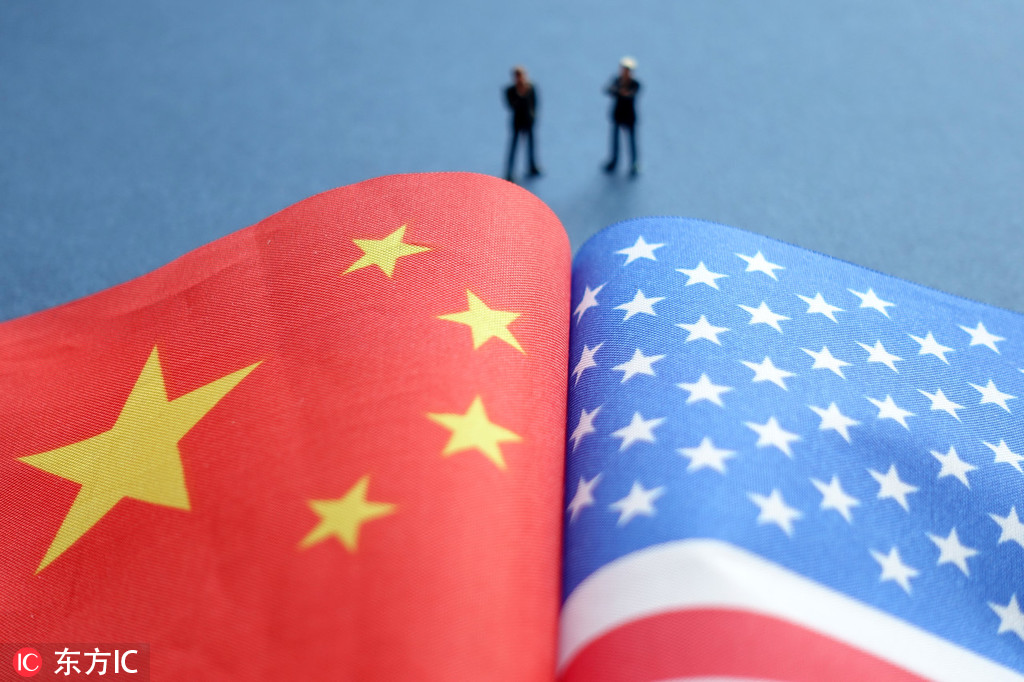
US President Donald Trump's visit to China, and expected head-of-state meetings, are drawing a lot of attention at a time when the world is seeing conflicts in Ukraine and the Strait of Hormuz. A key task for both Beijing and Washington is to sustain a stable, manageable and enduring bilateral relationship.
Although geopolitical experts often refer to the "Thucydides Trap" theory — a phenomenon whereby a rising power can cause fear in an established power, escalating to war — to interpret Sino-US relations, China has taken a different approach.
This is evident in the strategies it employed to counter the tariff war initiated by Washington last year, and its vision of building a community with a shared future for humanity, which is supported by four global initiatives and guided by principles of mutual respect and win-win cooperation.
This approach has worked, producing steady, positive outcomes in bilateral interactions, while acting as a stabilizing force in a turbulent, ever-changing world.
In this context, Washington should take advantage of the opportunity for dialogue presented by the US leader's visit, to seek closer cooperation with China.
While some in the US who view China as their greatest "strategic competitor" and seek to contain it have done little to conceal their intentions, the broader trend of China-US exchanges and collaboration remains unstoppable.
This disconnect on the US side needs to be addressed with an objective understanding of Beijing.
After the US Supreme Court ruled in February that the US administration's imposition of reciprocal tariffs on trading partners under the International Emergency Economic Powers Act was illegal, the US side levied an additional 10 percent import surcharge on all trading partners under Section 122 of the Trade Act of 1974.
The US also introduced a series of negative measures concerning China, including the Section 301 investigations, aimed at undermining China's production capacity advantages and reducing dependence on Chinese industry and supply chains.
However, Washington should have been aware that, given China's 35 percent share of global industrial output, a rapid and complete decoupling is unattainable.
Although the US administration is trying to keep a relatively low profile on the Taiwan question and disputes in the South China Sea, its arms sales to the Chinese island in late 2025 were the largest since 1979.
Additionally, joint military exercises with the Philippines and other external forces in the South China Sea have significantly increased in frequency.
The US should not treat softened rhetoric as a short-term, tactical measure to stabilize bilateral relations.
A US-led rare earths supply alliance designed to reduce dependence on China's rare earths is closely tied to technological innovation and access to critical resources. The same is true of Washington's ambition to revitalize and expand its manufacturing sector.
However, the path to "make America great again" is not necessarily contradictory to China's great rejuvenation. China's significant growth potential, as revealed in its 15th Five-Year Plan (2026-30), can offer US enterprises many opportunities to cooperate with their Chinese counterparts.
For China-US relations to continue providing mutual economic benefits, fostering exchanges across various social sectors, and enhancing complementary security through normal engagement and cooperation, the US side needs to foster a correct perception of China within its broader strategic framework.
Despite some challenges, Sino-US relations have remained generally stable, thanks to head-of-state diplomacy, with the two leaders maintaining frequent communication and dialogue, and recalibrating the direction of ties at critical junctures.
As the Chinese side has repeatedly emphasized, China and the US need to enable each other's success as interests converge, and to pursue mutually beneficial cooperation.
Both China and the US should make mutual respect the cornerstone, peaceful coexistence the principle and win-win cooperation the goal.
This approach will help the two countries explore the appropriate way to interact, jointly contributing to global peace and stability.
China will never follow the obsolete model of a country seeking hegemony when growing stronger. It will instead remain committed to peaceful development.
Beijing hopes that Washington can respect China's core interests and work together to properly manage differences.
In a world facing increasing turmoil, a stable China-US relationship not only serves the fundamental interests of both nations but also aligns with the widespread expectations of the international community.
The author is Zhu Feng, the dean and a professor of the School of International Studies, Nanjing University.
Source: China Daily