



Three signs of realignment in Asia-Pacific region at APEC MRT meeting in Suzhou - 2026-05-26
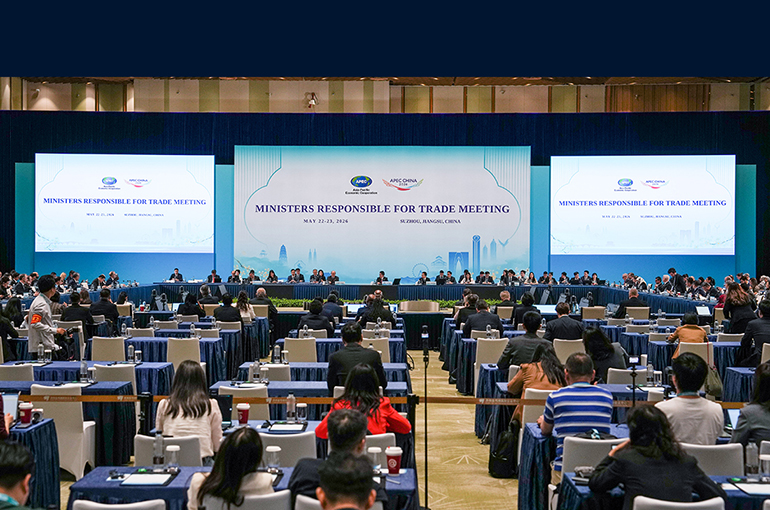
Three Signs of Realignment in Asia-Pacific Region at APEC MRT Meeting in Suzhou
The 32nd APEC Ministers Responsible for Trade meeting concluded with the adoption of the joint communique "The Suzhou Statement" and the approval of the Asia-Pacific Economic Cooperation Roadmap for Innovative, Competitive and Resilient Services.
Suzhou in China's eastern Jiangsu province last hosted an APEC ministerial meeting 25 years ago, making the latest gathering, which was held from May 22 through 23, a crucial vantage point from which to observe signs of new economic cooperation patterns in the Asia-Pacific region.
The first sign is a shift in China's relationship with APEC. When Suzhou hosted the eighth APEC Finance Ministers' Meeting in 2001, regional cooperation focused on "at-the-border" measures, such as cutting tariffs and market access expansion. At the latest meeting, the agenda pivoted to emerging areas like the digital economy, supply chain resilience, and green low-carbon development.
As a connecting hub for many domestic and global supply chains, Suzhou is home to 160,000 industrial enterprises spanning electronics and information technology, equipment manufacturing, new materials, new energy, biomedicine, and artificial intelligence.
According to trade data, Suzhou's imports and exports with APEC countries rose to CNY1.92 trillion (USD263 billion) last year from CNY154.5 billion (USD22.7 billion) in 2001, with an average annual growth rate of about 11 percent. The Asia-Pacific market has consistently accounted for around 70 percent of the city's total foreign trade.
The second sign is a reshuffling of the economic landscape within the region. Over the past 25 years, South Korea has overtaken Japan economically, with a gross domestic product per capita standing of USD37,000 versus USD33,000. In addition, the former's monthly median wage is USD2,170 while the latter's is USD1,900, with the gap continuing to widen.
Japan's representation within the Fortune Global 500 has collapsed from 149 companies three decades ago to just 38, which is less than a quarter of China's tally. China and South Korea have largely displaced Japan in sectors it once dominated, including electronics, semiconductors, and home appliances, while it also remains almost absent from emerging areas like AI chips, new energy, and humanoid robotics.
South Korea has seized this round of technological dividends through the AI chip strategies of Samsung Electronics and SK Hynix.
The third sign is that external energy shocks are accelerating the Asia-Pacific region's green transition. The disruption to tanker routes caused by the situation in the Gulf has had a particularly severe impact on the Philippines, which imports more than 92 percent of its energy. Its GDP grew just 2.8 percent last quarter from a year ago, far below expectations, while public debt as a percentage of GDP rose to 60 percent from 41.5 percent before the pandemic.
Singapore, which also depends on the Strait of Malacca, introduced a tiered tax incentive framework, offering 100 percent corporate income tax exemption for the first three years and 50 percent for the following three years for companies in the clean energy and carbon reduction sectors, guiding capital toward the green economy through policy tools.
The author of this article is Wang Lingyi, a researcher at the Shanghai Academy of Social Sciences' Center for International Economic Exchanges.
Source: Yicai Global