


Culture is the bridge between paris, beijing - 2026-10-14
I have always believed that when people from different nations meet, exchange ideas and discover one another, they undertake one of humanity's most beautiful and necessary journeys.
At a time of mounting tensions and uncertainty, when societies often turn inward, we need open spaces for dialogue more than ever. Such spaces do not require immediate agreement, or even complete understanding. Instead, they seek to ensure that differences are not seen as barriers, but as invitations to conversation.
The cultural exchanges between Paris and Beijing offer a powerful example. Heritage sites carry memories of the past, but heritage does not survive simply by being placed in glass cases. It comes alive when each generation questions, shares and gives it new meaning.
Beijing is home to many such places. The former Sino-French University, founded in 1920, is a symbol of cultural exchange between our countries. A century ago, French and Chinese people realized that true friendship could not rest solely on government contacts, trade or diplomacy. It needed to flow through universities, workshops, books and works of art.
We have a responsibility to revive that heritage. Artists instinctively understand this. They observe the marks left by history, listen to the present and imagine new forms of expression. Their work reminds us that civilization is not a finished monument, but a continuing act of creation.
Both France and China boast long histories and rich artistic traditions. That inheritance can be a source of strength — but only if we do not turn it into a boundary. Encountering another culture does not mean abandoning one's identity. On the contrary, another civilization can help us understand our own more clearly. Sometimes it is through another person's eyes that we see ourselves anew.
This is why artist residencies matter. A brief visit can offer a glimpse of a country, but living and working there is something entirely different. Artists in residence can immerse themselves in a city, speak with its residents and experience the rhythms of everyday life. They come with their own histories, yet remain open to being changed by what they encounter.
Reciprocal residency programs between France and China have immense value: French artists create in China, while Chinese artists work in France. They cross more than geographical borders; they cross inner borders within themselves. After such journeys, they may see both the other country and their own differently.
Art wields a special power here. It can forge human connections even before complete agreement is reached. A work of art does not ask for our nationality before it moves us. A color, a material, a gesture or a melody can touch us without a translator.
While art cannot erase every distance or settle every disagreement, it can create a space in which people meet. That space is especially precious today. Globalization has made contact easier, but contact does not automatically lead to understanding. Images cross borders in an instant; prejudice can travel just as fast. We do not always take the time to listen.
Culture is not merely an ornament in international relations; it is an integral part of them. Artists are not supporting actors in the dialogue between nations; they are often its pioneers. They cross boundaries first and express feelings that official language cannot easily convey. Behind the words "France" and "China" are millions of people who create, work, remember and dream.
Parliamentary diplomacy serves a similar purpose. The France-China Friendship Group in the French Senate brings together senators with different political views. We may disagree on many questions, but we share a commitment to sustained, frank and respectful dialogue. Parliamentarians can help place bilateral relations in a longer historical perspective by staying connected with businesses, universities, cultural institutions and civil society.
Our task is not to pretend that differences do not exist.
Genuine friendship is not built on silence or erasing what makes each country unique. It rests on trust — the trust to remain in conversation even when we disagree. Culture gives that trust a human dimension.
The younger generation plays a special role. Young people should not simply inherit France-China relationship; they should experience it, reshape it and advance it through real encounters and sustained exchange.
It is not enough to praise dialogue; we must create spaces, time and opportunities for artists to work together and produce things that could exist only through their encounter.
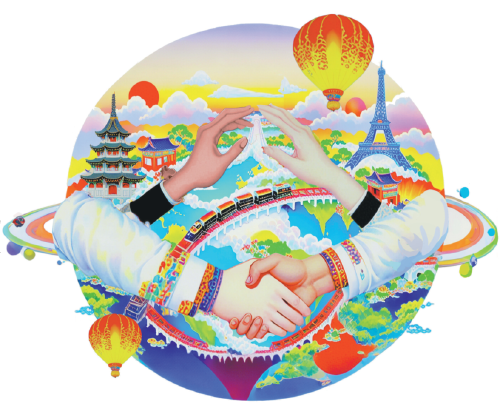
Every artist invited, every exhibition held and every conversation begun adds another stone to the bridge between our countries. That bridge will never be finished. It must be maintained, strengthened and extended.
As two old civilizations, both France and China bear a particular responsibility. The weight of the past should not become an excuse for closing ourselves off. It should be a source from which we imagine the future.
At a time when many voices call for higher walls, I would rather build bridges. A bridge exists because both sides are willing to take a step toward the other.
When international relations are overshadowed by competition, we should protect the ground where cooperation can thrive. And in a world obsessed with speed, we should preserve the slower time that knowledge, creativity and friendship require.
Our hope is for France-China relations to remain rooted in a rich history while looking firmly toward the future. Culture should not stand at the margins. It belongs at the heart of the relationship.
Let us keep creating, preserving and talking. Let heritage remain our starting point, not our boundary. And let us give France-China friendship a future that can continue to grow.
Source: China Daily