



Manufacturing sector shifting from scale to sophistication - 2026-11-10
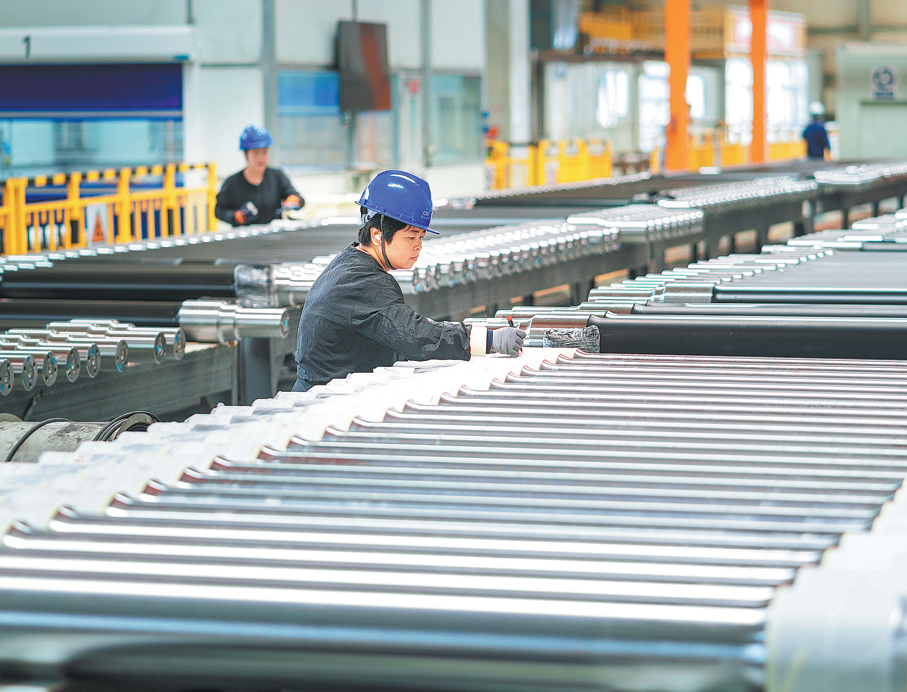
For years, China prioritized expanding its manufacturing capacity, building an extensive industrial framework to ensure a stable supply. This expansion was a practical necessity. However, with a comprehensive manufacturing system now in place and robust industrial support, the country's focus is shifting.
The potential for growth through sheer volume expansion has diminished. Manufacturing competition now focuses on technological sophistication, efficiency and added value. The growth drivers have changed, but growth itself has not weakened.
China's key advantage in global markets has traditionally been its cost-performance ratio. However, with a global surplus of general goods and rising geopolitical uncertainties, relying solely on the price edge may not yield higher profits, even if sales volumes increase.
Some sectors may increase output and revenue to maintain market share, but this could lead to price wars that squeeze profit margins and hinder future investment in production and upgrades.
In the first three quarters of 2026, profits of industrial enterprises above the designated size rose by 15.5 percent year-on-year. While profits of the computers, communication and other electronic equipment sectors doubled, those in non-metallic mineral products fell by 46.9 percent and automotive manufacturing dropped by 22.8 percent.
These figures highlight the key challenge before manufacturing: converting growth into profits, efficiency and competitiveness.
Manufacturing is increasingly driven by technology-intensive, high-value-added sectors, with significant divergence across industries. High-tech manufacturing value added rose by 14.3 percent in the first nine months, outpacing overall industrial value-added growth by 9 percentage points.
The output of high-tech products such as 3D printing equipment, lithium-ion batteries, and industrial robots surged by 62.5 percent, 39.5 percent, and 29.1 percent year-on-year, respectively, confirming this trend.
High-tech manufacturing has shown a strong capacity for value creation, which is essential for growth. In the first three quarters, profits for large enterprises in this sector rose by 52 percent year-on-year, significantly boosting overall industrial profits. The electronics sector is a key growth driver, with integrated circuits, communication equipment and high-end instruments offering new opportunities. This indicates that China's shift focuses on increasing value content rather than reducing manufacturing scale.
Copying mature technologies was once the main strategy of large-scale production, which focused on cost-cutting and capacity expansion to compete in markets. Now, differentiated products with superior performance and quality are key to competitiveness. Global manufacturing competition has shifted from cost and output to include technology, standards, supply chains and moving up the value chain.
Constraints on the traditional expansion model mean manufacturing now seeks reasonable incremental growth through enhanced technology, improved efficiency, and stronger capacity for value creation.
Therefore, companies must overcome technological bottlenecks, refine products and transform innovation into genuine industrial competitiveness. Future growth in manufacturing will rely more on new products than on expanding existing capacity.
China's manufacturing sector established its cost advantages through large-scale production, a comprehensive industry chain and relatively low factor costs. While these advantages are significant, changes in labor, land, and energy conditions are limiting growth opportunities. The focus of cost reduction is shifting as digital, automated and intelligent upgrades effectively increase output per unit of input.
In 2020, the penetration of digital R&D and design tools in China's key industrial enterprises was 71.5 percent, with key processes having a numerical control rate of 51.1 percent. By June, these figures increased to 86.3 percent and 69.5 percent, respectively. Nationwide, a cumulative total of over 56,000 basic-level smart factories has been established. Thus, quality upgrades focus on building cost advantages through productivity gains.
In 2025, China's high-tech product exports reached 5.25 trillion yuan, a 13.2 percent increase from the previous year. Exports of domestically developed brands grew by 12.9 percent, raising their share of total export value by 1.4 percentage points. This growth signifies China's shift in global industry chains from processing and manufacturing to high-value-added segments such as key technology, patents, standards and channel services.
Traditional industries continue to be the backbone of China's manufacturing, and quality upgrading doesn't imply phasing them out. Instead, it involves enhancing technological levels and production efficiency through equipment renewal, process streamlining, digitalization, and green upgrades.
A large industrial base isn't a burden for transformation; the key is empowering it to convert scale advantages into efficiency and quality.
New growth points should not be equated with expanding uniform capacities. Incremental growth will come more from new products, applications, and demand generated by technological breakthroughs — typically in emerging industries such as integrated circuits, energy storage and aerospace, as well as future industries such as bio-manufacturing, quantum technology and 6G.
At the same time, efforts are needed to bridge the gap between technological achievements and industrialization, and avoid low-level, homogenized work. This approach will create new supply that truly meets market demand.
A supportive policy environment for long-term investment is essential.
By regulating market order, curbing disorderly price competition, preventing inefficient competition and directing resources to enterprises with genuine technological and product competitiveness, China can ensure that the shift from volume to quality enhances industrial development and corporate operations.
Source: China Daily