



Economic News
Nine Chinese research institutions team up to develop ‘Artificial Sun’ HTS magnets 2026-08-26
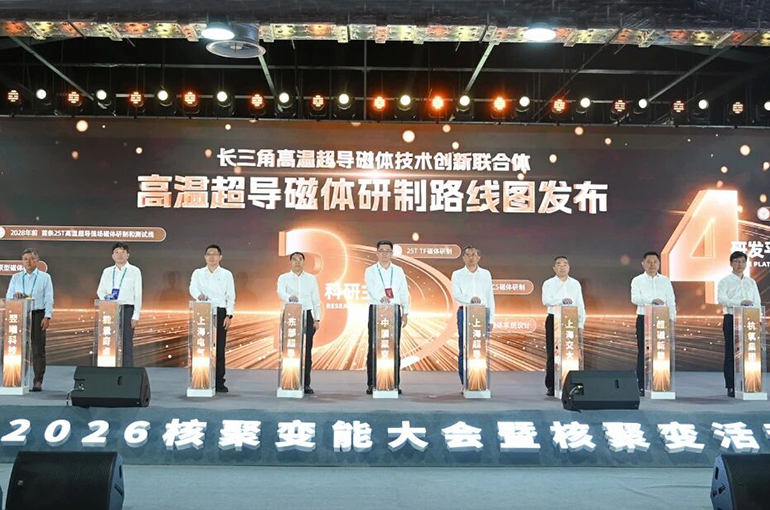
Nine Chinese research organizations, including China Fusion Energy, are joining forces to develop high-temperature superconducting, high-field tokamak magnets for use in a fourth-generation magnetic-confinement nuclear fusion research facility, also known as an ‘artificial sun.’
China Fusion Energy unveiled the planned design of Huanliu-4 at the Nuclear Fusion Energy Conference 2026 held on August 25. Located in Shanghai, the facility aims to become the world’s first steady-state burning-fusion experimental platform using 25-tesla high-temperature superconducting magnets. It will systematically test the reliability of such magnets under the complex conditions of a fusion environment.
To advance the development of Huanliu-4, the nine institutions, which also include Shanghai Superconductor Technology and Shanghai Jiao Tong University, said on August 25 that they aim to build China’s first 25-tesla high-temperature superconducting magnet development and testing line by 2028 and to complete a prototype magnet by 2030.
High-temperature superconducting fusion devices are widely regarded as a key pathway toward the commercialization of fusion power. Several countries are developing fusion facilities based on high-temperature superconducting technology, including the SPARC project in the US and the STEP program in the UK.
China’s Huanliu-4 will also serve as a crucial experimental platform to validate key technologies for controlled nuclear fusion, paving the way for future fusion power generation using deuterium extracted from seawater as fuel.
Source: Yicai Global