



Shanghai Today
Symposium held to mark 80th anniversary of Tokyo Trial’s opening - May 28, 2026
纪念东京审判开庭80周年国际研讨会
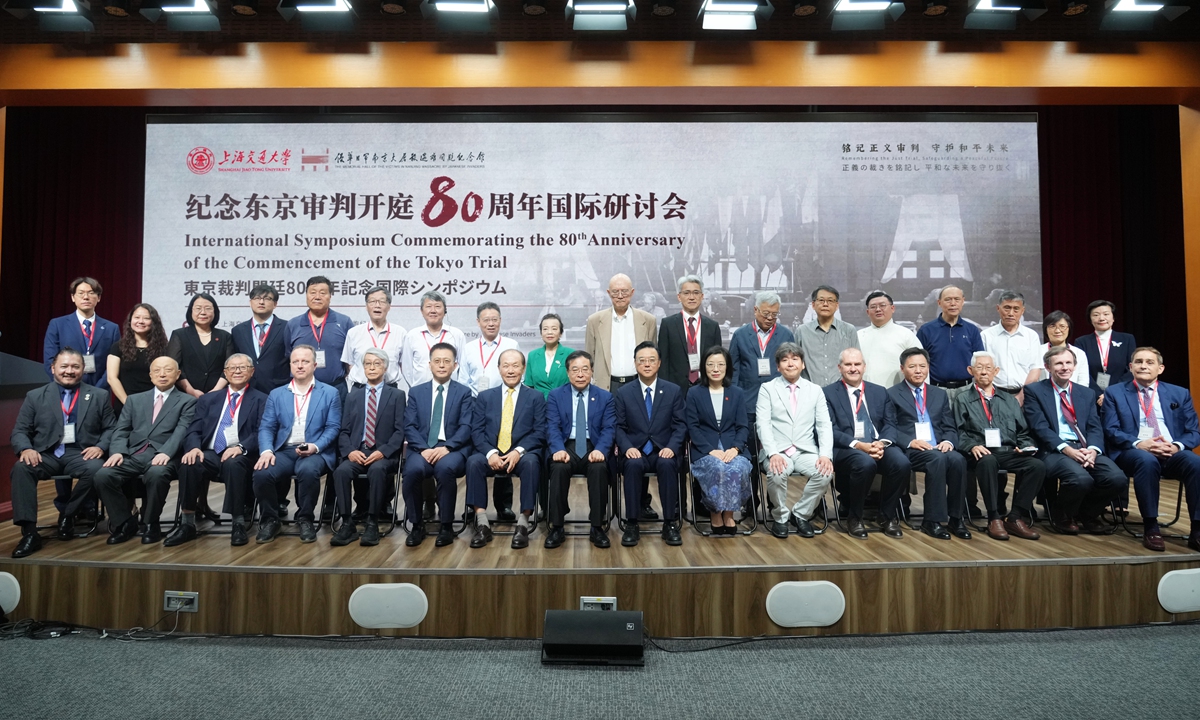 Scholars attending the "International Symposium Commemorating the 80th Anniversary of the Commencement of the Tokyo Trial" pose for a group photo in Shanghai on May 28, 2026.
 The "International Symposium Commemorating the 80th Anniversary of the Commencement of the Tokyo Trial" kicked off in Shanghai on Thursday, bringing together experts from multiple countries to discuss this landmark tribunal that helped shape the post-war international order.
The International Military Tribunal for the Far East, or Tokyo Trial, officially opened in Tokyo in May 1946, launching a two-and-a-half-year prosecution of Japanese Class-A war criminals that comprised 818 public sessions and produced over 48,000 pages of trial transcripts.
The Tokyo Trial was a historic judgment in which peace triumphs over violence, justice prevails over evil, civilization purges barbarism, and the rule of law holds arbitrary power to account, carrying enduring political and legal significance, Qi Dahai, Director-General of the Department of Treaty and Law of the Foreign Ministry, said in an opening address he delivered at the symposium.
The symposium gathered dozens of scholars, former government officials, and heads of relevant organizations specializing in history, international relations, and international law from countries including China, Japan, South Korea, and Vietnam.
During the event, many participants noted that revisiting and safeguarding the just outcomes of the Tokyo Trial hold profound historical and practical meaning, especially at a time when Japanese society is becoming increasingly right-leaning, and historical revisionism is on the rise.
The Tokyo Trial holds epoch-making historical significance, said Xiang Haoyu, a participating scholar and specially appointed research fellow in the Department for Asia-Pacific Studies, China Institute of International Studies.
"At the international political level, the trial firmly safeguarded the victory of World Anti-Fascist War, stabilized the post-war Asia-Pacific international order, and conveyed to all humanity the principle that aggression will be punished and justice can never be erased," Xiang told the Global Times. "It established an authoritative historical and judicial benchmark for future generations to oppose aggression and uphold peace."
This year marks the 80th anniversary of the opening of the Tokyo Trial. Yet the Sanae Takaichi government has not only failed to deeply reflect on history and abide by its post-war international commitments, but even sought to break from Japan's pacifist constitution and showed tendency of reviving militarism - posing a serious and real threat to peace and stability in the Asia-Pacific region, according to observers.
At the Thursday symposium, many participants strongly condemned the dangerous actions of Japanese right-wing forces in denying the history of aggression, and expressed deep concern over Japan's ongoing political shift and the resurgence of militarism.
"Any act that glorifies aggression, denies history, or challenges the post-war order tramples on humanity's conscience and will face resolute opposition," Zhou Feng, director of The Memorial Hall of the Victims in Nanjing Massacre by Japanese Invaders, said in a speech delivered at the symposium.
Symposium participant Masataka Mori, a former professor at Shizuoka University, has long been exposing the truth about Japanese militarist aggression regardless of threats and intimidation from Japanese right-wing forces. On the sidelines of the symposium, he recalled to the Global Times how Japanese society has gradually shifted from facing its history to leaning rightward in recent decades.
The Murayama Statement in 1995 was the first time the Japanese government officially admitted its aggressive war and apologized to the Asian people in a written declaration, Mori said. But soon after, prime minister Junichiro Koizumi frequently visited the infamous Yasukuni Shrine, and the cabinet of Shinzo Abe began to rapidly turn Japanese politics to the right, he added.
"The current Takaichi administration is even seemingly preparing for a new war, openly claiming that a 'Taiwan contingency' could constitute a 'survival-threatening situation' for Japan," Mori told the Global Times in Japanese. "This is a gross interference in China's internal affairs and is tantamount to a declaration of war," adding that "Japan is heading in an extremely dangerous direction."
Against this backdrop, revisiting the Tokyo Trial carries irreplaceable practical value, Xiang pointed out.
"The judicial rulings and historical evidence established by the trial serve as powerful tools to refute historical nihilism and debunk lies peddled by Japan's right-wing forces. The principles of international justice embodied in the trial continue to alert the world to the resurgence of militarism," Xiang said. "Meanwhile, reflecting on this period of history can urge Japan to face up to its wartime crimes and honor its post-war international commitments."
Historical truth needs to be safeguarded by generations to come. Mori said many young people in Japan today know almost nothing about the Tokyo Trial, making it crucial for him to pass down this history to younger generations. Over the past two years, he has led groups of Japanese youth to visit sites in China that suffered from Japanese aggression, including The Memorial Hall of the Victims in Nanjing Massacre by Japanese Invaders. "We work together to preserve this historical memory, and vow never to repeat the tragedies of the past," he said.
The symposium was co-hosted by Shanghai Jiao Tong University and The Memorial Hall of the Victims in Nanjing Massacre by Japanese Invaders. The participating guests will visit Nanjing on Friday for a group tour of the memorial hall, according to the organizers.
Source: Global Times