


Shanghai Today
A world first medical breakthrough in Shanghai beats Elon Musk - July 15, 2026
上海实现全球首创医学突破,领先埃隆·马斯克
The machine that gave a hand back
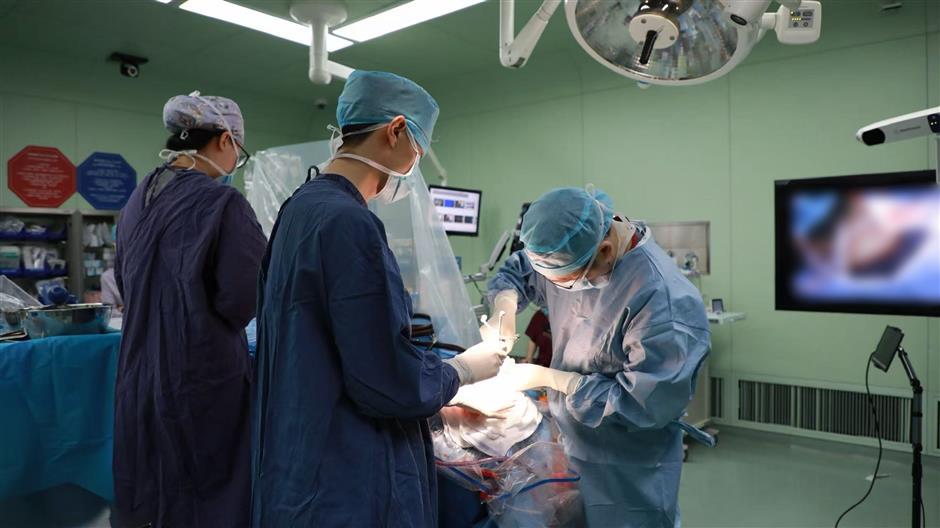
On July 13, in a hospital off Wulumuqi Rd, Shanghai did something no other city on earth has done. The remarkable part is not the technology. It is where the technology happened to be.
For 10 years, a man in this city could not close his hand around a cup.
He had done everything the doctors asked of him. A traffic accident had cut the line between his intention and his fingers, the way a severed cable kills a phone signal, and after the crash came the long, unglamorous years: the standardized rehabilitation, the daily exercises, the slow grinding work of teaching a body to do again what it had forgotten how to do. Then, as happens to nearly everyone with a serious spinal cord injury, he hit the wall. Doctors have a flat little word for the wall. They call it a plateau (the point where the line on your recovery chart goes level and stays there, no matter how hard you push against it, you simply cannot improve any further).
On July 13, at Huashan Hospital, the line moved.
The coin that goes inside the brain
The thing they put in his head is called NEO, which officially stands for Neural Electronic Opportunity, though anyone who has held one tends to describe it by what it resembles: a coin. It is a brain-computer interface, or BCI, which is the machinery that lets a brain speak straight to a computer with no working muscle in between. The idea is old, and the demonstrations are many. What almost never happens is the part where a hospital writes it on a prescription pad and bills you for it like a course of antibiotics.
That is what makes July 13 a date and not an anecdote. Back in March, China's National Medical Products Administration (the country's equivalent of the American FDA) approved NEO chips for sale. It was the first time any national regulator anywhere had cleared an invasive BCI for ordinary commercial use, which is to say for real patients outside the sealed terrarium of a clinical trial. Four months later, Huashan turned that approval into the first actual commercial surgery. Four months. China is changing at breakneck speed, and along with this progress, China is also becoming known for "speed of innovation" in healthcare. This makes China one of the most exciting places to be on the planet right now, when it comes to medical research, development, and deployment.
It is worth being precise about who Shanghai beat, because the names are familiar. In Austin, Elon Musk's Neuralink threads thousands of fine electrodes directly into living brain tissue, a method that reads beautifully and carries real risk (infection, scarring, the slow decay of the signal as the brain fights the intrusion). Musk has talked loudly about implanting a thousand of them. He does not, as of this writing, have commercial approval to implant a single one. NEO, on the other hand, is on. steady path to widespread availability without a plethora of X posts. Its sensors rest on the dura mater (the tough outer membrane that wraps the brain like a helmet liner) and never pierce the tissue underneath. Lower risk. Smaller promises. A medical solution you can actually buy.
Musk announced. Shanghai shipped.
Why it matters that it was here
Many foreign residents who have stayed in Shanghai long enough have had the phone call. It is your mother, or a college friend, or a man cornering you at a wedding back home, and the question underneath every question is always the same: but is it safe there in Shanghai? You stopped arguing years ago. You just live here, and you let the city make its own case on its own schedule.
This is the city making its case.
Huashan is not a gleaming campus dropped into a field. Its main gate opens onto Wulumuqi Rd, right in the center of downtown, where the plane trees knit together over the road and somebody is always selling fruit on the corner and the whole texture of the block is so thoroughly, unremarkably Shanghai that you could walk past the entrance a hundred times without a second look. And inside that building, on an ordinary Monday in July, surgeons gave a stranger his hand back with a coin of silicon and a decade of somebody's refusal to quit. The frontier turns out not to be in the desert outside Austin. It is behind a wall you have cycled past on your way to dinner.
Huashan Hospital, for the record, is nobody's lucky amateur. It houses the country's National Center for Neurological Disorders, and the trial that earned NEO its approval ran across eleven hospitals and thirty-two patients before anyone was allowed to sell a thing. This is a place that has been doing brains for a long time. It simply happens to sit under the same plane trees as your favorite noodle shop.
How the hand comes back
The mechanics are almost elegant. The coin listens to the motor cortex (the strip of brain that plans movement) and the sensory cortex (the strip that handles touch), catches the electrical intention to grasp, and hands that intention to a computer. The computer drives a pneumatic glove (a glove worked by little pockets of air) that the patient wears. He thinks closely. The glove closes. Do that for enough hours across enough weeks and something genuinely strange begins: the brain, handed a working loop again, starts to rebuild the connection it thought it had lost. The device is not only a crutch. It is a teacher.
For now, it is approved for exactly one job, restoring hand function in people paralyzed by spinal cord and neck injuries, and one job is plenty when the job is holding your own cup. The Huashan team is already reaching past it: stroke patients by the end of the year.
The bill
Here is the number, because you were going to ask. The surgery and the device together run about 600,000 yuan (roughly US$88,000). There is no global price to measure it against, since nobody else on earth has this device yet, but it lands at a fraction of what a comparable neurosurgical intervention costs in the West, which is precisely why the phrase "medical tourism" is already being stapled to it. We should mention that medical tourism is something that is really taking off here in China, partly because of the cutting-edge medical technology and expertise, and also partly due to affordability and lower wait times.
The more interesting number (if you live here), is the one you might not have to pay at all. NEO has been folded into Huhuibao (沪惠宝), Shanghai's affordable supplementary insurance scheme, the one that costs almost nothing a year and that most of us sign up for and then promptly forget we have. Huhuibao covers eligible foreign residents. Read that sentence again. A municipal insurance product you buy on your phone, for less than the price of a decent dinner, has decided it will help pay to install a computer in your skull.
That is the part that will never make the brochure, and it is the part that matters most. The future did not show up in Shanghai as a bauble for the very rich or the very famous. It showed up as a line item on the same city insurance the ayi downstairs is signed up for. Is it too much of a stretch to say that China's common prosperity is increasingly adding optimism for the future?
BCI clinical consultation
Do you have a medical issue that might benefit from this new technology? International and domestic patients seeking consultation on the NEO BCI therapy may contact the Huashan Hospital BCI team via official email:
huashan_bci@163.com
Source: City News Service