



Shanghai Today
Robotics companies eye homes as potential market - September 14, 2026
机器人公司视家庭为潜在市场
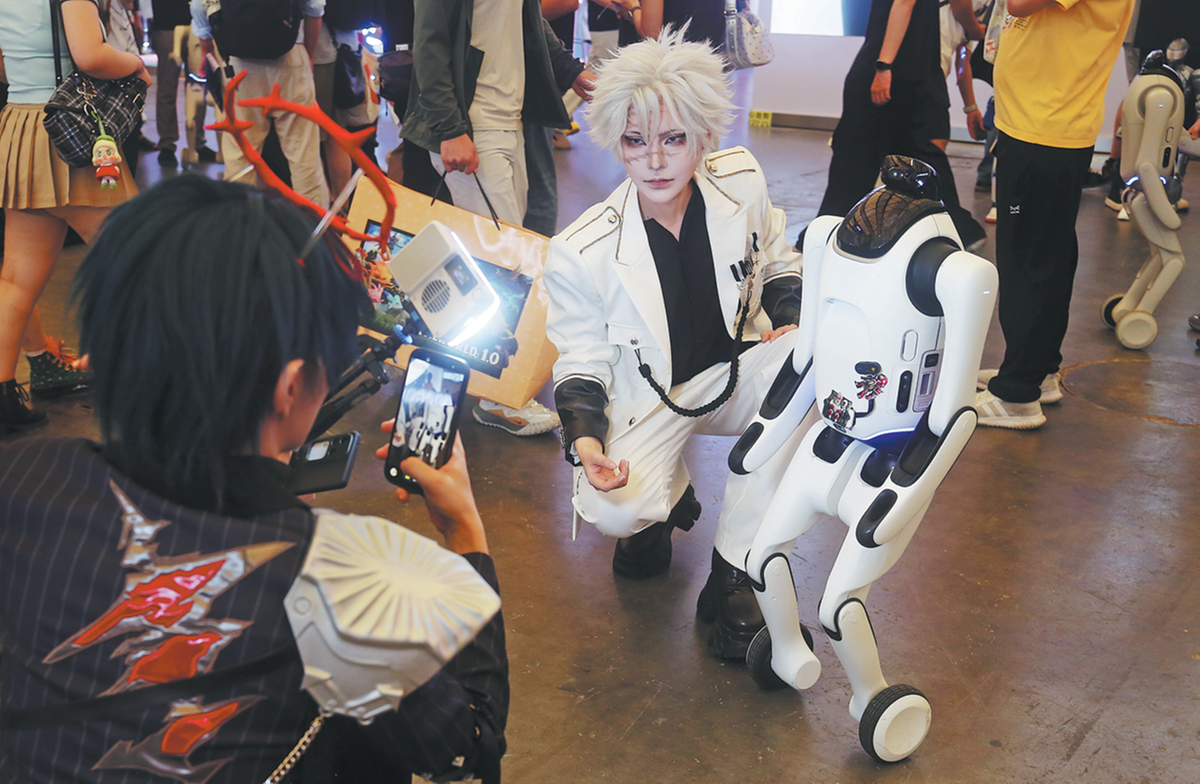
China's next "family member" may be 88 centimeters tall, weigh 15 kilograms and small enough to fit inside a backpack.
It is not a child or a pet, but Qiyuan Q1, a compact robot from Qiyuan Robotics, the consumer-robotics business of Shanghai-listed Swancor Advanced Materials. Together with another deformable robot T1, the two robots are expected to be delivered soon.
The launch marks a new test for China's fast-growing embodied artificial intelligence industry. After two years spent proving that humanoid robots can walk, run, dance and work in factories, companies are increasingly confronting a harder question: can they build a robot ordinary consumers actually want in their homes?
Tian Hua, CEO of Swancor Advanced Materials, has framed the bet in broader terms. "Personal robots are not simply industrial robots moved into homes, nor are they AI toys with large models stuffed into hardware shells. They are a still-emerging new species of human-machine interaction."
For Tian, the long-term prize is not just selling another gadget. He said that personal robots could become the next major interface after keyboards, screens, smartphones and smart speakers — a physical carrier connecting AI, digital services and real-world life.
The ambition comes with a tougher operating environment than factories. Factories are relatively structured environments, with fixed routes, predictable lighting and repetitive tasks. Homes are chaotic: chairs move, toys appear on the floor, pets wander through rooms and the same cup can be in the kitchen one day and the bedroom the next.
That is why Qiyuan is not starting with a full-sized humanoid promising to do everything.
The Q1 is deliberately small. Its 88-centimeter frame is designed for companionship, entertainment and embodied-AI development, while its size and 15-kilogram weight may help reduce power consumption and safety risks around children and elderly users.
Tian said making Q1 small was partly about giving a home robot greater approachability and safety, supported by torque sensing and force-control capabilities.
The T1 takes a different approach. Standing about one meter tall, it can switch between a wheeled humanoid form for indoor use and a quadruped configuration for grass, gravel, slopes and other outdoor terrain.
The two designs reflect a broader rethink across the robotics industry: the most useful consumer robot may not be the one that looks most human, but the one that best fits human life.
Such a design is also being explored abroad. US-Norwegian robotics company 1X has opened reservations for its NEO home robot, while South Korea's LG Electronics has developed a wheeled dual-arm robot designed to work with smart-home appliances.
For Swancor, the bigger test may be less about body shape and more about whether it can move from prototypes to mass production.
The company said its consumer embodied-AI robot business had received 210 million yuan ($31.29 million) in advance payments in the first half of 2026. It also invested 164 million yuan in related research and development and built a robotics R&D team of about 180 people.
The company has partnered with Lens Intelligent Robotics, a unit of Lens Technology, on a first-phase production line planned at the 10,000-unit level, covering precision parts processing, joint-module production and final assembly.
In Guangzhou, Guangdong province, the company has worked with Shangpin Home Collection on so-called robot-ready homes, integrating furniture, smart controls and robotic systems so machines can more easily locate and manipulate household objects.
Tian said: "Swancor's materials background is not incidental to the robotics push. Many technical problems ultimately become materials problems; the company's experience in lightweight, environmentally friendly and high-strength materials can be applied to robot bodies, with some key materials expected to be supplied internally after product launch."
Wang Feili, China industrial analyst at UBS Securities, said in a separate interview that humanoid robots have not yet reached a true commercialization turning point.
"Industrial use cases are likely to scale first over the next three to five years, while the home remains the most promising but more distant market," Wang said.
Source: China Daily