


政府新闻
上海为自动驾驶汽车测试开辟更多道路 2025-12-08
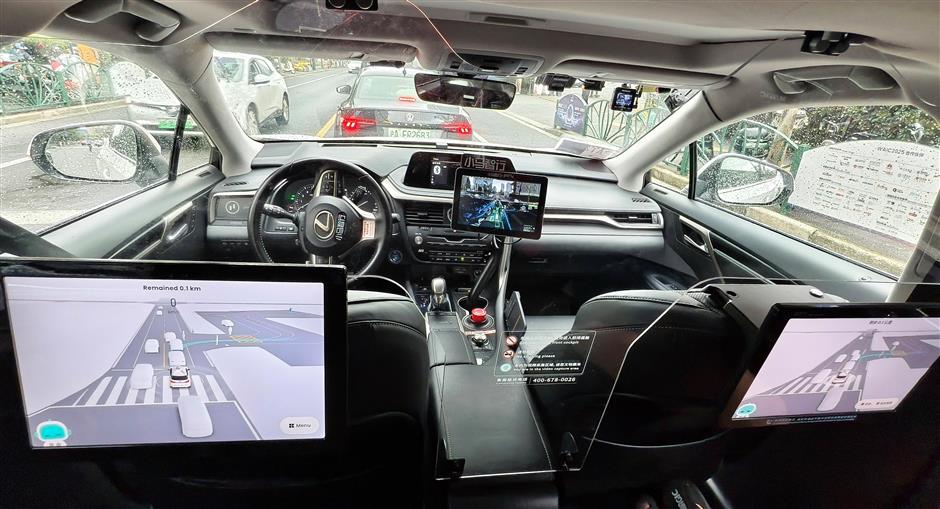
Passengers try autonomous driving during the World Artificial Intelligence Conference in Shanghai in July.
Shanghai is opening more roads for autonomous driving tests, officials said last Sunday.
Building on existing pilot areas in the Pudong New Area, the city will extend testing roads across most of Pudong and expand further into Minhang District and the Hongqiao transport hub, the Shanghai Transportation Commission announced at the "Artificial Intelligence + Transportation Shanghai Release 2025" event.
With the latest additions, Shanghai has opened 3,173 roads for autonomous driving test, totaling a combined length of over 5,200 kilometers, roughly one-third of the city's road system.
Cross-regional coordination is also advancing. Shanghai and neighboring Jiangsu Province are linking testing roads between Shanghai's Jiading District and Jiangsu's Taicang and Kunshan, enabling driverless test vehicles to operate across administrative boundaries, according to the commission.
Shanghai also unveiled citywide traffic signal data sharing, the first such move by a Chinese megacity.
Vehicles will be able to receive data of traffic signals at intersections, rather than relying solely on the cameras that capture the signals. Officials said the change would help reduce recognition errors, lower the risk of system misjudgment, and cut both software and hardware costs.
In addition, the Shanghai Transportation Commission has signed a strategic cooperation agreement with the meteorological authority to enable data sharing.
"With weather data integrated into transport systems, it becomes possible to better analyze accident causes and understand how traffic facilities are affected by weather conditions," said Zhu Xingyi, a professor at Tongji University's College of Transportation.
She added that data sharing would reduce the need for companies to deploy separate weather-monitoring equipment, helping cut repeated investment and improve efficiency.
On the technology front, Wu Jianping, a professor at Tsinghua University, introduced a training platform developed by his team. The platform uses virtual traffic environments to train autonomous vehicles in specific, user-defined scenarios.
"Road testing is crucial for autonomous vehicle development, but real-world testing has limitations, especially in dangerous, complex, or rare scenarios," Wu said. "Virtual testing allows these scenarios to be safely recreated."
Source: City News Service
