



政府新闻
NeuroXess实现中国首个电池集成脑芯片植入里程碑 2025-12-15
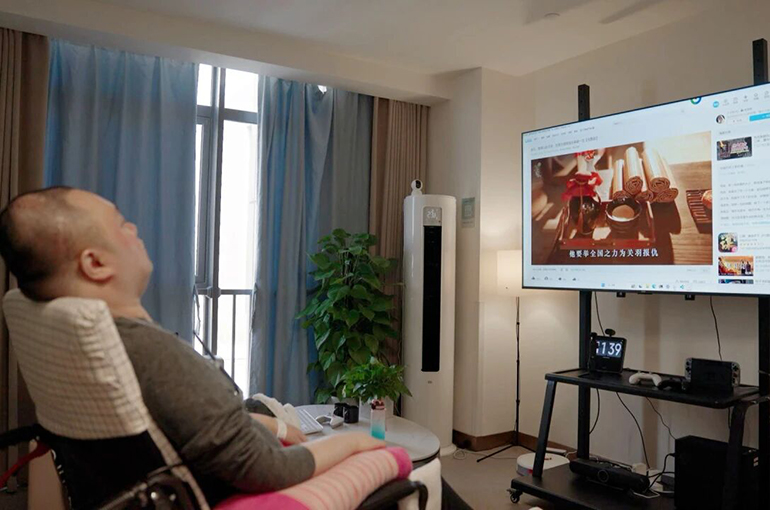
Local life-science company NeuroXess has completed China’s first human implantation of a fully implanted brain-computer interface product with an integrated battery, marking a key step in the country’s push to move BCI technology from laboratory research into clinical application.
The system was developed by Shanghai-based NeuroXess, with the implantation surgery performed by a medical team from Huashan Hospital affiliated with Fudan University. At present, only a handful of companies worldwide, including Neuralink, founded by Elon Musk, have developed similar fully implanted BCI products.
The patient, a high-level paraplegic unable to move below the shoulders, achieved mind control just five days after surgery, Yicai learned at the annual conference of the Brain-Computer Interface and Interaction Branch of the Chinese Neuroscience Society held recently. After systematic training, the patient’s brain-control decoding rate reached 5.2 bits per second in standard tests, a level considered among the world’s best, Mao Ying, president of Huashan Hospital, told Yicai.
Earlier generations of BCI products required battery modules to remain outside the skull and relied on external devices for power. NeuroXess’ product fully implants the core module containing the battery inside the body, integrating wireless power supply and wireless data transmission, allowing patients to dispense entirely with external equipment and fundamentally eliminating infection risks at the physical level, said Tao Hu, founder and chief scientist of NeuroXess.
The company has also placed the battery module subcutaneously in the chest and optimized the architecture of deep brain stimulation technology to move heat-generating components away from the brain, further enhancing system safety, Tao added.
Including the latest procedure, NeuroXess has completed 54 human BCI implantations since its establishment four years ago. The company plans to complete the registration of clinical trials next year, accelerating the commercialization of its products, Tao said.
BCI technology is transitioning from the laboratory to clinical practice, delivering tangible results in helping patients with motor function disorders regain abilities, and in decoding language signals, Mao said at the conference. During this process, the accelerating integration of artificial intelligence and BCIs is expected to reshape the future of humanity.
Promoting deeper collaboration between engineering teams and rehabilitation specialists, and optimizing technology based on real-world clinical needs to achieve personalized adaptation of BCIs for different conditions and scenarios, remains an important direction for further exploration, said Shan Chunlei, director of the Institute of Rehabilitation at Shanghai Jiao Tong University School of Medicine.
Source: Yicai Global
