



政府新闻
中国宣布在智能轮椅、机器狗的意念控制技术上取得突破 2025-12-18
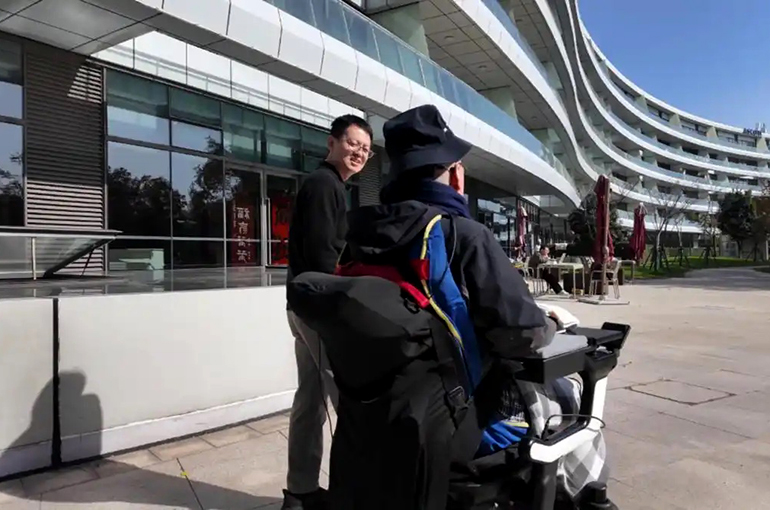 The Center for Excellence in Brain Science and Intelligence Technology under the Chinese Academy of Sciences and partners has enabled a patient implanted with an invasive brain-computer interface to control an electric wheelchair and a robot dog using his mind.
A middle-aged person with high-level paraplegia used his mind to move his wheelchair after getting the invasive BCI co-developed by the center, according to a video highlighting the achievements of a clinical trial shared with Yicai on Wednesday. He was also able to direct a robot dog to pick up takeout deliveries at his doorstep and do simple housework.
The latest is the second invasive BCI clinical trial done by a team led by Zhao Zhengtuo and Li Xue from the center in collaboration with Huashan Hospital in Shanghai and corporate partners. Patients in the first trial were only able to control a cursor on a screen with their minds.
After two to three weeks of training post-surgery in June, the latest patient was also only able to control electronic devices, including cursors and tablets. However, thanks to a series of technological breakthroughs, the development team expanded his mind control from two-dimensional electronic screens to three-dimensional physical peripherals.
The mind control is very successful, with devices moving in the direction you want them to go, the patient said, noting that the signal transmission is relatively stable with minor delay.
The patient suffered a spinal cord injury, allowing him to move only his head and neck. He was implanted with the BCI after more than a year of rehabilitation that failed to improve his mobility.
"We hope to build a universal interface to convert all brain control instructions into universal control instructions and achieve connection with all smart devices," Zhao said in an interview with Yicai.
However, reaching the full potential of BCI cannot be achieved without the progress of external smart devices, Zhao noted. It is the maturity and popularization of intelligent peripherals, including electric wheelchairs, robot dogs, and humanoid robots, that have given mind control room to play and improve patients' quality of life, Zhao said.
The research team has taken the initiative to collaborate with smart device manufacturers to co-define control protocols and application scenarios, thus forming a win-win model of "a BCI bridge empowered by intelligent peripherals", Zhao pointed out.
BCI can be applied on a large scale in human motor and language function reconstruction within the next three years and will have the ability to restore visual, auditory, and other perception abilities artificially, Zhao said, adding that they can also make breakthroughs in the precise regulation of neuropsychiatric diseases, including Parkinson's disease and depression, within five years.
Over the next decade, BCI surgeries will likely be minimally invasive, with the technology's application scenarios no longer limited to medical care, and also benefiting the general population, according to Zhao. This will give rise to ordinary consumption scenarios beyond medical care, helping people expand their body functions, Zhao noted.
Source: Yicai Global
