



政府新闻
第十届华人数学家国际大会在上海开幕,聚焦数学在创新中的作用 2026-01-04
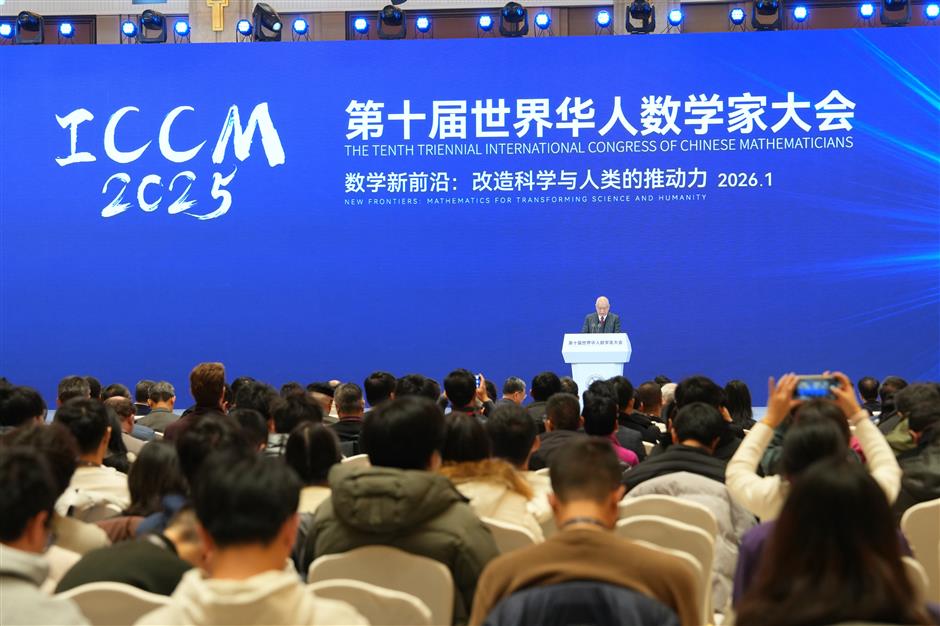
The 10th International Congress of Chinese Mathematicians opened in Shanghai last Saturday.
The 10th International Congress of Chinese Mathematicians opened in Shanghai last Saturday, centered on the theme "New Frontiers: Mathematics for Transforming Science and Humanity" and highlighting the discipline's pivotal role in driving innovation.
Chen Jining, Secretary of the Communist Party of China Shanghai Committee, told the opening ceremony that Shanghai will stay committed to innovation-driven development and boosting the overall efficiency of its innovation system. The city will build an open and inclusive world-class innovation ecosystem, he added, while collaborating with neighboring Jiangsu, Zhejiang and Anhui provinces to accelerate construction of the Shanghai (Yangtze River Delta) International Science and Technology Innovation Hub.
As China enters the 15th Five-Year Plan period, Chen said, Shanghai is striving to fulfill its mission of becoming a global hub for economy, finance, trade, shipping and scientific innovation, as well as a world-influential socialist modern international metropolis.
"Advancing Chinese-style modernization is inseparable from the fundamental and strategic support of education, science and technology, and talents, as well as the empowerment of basic disciplines and fundamental research," he said.
Chen outlined key initiatives for Shanghai, including piloting basic research, advancing high-risk and high-reward fundamental research, and expanding interdisciplinary cooperation to yield more landmark original achievements. He also emphasized plans to fully implement programs for cultivating top students in basic disciplines, innovate math education models, and integrate science and technology education with humanities education. Additionally, he stressed the need to integrate into the global innovation network to promote broader international cooperation in mathematics.
"Chinese mathematicians are active advocates and firm practitioners of an open innovation ecosystem," Chen said. He expressed hope for joint efforts to explore the frontiers of mathematical science, nurture young mathematicians, expand international cooperation, and create an open, fair, impartial and non-discriminatory innovation environment that benefits people worldwide.
Shing-Tung Yau, a Chinese-born mathematician who won the 1982 Fields Medal for his work in differential geometry, founded the International Congress of Chinese Mathematicians 28 years ago. He voiced pride in the achievements of the Chinese mathematical community over that period.
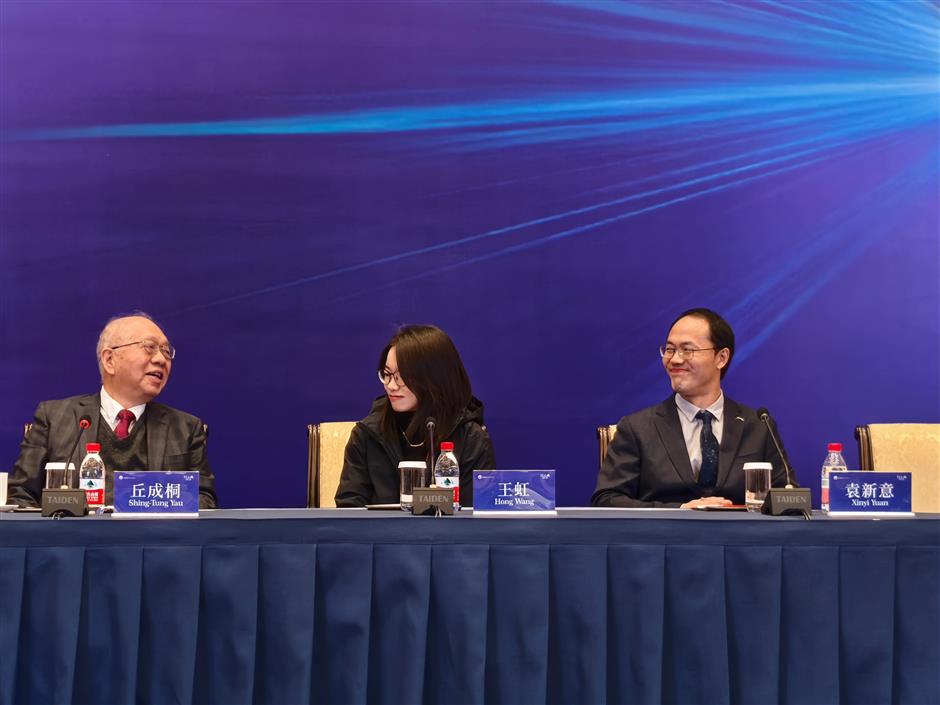
From left to right: Shing-Tung Yau, president of the ICCM; Wang Hong and Yuan Xinyi, two of this year's three ICCM Gold Medal laureates; at a press conference following the opening ceremony of the congress.
"At the first congress in 1998, the ICCM Gold Medal of Mathematics recipients were mostly China's top young students. Back then, we faced many challenges," Yau said. "Today, 28 years later, the caliber of winners across all awards – including Gold and Silver medals – has reached the world's cutting-edge level."
He said that approximately one-third of current awardees are domestic scholars, expressing hope that this proportion will continue to rise, marking a historic shift in China's mathematical talent ecosystem from "relying on external talent input" to "nurturing indigenous talent."
This year's ICCM Gold Medal laureates include 34-year-old Wang Hong, who, alongside her colleague, solved the century-old three-dimensional Kakeya conjecture, establishing herself as a potential contender for the prestigious Fields Medal.
Another two Gold Medal recipients, Deng Yu and Yuan Xinyi, were also honored: Deng for solving the "Special Hilbert's Sixth Problem," a long-standing challenge in the mathematical axiomatization of physics, and Yuan for groundbreaking work in number theory spanning Arakelov geometry, Diophantine equations, automorphic forms, and algebraic dynamics.
Looking ahead, Yau expressed full confidence: "I can say with great certainty and pride that China will transform from a major mathematical power to a leading mathematical power within the next five to ten years."
Yau emphasized that his prediction is not empty encouragement but rooted in profound insights into the overall strength, talent echelon and development momentum of China's mathematical community.
He specifically cited unprecedented national support for basic science as a key driving force.
"Hosting this congress in Shanghai has received tremendous support from the city government. This is the most tangible national support for basic research," he said. Such support, he added, has given the mathematical community "significant confidence" and helped more overseas scholars to see vast development prospects in returning to China.
Source: City News Service
