



政府新闻
韧性与增长并进:上海2025年强劲复苏引领全球指标 2026-01-22
Every number tells a story.
While Shanghai's GDP for 2025, at 5,670,871 million yuan, shows a year-on-year growth of 5.4 percent, outpacing the national average, it means a global standout across multiple metrics: Its port's total trade volume exceeded 11 trillion yuan last year, topping the global city rankings; Shanghai Port's container throughput hit 55.063 million TEUs in the same period, retaining its title as the world's busiest for 16 consecutive years; and air cargo traffic at the city's airports set a new all-time high, reaching 4.538 million tons with a 7.9 percent year-on-year growth, ranking second globally.
Significantly, Shanghai achieved these stellar figures in spite of the volatile external environment and some adverse factors, hinting at the strong drivers for growth within the mega-city.
Resilience on display
Zhang Yina, director of Fudan University's Consumer Market Big Data Laboratory, attributed the city's stunning growth, achieved in spite of the complicated global conditions, to its resilience in mitigating risks, as scientific innovation and industrial upgrade become pivotal drivers.
Plainly visible behind the high growth is also the efficacy of the city's economic restructuring, with palpable effects of forging new quality productive forces, and a thorough-going integration between manufacturing and services, among others, according to Shen Kaiyan, director of the Institute of Economics at the Shanghai Academy of Social Sciences.
"These (developments) could all be calibrated in light of global metrics," said Shen, who believed the glowing figures show the city's growing role in resources allocation, its power to leverage as a trade hub, and the overall outcome of the city's openEvery number tells a story.
While Shanghai's GDP for 2025, at 5,670,871 million yuan, shows a year-on-year growth of 5.4 percent, outpacing the national average, it means a global standout across multiple metrics: Its port's total trade volume exceeded 11 trillion yuan last year, topping the global city rankings; Shanghai Port's container throughput hit 55.063 million TEUs in the same period, retaining its title as the world's busiest for 16 consecutive years; and air cargo traffic at the city's airports set a new all-time high, reaching 4.538 million tons with a 7.9 percent year-on-year growth, ranking second globally.
Significantly, Shanghai achieved these stellar figures in spite of the volatile external environment and some adverse factors, hinting at the strong drivers for growth within the mega-city.
Resilience on display
Zhang Yina, director of Fudan University's Consumer Market Big Data Laboratory, attributed the city's stunning growth, achieved in spite of the complicated global conditions, to its resilience in mitigating risks, as scientific innovation and industrial upgrade become pivotal drivers.
Plainly visible behind the high growth is also the efficacy of the city's economic restructuring, with palpable effects of forging new quality productive forces, and a thorough-going integration between manufacturing and services, among others, according to Shen Kaiyan, director of the Institute of Economics at the Shanghai Academy of Social Sciences.
"These (developments) could all be calibrated in light of global metrics," said Shen, who believed the glowing figures show the city's growing role in resources allocation, its power to leverage as a trade hub, and the overall outcome of the city's opening-up in myriad aspects.
Industries on upgrade
Statistics show that last year the three leading industries, namely artificial intelligence, integrated circuits and biomedicine, registered a growth of 9.6 percent in industrial value.
As Shen explained, these numbers suggest that these three leading industries, which used to be light-weight, have become more consolidated, turning into a key ballast for the city's steadying growth. Credit should also go to the growing new quality productive forces, full-chain innovation, and the effects of cluster innovation.
In integrated circuits, the city boasts the largest number of relevant enterprises listed on STAR Market, over 1,200 entities, with about 40 percent of the talent in the sector nationwide, and about half of all innovation resources.
For 2025, enterprises in the city's science and innovation sector saw robust growth, as evidenced in the record output and market share of AgiBot. In biopharmaceuticals, a total of nine domestically developed Class I innovative drugs and nine Class III innovative medical devices were approved for market launch.
 Shanghai-based AgiBot showcases its robots in CES 2026 in Las Vegas recently.
Shen added that Shanghai is also helping adjust the industrial layout in the Yangtze River Delta region in light of the preconception that the city is the R&D center, while manufacturing would be more scattered across Jiangsu, Zhejiang and Anhui provinces, as part of an effort to reallocate regional resources aimed at boosting the global competitiveness of the delta region as a whole.
As for 2026 and the 15th Five Year (2026-2030) Plan, Shen said the key still lies in building a modern industrial system, with particular attention to the low-altitude economy, commercial aerospace, embodied AI and intelligent terminals.
These developments, however, could be impacted by some external constraints, as well as bottlenecks in core technology and the relatively higher cost factor. Hopefully, more breakthroughs will take place in these areas.
Shen believed that in an increasingly diversified market, innovation and breakthroughs would intensify, thus greater optimization and coordination regarding spatial layout and productive factors would be of critical importance.
Demand on the rise
Seen from the perspective of demand, the robust growth has been bolstered by joint efforts along multiple lines.
From the consumption perspective, last year Shanghai's total annual retail sales of consumer goods rose 4.6 percent, with NEVs (new-energy vehicles), telecom devices and home appliances seeing double-digit growths. In investment, the total fixed asset investment also increased 4.6 percent year on year.
In exports, annual foreign trade exports went up by 10.8 percent, with those to the ASEAN (Association of Southeast Asian Nations) and Belt and Road countries registering growths at 26.5 and 21.9 percent, respectively.
As Fudan University's Zhang observed, the quality development in Shanghai's consumption landscape for 2025 testified to the resilience and vigor of the market. Particularly noteworthy was the added consumption realized by in-bound tourists, whose number last year hit a new record of 9.36 million, up 40 percent compared with the previous year.
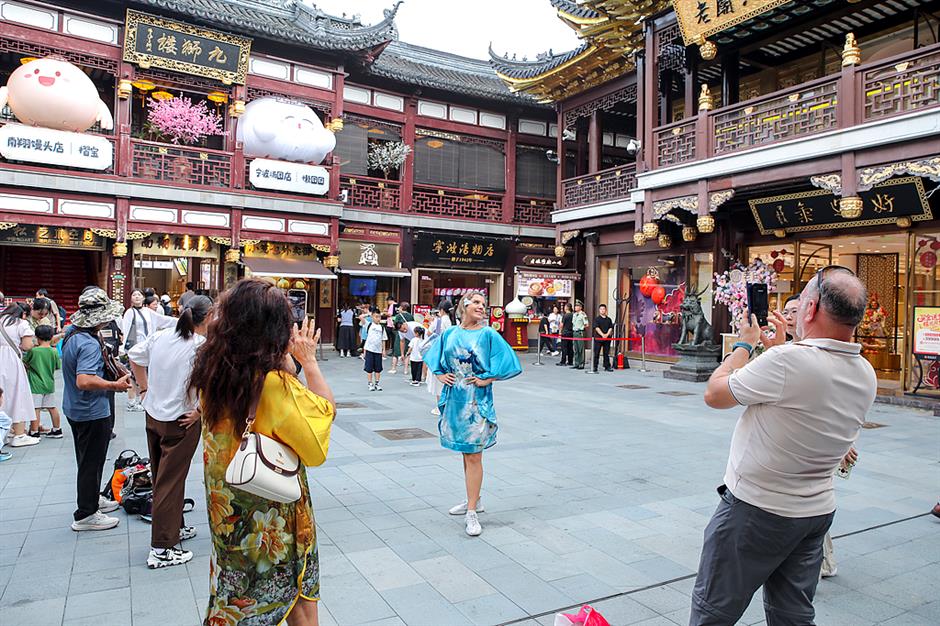 Foreign tourists visit Yuyuan Garden during the National Day and Mid-Autumn Festival holiday in 2025.
According to Zhang, a number of economic indicators are directly linked to the targeted regulatory policies and measures launched in 2025. For instance, the annual sales of trade-in commodities exceeded 120 billion yuan, benefiting over 21.95 million people. These incentives, by consolidating consumption, reflect Shanghai's ingenuity in fueling bulk consumption through specific policy tools.
Predictably, there would be no letup in the city's aspiration for steadily higher growth in the years ahead.
According to Shanghai's newly released "Proposal for the 15th Five-Year Plan," the city will maintain economic growth in a reasonable range, in step with the national economy.
For the next five years, as spelled out in the proposal, Shanghai will build on the current momentum, make all-out efforts in accelerating transformation and upgrading.
Source: City News Serviceing-up in myriad aspects.
Industries on upgrade
Statistics show that last year the three leading industries, namely artificial intelligence, integrated circuits and biomedicine, registered a growth of 9.6 percent in industrial value.
As Shen explained, these numbers suggest that these three leading industries, which used to be light-weight, have become more consolidated, turning into a key ballast for the city's steadying growth. Credit should also go to the growing new quality productive forces, full-chain innovation, and the effects of cluster innovation.
In integrated circuits, the city boasts the largest number of relevant enterprises listed on STAR Market, over 1,200 entities, with about 40 percent of the talent in the sector nationwide, and about half of all innovation resources.
For 2025, enterprises in the city's science and innovation sector saw robust growth, as evidenced in the record output and market share of AgiBot. In biopharmaceuticals, a total of nine domestically developed Class I innovative drugs and nine Class III innovative medical devices were approved for market launch.
Shanghai-based AgiBot showcases its robots in CES 2026 in Las Vegas recently.Shen added that Shanghai is also helping adjust the industrial layout in the Yangtze River Delta region in light of the preconception that the city is the R&D center, while manufacturing would be more scattered across Jiangsu, Zhejiang and Anhui provinces, as part of an effort to reallocate regional resources aimed at boosting the global competitiveness of the delta region as a whole.
As for 2026 and the 15th Five Year (2026-2030) Plan, Shen said the key still lies in building a modern industrial system, with particular attention to the low-altitude economy, commercial aerospace, embodied AI and intelligent terminals.
These developments, however, could be impacted by some external constraints, as well as bottlenecks in core technology and the relatively higher cost factor. Hopefully, more breakthroughs will take place in these areas.
Shen believed that in an increasingly diversified market, innovation and breakthroughs would intensify, thus greater optimization and coordination regarding spatial layout and productive factors would be of critical importance.
Demand on the rise
Seen from the perspective of demand, the robust growth has been bolstered by joint efforts along multiple lines.
From the consumption perspective, last year Shanghai's total annual retail sales of consumer goods rose 4.6 percent, with NEVs (new-energy vehicles), telecom devices and home appliances seeing double-digit growths. In investment, the total fixed asset investment also increased 4.6 percent year on year.
In exports, annual foreign trade exports went up by 10.8 percent, with those to the ASEAN (Association of Southeast Asian Nations) and Belt and Road countries registering growths at 26.5 and 21.9 percent, respectively.
As Fudan University's Zhang observed, the quality development in Shanghai's consumption landscape for 2025 testified to the resilience and vigor of the market. Particularly noteworthy was the added consumption realized by in-bound tourists, whose number last year hit a new record of 9.36 million, up 40 percent compared with the previous year.
Foreign tourists visit Yuyuan Garden during the National Day and Mid-Autumn Festival holiday in 2025.According to Zhang, a number of economic indicators are directly linked to the targeted regulatory policies and measures launched in 2025. For instance, the annual sales of trade-in commodities exceeded 120 billion yuan, benefiting over 21.95 million people. These incentives, by consolidating consumption, reflect Shanghai's ingenuity in fueling bulk consumption through specific policy tools.
Predictably, there would be no letup in the city's aspiration for steadily higher growth in the years ahead.
According to Shanghai's newly released "Proposal for the 15th Five-Year Plan," the city will maintain economic growth in a reasonable range, in step with the national economy.
For the next five years, as spelled out in the proposal, Shanghai will build on the current momentum, make all-out efforts in accelerating transformation and upgrading.
Source: City News Service
