


政府新闻
人工智能培训师认证成为上海顶级证书 2026-01-26
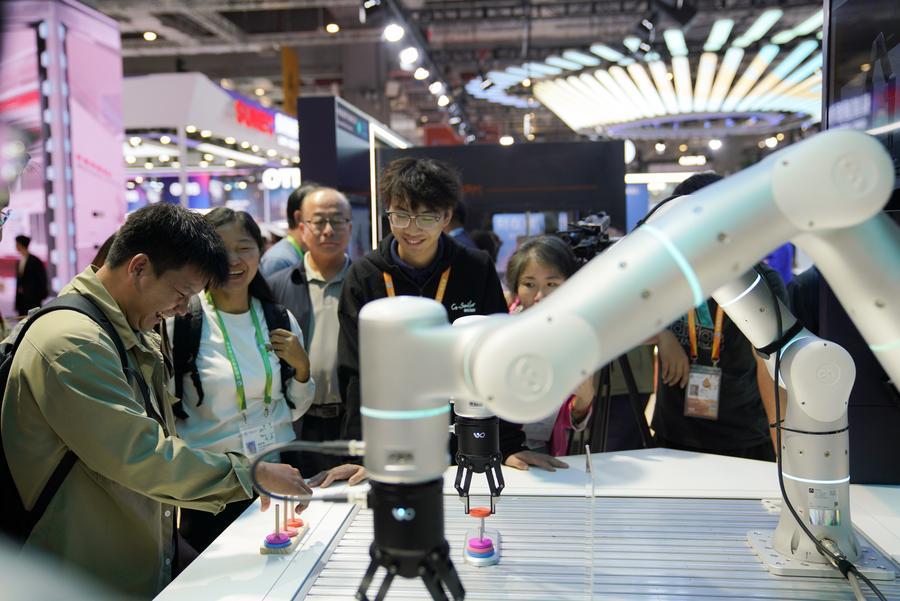
A visitor plays a game with an AI robot arm at the Intelligent Industry and Information Technology exhibition area of the eighth China International Import Expo (CIIE) in east China's Shanghai, Nov. 6, 2025.
In a bustling Shanghai office building last Saturday, dozens of white-collar workers gathered for a hands-on artificial intelligence (AI) training session, reflecting the city's soaring interest in becoming AI trainers.
This emerging profession, officially recognized as "AI trainer" in China's occupational catalog, has been officially listed as "an occupation in short supply" in Shanghai. As AI transforms industries, these trainers act as "translators" between humans and machines, ensuring AI systems understand real-world needs.
"I decided to try the AI trainer course after seeing it on WeChat," said Chen Ke, who has no computer science background. "Through systematic training, instructors break down complex theories and help beginners like me digest knowledge through practical operations. Even novices can ride the wave of AI as a new productive force."
The course, offered by an industry-training integration skills development center supported by the municipal government, blends 30 percent theory with 70 percent hands-on practice and caters largely to working professionals on weekends, according to its general manager, Pan Pan.
Pan emphasized that instructors continuously update curricula with industry insights and real-world scenarios to "support learners from start to finish."
For many, the certification aligns with career shifts. "AI training perfectly matches my professional development and transition needs," noted Yi Zhou, a researcher at a Japanese drug R&D company, who observed the growing trend of AI in biopharma.
"While I previously learned AI online superficially, structured training helps build a solid knowledge base to use models for predicting key indicators in drug R&D, accelerating processes," Yi said.
Enterprises are keen to hire certified AI trainers. At Shanghai Ideal Information Industry (Group) Co., Ltd., trained trainers serve as "guardians of the last mile in AI product deployment," overseeing data annotation, model optimization, and quality control.
"Shanghai's AI trainer job demand has surged over 30 percent, but talents with both technical and industry expertise remain scarce, leading to recruitment challenges," said Li Na, the company's general manager.
She credited local policies for reducing training costs via subsidies and fostering a "market-driven, institution-nurtured, policy-supported" ecosystem.
Shanghai has bolstered training through higher subsidies and rigorous evaluation. AI trainer certification is included in the city's key support catalog, with skill-upgrade subsidies raised by 30 percent to incentivize participation.
"Aligning with Shanghai's goals of scientific innovation and high-end industry leadership, we anchor training to tech and industrial chains, shifting from following trends to shaping the future," said Yang Jiaying, director of the Shanghai Municipal Human Resources and Social Security Bureau.
In 2025, Shanghai recorded 16,300 participants for AI trainers, with 10,900 earning the credential.
Source: Xinhua
